


Page 92 - JSOM Spring 2021
P. 92
approved by the FDA. We selected a pulse rate of 2 to 5 for   was transferred to a local hospital per current medical rules of
          our patients, using lower pulse rates for extremity imaging and   engagement. Because of the radiologic evidence available, we
          higher pulse rates for axial imaging. This provides a radia-  felt comfortable observing the patient without further surgical
          tion dose of 0.052 to 0.18 mSv, which is comparable to previ-  interventions. This allowed us to remain ready for subsequent
          ously reported radiation dosages for standard imaging studies   casualties, preserving operating room time and nursing care.
          (0.001 to 1.2 mSv). 6
                                                             Case No. 2
          All images were reviewed and interpreted by a board- certified   A 24-year-old man presented for evaluation after having an
          emergency medicine physician, board-certified general sur-  up-armored door closed on his right index finger while on a
          geon, or board-certified orthopedic surgeon. Images were pre-  forward-staged mission. The patient is right-hand dominant
          viewed immediately after exposure and, if deemed inadequate,   and a member of a special operations team. Clinical examina-
          were repeated. Given the positioning of our patients, a pro-  tion demonstrated a nail bed injury with a partially avulsed
          vider often had to hold the generator to provide an adequate   nail plate. He was holding his finger in a partially flexed posi-
          image and therefore was not the recommended 10 feet away   tion at the distal interphalangeal joint. The finger was tempo-
          during operations.                                 rarily splinted by the co-located surgical team, and the patient
                                                             returned to his forward operating base for further evaluation
                                                             and consultation with the FRST orthopedic surgeon. By x-ray,
          Clinical Case Scenarios
                                                             the surgeon was able to fully evaluate the comminuted, in-
          Case No. 1                                         tra-articular fracture with 100% displacement and apex dorsal
          A 28-year-old man presented to the FRST with a gunshot   angulation (Figure 3A). After digital block, a closed reduc-
          wound to his left, lateral arm. Trauma assessment revealed   tion was performed, and the patient’s finger was placed in an
          decreased breath sounds to the left chest, and an eFAST (ex-  AlumaFoam splint (Hartmann USA). Confirmation of accept-
          tended focused assessment with sonography for trauma) ex-  able reduction is shown in Figure 3B. At 6 weeks, follow-up
          amination was notable for lack of lung sliding in the left chest.   radiographs showed appropriate healing (Figure 3C). At this
          A 36Fr thoracostomy tube was placed for a suspected hemo-  time, the patient was transitioned from a full-time splint to
          pneumothorax and returned approximately 400mL of blood.   a night-only splint. With field radiographic capabilities, our
          While chest tube output was monitored, a secondary survey   team was able to treat this soldier without the need for evacu-
          demonstrated a suspected proximal humerus fracture. Using   ation to the Role 3. Had this resource not been available, the
          the radiography capabilities of the EOD team, we were able   patient would have required evacuation, adversely affecting
          to identify a retained bullet fragment in the left chest and con-  his team’s mission and operational capabilities.
          firm acceptable placement of the chest tube. We were also able
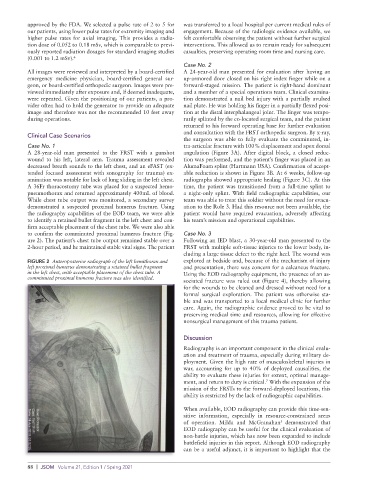
          to confirm the comminuted proximal humerus fracture (Fig-  Case No. 3
          ure 2). The patient’s chest tube output remained stable over a   Following an IED blast, a 30-year-old man presented to the
          2-hour period, and he maintained stable vital signs. The patient   FRST with multiple soft-tissue injuries to the lower body, in-
                                                             cluding a large tissue defect to the right heel. The wound was
          FIGURE 2  Anteroposterior radiograph of the left hemithorax and   explored at bedside and, because of the mechanism of injury
          left proximal humerus demonstrating a retained bullet fragment   and presentation, there was concern for a calcaneus fracture.
          in the left chest, with acceptable placement of the chest tube. A   Using the EOD radiography equipment, the presence of an as-
          comminuted proximal humerus fracture was also identified.
                                                             sociated fracture was ruled out (Figure 4), thereby allowing
                                                             for the wounds to be cleaned and dressed without need for a
                                                             formal surgical exploration. The patient was otherwise sta-
                                                             ble and was transported to a local medical clinic for further
                                                             care. Again, the radiographic evidence proved to be vital to
                                                             preserving medical time and resources, allowing for effective
                                                             nonsurgical management of this trauma patient.

                                                             Discussion
                                                             Radiography is an important component in the clinical evalu-
                                                             ation and treatment of trauma, especially during military de-
                                                             ployment. Given the high rate of musculoskeletal injuries in
                                                             war, accounting for up to 40% of deployed causalities, the
                                                             ability to evaluate these injuries for extent, optimal manage-
                                                             ment, and return to duty is critical.  With the expansion of the
                                                                                        7
                                                             mission of the FRSTs to the forward-deployed locations, this
                                                             ability is restricted by the lack of radiographic capabilities.

                                                             When available, EOD radiography can provide this time-sen-
                                                             sitive information,  especially  in resource-constrained  areas
                                                             of operation. Milda and McGranahan  demonstrated that
                                                                                             5
                                                             EOD radiography can be useful for the clinical evaluation of
                                                             non-battle injuries, which has now been expanded to include
                                                             battlefield injuries in this report. Although EOD radiography
                                                             can be a useful adjunct, it is important to highlight that the


          88  |  JSOM   Volume 21, Edition 1 / Spring 2021

