


Page 96 - JSOM Spring 2021
P. 96
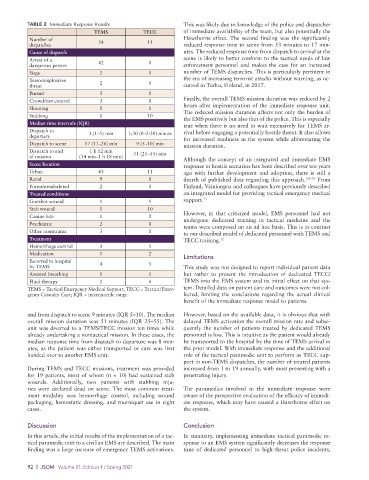
TABLE 2  Immediate Response Results                This was likely due to knowledge of the police and dispatcher
                                TEMS            TECC         of immediate availability of the team, but also potentially the
           Number of                                         Hawthorne effect. The second finding was the significantly
           dispatches            54              11          reduced response time to scene from 53 minutes to 17 min-
           Cause of dispatch                                 utes. The reduced response time from dispatch to arrival at the
           Arrest of a           42               0          scene is likely to better conform to the tactical needs of law
           dangerous person                                  enforcement personnel and makes the case for an increased
           Siege                  2               0          number of TEMS dispatches. This is particularly pertinent in
           Terror/explosives                                 the era of increasing terrorist attacks without warning, as oc-
           threat                 2               0          curred in Turku, Finland, in 2017.
           Pursuit                5               0
           Crowd/riot control     3               0          Finally, the overall TEMS mission duration was reduced by 2
                                                             hours after implementation of the immediate response unit.
           Shooting               0               1          The reduced mission duration affects not only the burden of
           Stabbing               0              10          the EMS positively but also that of the police. This is especially
           Median time intervals (IQR)                       true when there is no need to wait extensively for TEMS ar-
           Dispatch to                                       rival before engaging a potentially hostile threat. It also allows
           departure          3 (1–5) min  1:30 (0–2:30) min:ss  for increased readiness in the system while abbreviating the
           Dispatch to scene  17 (11–26) min  9 (5–10) min   mission duration.
           Dispatch to end    1 h 12 min     51 (25–55) min
           of mission      (34 min–1 h 18 min)               Although the concept of an integrated and immediate EMS
           Scene location                                    response to hostile scenarios has been described over ten years
           Urban                 43              11          ago with further development and adoption, there is still a
           Rural                  9               0          dearth of published data regarding this approach. 7,8–10  From
           Forest/uninhabited     2               0          Finland, Vainionpaa and colleagues have previously described
           Treated conditions                                an integrated model for providing tactical emergency medical
           Gunshot wound          1               1          support. 11
           Stab wound             1              10          However, in that criticized model, EMS personnel had not
           Canine bite            1               0          undergone dedicated training in tactical medicine and the
           Psychiatric            2               0          teams were composed on an ad hoc basis. This is in contrast
           Other nontrauma        3               0          to our described model of dedicated personnel with TEMS and
           Treatment                                         TECC training. 12
           Hemorrhage control     3               5
           Medication             1               2          Limitations
           Escorted to hospital
           by TEMS                4               5          This study was not designed to report individual patient data
           Assisted breathing     1               1          but rather to present the introduction of dedicated TECC/
           Fluid therapy          1               4          TEMS into the EMS system and its initial effect on that sys-
          TEMS = Tactical Emergency Medical Support; TECC = Tactical Emer-  tem. Detailed data on patient care and outcomes were not col-
          gency Casualty Care; IQR = interquartile range.    lected, limiting the conclusions regarding the actual clinical
                                                             benefit of the immediate response model to patients.

          and from dispatch to scene 9 minutes (IQR 5–10). The median   However, based on the available data, it is obvious that with
          overall mission duration was 51 minutes (IQR 25–55). The   delayed TEMS activation the overall mission rate and subse-
          unit was diverted to a TEMS/TECC mission ten times while   quently the number  of patients treated by dedicated  TEMS
          already undertaking a nontactical mission. In these cases, the   personnel is low. This is intuitive as the patient would already
          median response time from dispatch to departure was 8 min-  be transported to the hospital by the time of TEMS arrival in
          utes, as the patient was either transported or care was first   the prior model. With immediate response and the additional
          handed over to another EMS unit.                   role of the tactical paramedic unit to perform as TECC sup-
                                                             port in non-TEMS dispatches, the number of treated patients
          During TEMS and TECC missions, treatment was provided   increased from 1 to 19 annually, with most presenting with a
          for 19 patients, most of whom (n = 10) had sustained stab   penetrating injury.
          wounds. Additionally, two patients with stabbing inju-
          ries were declared dead on scene. The most common treat-  The paramedics involved in the immediate response were
          ment modality was hemorrhage control, including wound   aware of the prospective evaluation of the efficacy of immedi-
          packaging, hemostatic dressing, and tourniquet use in eight     ate response, which may have caused a Hawthorne effect on
          cases.                                             the system.

          Discussion                                         Conclusion
          In this article, the initial results of the implementation of a tac-  In summary, implementing immediate tactical paramedic re-
          tical paramedic unit to a civilian EMS are described. The main   sponse to an EMS system significantly decreases the response
          finding was a large increase of emergency TEMS activations.   time of dedicated personnel to high-threat police incidents,


          92  |  JSOM   Volume 21, Edition 1 / Spring 2021

