


Page 101 - JSOM Spring 2021
P. 101
and packaged, may be inferior if applied under stress during a   not necessarily linked to the use of a chest seal, within their
              combat situation.  All studies reported above are summarized   full guidelines. 32,34,35,40–42
                           16
              in Table 2.
                                                                 Discussion
              Following this author’s search strategy for international
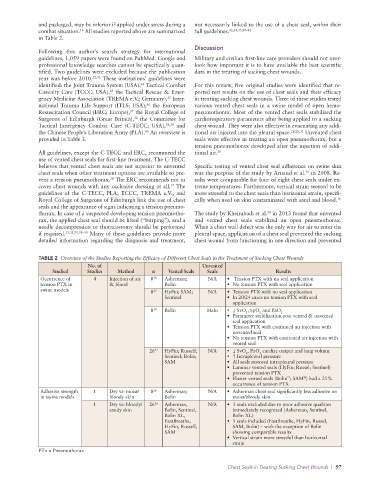
              guidelines, 1,059 papers were found on PubMed. Google and   Military and civilian first-line care providers should not over-
              professional knowledge searches cannot be specifically quan-  look how important it is to have available the best scientific
              tified. Two guidelines were excluded because the publication   data in the treating of sucking chest wounds.
              year was before 2010. 32,33  These institutions’ guidelines were
              identified: the Joint Trauma System (USA),  Tactical Combat   For this review, five original studies were identified that re-
                                               34
              Casualty Care (TCCC; USA),  the Tactical Rescue & Emer-  ported test results on the use of chest seals and their efficacy
                                     25
              gency Medicine Association (TREMA e.V.; Germany),  Inter-  in treating sucking chest wounds. Three of these studies tested
                                                        35
              national Trauma Life Support (ITLS; USA),  the European   various vented chest seals in a swine model of open hemo-
                                                 36
              Resuscitation Council (ERC; Europe),  the Royal College of   pneumothorax. Most of the vented chest seals stabilized the
                                            37
              Surgeons of Edinburgh (Great Britain),  the Committee for   cardiorespiratory parameters after being applied to a sucking
                                             32
              Tactical Emergency Combat Care (C-TECC; USA), 38,39  and   chest wound. They were also effective in evacuating any addi-
              the Chinese People’s Liberation Army (PLA).  An overview is   tional air injected into the pleural space. 28,29,31  Unvented chest
                                                40
              provided in Table 3.                               seals were effective in treating an open pneumothorax, but a
                                                                 tension pneumothorax developed after the injection of addi-
              All guidelines, except the C-TECC and ERC, recommend the   tional air. 30
              use of vented chest seals for first-line treatment. The C-TECC
              believes that vented chest seals are not superior to unvented   Specific testing of vented chest seal adherence on swine skin
              chest seals when other treatment options are available to pre-  was the purpose of the study by Arnaud et al.  in 2008. Re-
                                                                                                     16
              vent a tension pneumothorax.  The ERC recommends not to   sults were comparable for four of eight chest seals under ex-
                                     38
              cover chest wounds with any occlusive dressing at all.  The   treme temperatures. Furthermore, vertical strain seemed to be
                                                         37
              guidelines of the C-TECC, PLA, TCCC, TREMA e.V., and   more stressful to the chest seals than horizontal strain, specifi-
              Royal College of Surgeons of Edinburgh link the use of chest   cally when used on skin contaminated with sand and blood. 16
              seals and the appearance of signs indicating a tension pneumo-
              thorax. In case of a suspected developing tension pneumotho-  The study by Kheirabadi et al.  in 2013 found that unvented
                                                                                        30
              rax, the applied chest seal should be lifted (“burping”), and a   and vented chest seals stabilized an open pneumothorax.
              needle decompression or thoracostomy should be performed   When a chest wall defect was the only way for air to enter the
              if required. 25,32,35,38–40  Many of these guidelines provide more   pleural space, application of a chest seal prevented the sucking
              detailed information regarding the diagnosis and treatment,   chest wound from functioning in one direction and prevented
              TABLE 2  Overview of the Studies Reporting the Efficacy of Different Chest Seals in the Treatment of Sucking Chest Wounds
                              No. of                               Unvented
                  Studied     Studies  Method      n    Vented Seals  Seals                Results
              Occurrence of     4    Injection of air   8 28  Asherman;   N/A  •   Tension PTX with no seal application
              tension PTX in         & blood           Bolin               •  No tension PTX with seal application
              swine models                        8 29  HyFin; SAM;   N/A  •  Tension PTX with no seal application
                                                       Sentinel            •  In 20/24 cases no tension PTX with seal
                                                                             application
                                                  8 30  Bolin        Halo  •  ↓ SvO , SpO  and PaO 2
                                                                                      2
                                                                                 2
                                                                           •  Parameter stabilization post vented & unvented
                                                                             seal application
                                                                           •  Tension PTX with continued air injection with
                                                                             unvented seal
                                                                           •  No tension PTX with continued air injection with
                                                                             vented seal
                                                  26 31  HyFin; Russell;   N/A  •  ↓ SvO , PaO cardiac output and lung volume
                                                                                 2
                                                                                      2,
                                                       Sentinel; Bolin;    •  ↑ Intrapleural pressure
                                                       SAM                 •  All seals restored intrapleural pressure
                                                                           •  Laminar vented seals (HyFin; Russel; Sentinel)
                                                                             prevented tension PTX
                                                                           •  Flutter vented seals (Bolin ; SAM ) had a 25%
                                                                                               ™
                                                                                                    ®
                                                                             occurrence of tension PTX
              Adhesive strength   1  Dry vs: moist/  8 28  Asherman;   N/A  •  Asherman chest seal significantly less adhesive on
              in swine models        bloody skin       Bolin                 moist/bloody skin
                                1    Dry vs: bloody/  26 16  Asherman,   N/A  •  3 seals excluded due to poor adhesive qualities
                                     sandy skin        Bolin, Sentinel,      immediately recognized (Asherman, Sentinel,
                                                       Bolin XL,             Bolin XL)
                                                       FastBreathe,        •  5 seals included (FastBreathe, HyFin, Russel,
                                                       HyFin, Russell,       SAM, Bolin) – with the exception of Bolin
                                                       SAM                   showing comparable results
                                                                           •  Vertical strain more stressful than horizontal
                                                                             strain
              PTx = Pneumothorax
                                                                           Chest Seals in Treating Sucking Chest Wounds  |  97

