


Page 102 - JSOM Spring 2021
P. 102
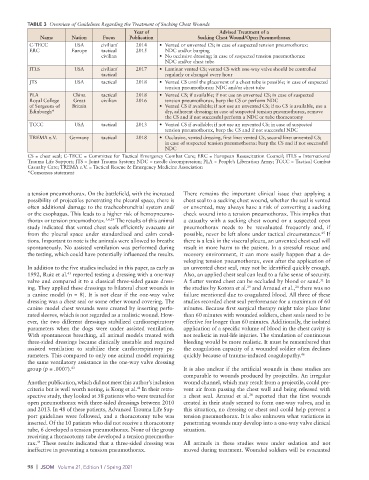
TABLE 3  Overview of Guidelines Regarding the Treatment of Sucking Chest Wounds
                                             Year of                     Advised Treatment of a
              Name      Nation     Focus   Publication            Sucking Chest Wound/Open Pneumothorax
           C-TECC        USA      civilian/  2014    •  Vented or unvented CS; in case of suspected tension pneumothorax:
           ERC          Europe    tactical   2015      NDC and/or burping
                                  civilian           •  No occlusive dressing; in case of suspected tension pneumothorax:
                                                       NDC and/or chest tube
           ITLS          USA      civilian/  2017    •  Laminar vented CS; vented CS with one-way valve should be controlled
                                  tactical             regularly or changed every hour
           JTS           USA      tactical   2018    •  Vented CS until the placement of a chest tube is possible; in case of suspected
                                                       tension pneumothorax: NDC and/or chest tube
           PLA           China    tactical   2018    •  Vented CS; if available; if not use an unvented CS; in case of suspected
           Royal College   Great   civilian  2016      tension pneumothorax, burp the CS or perform NDC
           of Surgeons of   Britain                  •  Vented CS if available; if not use an unvented CS; if no CS is available, use a
           Edinburgh*                                  dry, adherent dressing; in case of suspected tension pneumothorax, remove
                                                       the CS and if not successful perform a NDC or tube thoracotomy
           TCCC          USA      tactical   2013    •  Vented CS if available; if not use an unvented CS; in case of suspected
                                                       tension pneumothorax, burp the CS and if not successful NDC
           TREMA e.V.   Germany   tactical   2018    •  Occlusive, vented dressing, first line: vented CS, second line: unvented CS;
                                                       in case of suspected tension pneumothorax: burp the CS and if not successful
                                                       NDC
          CS = chest seal; C-TECC = Committee for Tactical Emergency Combat Care; ERC = European Resuscitation Council; ITLS = International
          Trauma Life Support; JTS = Joint Trauma System; NDC = needle decompression; PLA = People’s Liberation Army; TCCC = Tactical Combat
          Casualty Care; TREMA e.V. = Tactical Rescue & Emergency Medicine Association
          *Consensus statement


          a tension pneumothorax. On the battlefield, with the increased   There remains the important clinical issue that applying a
          possibility of projectiles penetrating the pleural space, there is   chest seal to a sucking chest wound, whether the seal is vented
          often additional damage to the tracheobronchial system and/  or unvented, may always have a risk of converting a sucking
          or the esophagus. This leads to a higher risk of hemopneumo-  check wound into a tension pneumothorax. This implies that
          thorax or tension pneumothorax. 5,6,24  The results of this animal   a casualty with a sucking chest wound or a suspected open
          study indicated that vented chest seals efficiently evacuate air   pneumothorax needs to be reevaluated frequently and, if
          from the pleural space under standardized and calm condi-  possible, never be left alone under tactical circumstances.  If
                                                                                                          45
          tions. Important to note is the animals were allowed to breathe   there is a leak in the visceral pleura, an unvented chest seal will
          spontaneously. No assisted ventilation was performed during   result in more harm to the patient. In a stressful rescue and
          the testing, which could have potentially influenced the results.  recovery environment, it can more easily happen that a de-
                                                             veloping tension pneumothorax, even after the application of
          In addition to the five studies included in this paper, as early as   an unvented chest seal, may not be identified quickly enough.
          1992, Ruiz et al.  reported testing a dressing with a one-way   Also, an applied chest seal can lead to a false sense of security.
                       43
          valve and compared it to a classical three-sided gauze dress-  A flutter vented chest can be occluded by blood or sand.  In
                                                                                                          31
          ing. They applied these dressings to bilateral chest wounds in   the studies by Kotora et al.  and Arnaud et al.,  there was no
                                                                                  29
                                                                                                 28
          a canine model (n = 8). It is not clear if the one-way valve   failure mentioned due to coagulated blood. All three of these
          dressing was a chest seal or some other wound covering. The   studies recorded chest seal performance for a maximum of 60
          canine model chest wounds were created by inserting perfo-  minutes. Because first surgical therapy might take place later
          rated sleeves, which is not regarded as a realistic wound. How-  than 60 minutes with wounded soldiers, chest seals need to be
          ever, the two different dressings stabilized cardiorespiratory   effective for longer than 60 minutes. Additionally, the isolated
          parameters when the dogs were under assisted ventilation.   application of a specific volume of blood in the chest cavity is
          With spontaneous breathing, all animal models treated with   not realistic in real-life injuries. The simulation of continuous
          three-sided dressings became clinically unstable and required   bleeding would be more realistic. It must be remembered that
          assisted ventilation to stabilize their cardiorespiratory pa-  the coagulation capacity of a wounded soldier often declines
          rameters. This compared to only one animal model requiring   quickly because of trauma-induced coagulopathy. 46
          the same ventilatory assistance in the one-way valve dressing
          group (p = .0007). 43                              It is also unclear if the artificial wounds in these studies are
                                                             comparable to wounds produced by projectiles. An irregular
          Another publication, which did not meet this author’s inclusion   wound channel, which may result from a projectile, could pre-
          criteria but is well worth noting, is Kong et al.  In their retro-  vent air from passing the chest wall and being released with
                                              44
          spective study, they looked at 58 patients who were treated for   a chest seal. Arnaud et al.  reported that the first wounds
                                                                                  28
          open pneumothorax with three-sided dressings between 2010   created in their study seemed to form one-way valves, and in
          and 2013. In 48 of these patients, Advanced Trauma Life Sup-  this situation, no dressing or chest seal could help prevent a
          port guidelines were followed, and a thoracotomy tube was   tension pneumothorax. It is also unknown what variations in
          inserted. Of the 10 patients who did not receive a thoracotomy   penetrating wounds may develop into a one-way valve clinical
          tube, 6 developed a tension pneumothorax. None of the group   situation.
          receiving a thoracotomy tube developed a tension pneumotho-
          rax.  These results indicated that a three-sided dressing was   All animals in these studies were under sedation and not
             44
          ineffective in preventing a tension pneumothorax.  moved during treatment. Wounded soldiers will be evacuated

          98  |  JSOM   Volume 21, Edition 1 / Spring 2021

