


Page 95 - JSOM Spring 2021
P. 95
aspects on police tactics in different scenarios, and general   occurred in cases of shooting and stabbing even when the dis-
              principles of patient care in these settings. Each county has   patch or situation itself did not require activation in the TEMS
              their own individual TEMS group that trains and operates to-  role. These primary missions that were not dispatched by the
              gether with local police on a variable basis.      police were categorized to be of TECC support type in nature
                                                                 as the role differed from that of TEMS. The purpose was to
              Nationally, the procedure of TEMS activation following dis-  benefit from the additional expertise of the tactical paramedics
              patch by police has been based on a volunteer model and no for-  in terms of patient care, but also to provide on-site real-time
              mal roster of availability—personnel respond from their other   direction and training to other paramedics.
              duties or from home. In the Pirkanmaa area, it was observed
              that this model results in prolonged response times and subop-  For the current study, the tactical EMS mission reports from 1
              timal performance in terms of the tactical needs of the police.  January 2014 to 13 April 2017 were retrospectively analyzed.
                                                                 Data were extracted to calculate mission rates, dispatch tim-
              To counteract these shortcomings, selected additional para-  ings, scene time, and treatment provided. The first year (14
              medic personnel were trained according to the national TEMS   April 2017 to 14 April 2018) of immediate tactical paramedic
              standard. The aim was to implement teams of two paramedics   response was also analyzed. This relied on prospective data
              with TEMS training in one of the ALS units operating in the   collection using a dedicated form to record the same vari-
              county on a 24/7 immediate response basis. This basic training   ables as above. Data were not collected on an individual pa-
              was complemented with a distinct TECC course. Ongoing tac-  tient level, but rather on the system and procedures. Because
              tical training was commenced, including operating in, for ex-  detailed patient data were not collected, the need for ethical
              ample, active shooter, armed siege, and other hostile scenarios.  board review was waived and the study was approved by the
                                                                 Research Approval Committee of the City of Tampere.
              Alongside additional training of specific personnel, one am-
              bulance was modified to have the capacity to carry tactical   Data are presented as rates, medians, and IQRs unless other-
              equipment (e.g., ballistic vests and helmets, lightweight treat-  wise indicated. The Kruskal-Wallis test was used to compare
              ment packs) in addition to regular EMS equipment.  dispatch delays between groups. Statistical significance was
                                                                 set at  p < .05. IBM SPSS version 20 for Windows (SPSS ,
                                                                                     ®
                                                                                                               ®
              The decision to dispatch the tactical EMS team was made by   https://www.ibm.com/products/spss-statistics)  was used for
              the police coordinating the operation in cooperation with the   data analysis.
              EMS field commander. Standard EMS dispatches were cate-
              gorized into four categories from A to D, with A- and B-level   Results
              dispatches reflecting potentially life-threatening emergencies,
              and C- and D-level dispatches corresponding to less urgent   Preceding Immediate Response
              situations. As the tactical paramedic unit was not segregated   In  the total  of  17 emergency  TEMS  dispatches,  the  median
              from standard EMS dispatches, a corresponding risk strati-  response time from dispatch to arrival at scene was 54 minutes
              fication tool for tactical missions was drafted to enable pri-  (IQR 39–65). The overall duration of these missions from dis-
              oritization between EMS and tactical dispatches. Nonurgent   patch to departure from scene was 3 h 13 min (IQR 2 h 29 min
              and planned police operations requiring TEMS presence were   to 4 h 40 min). The delays from dispatch to departure were
              managed separately from the immediate response.    not recorded during this period. During the four operations,
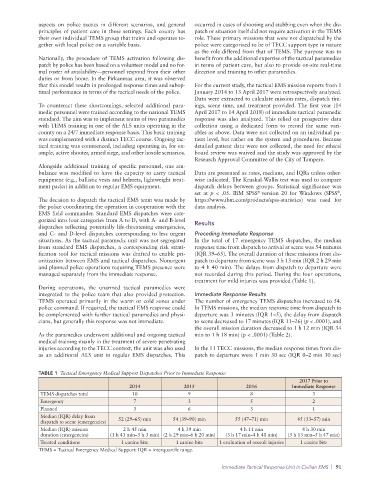
                                                                 treatment for mild injuries was provided (Table 1).
              During operations, the unarmed tactical paramedics were
              integrated  to  the  police  team  that  also  provided  protection.   Immediate Response Results
              TEMS operated primarily in the warm or cold zones under   The number of emergency TEMS dispatches increased to 54.
              police command. If required, the tactical EMS response could   In TEMS missions, the median response time from dispatch to
              be complemented with further tactical paramedics and physi-  departure was 3 minutes (IQR 1–5), the delay from dispatch
              cians, but generally this response was not immediate.  to scene decreased to 17 minutes (IQR 11–26) (p < .0001), and
                                                                 the overall mission duration decreased to 1 h 12 min (IQR 34
              As the paramedics underwent additional and ongoing tactical   min to 1 h 18 min) (p < .0001) (Table 2).
              medical training mainly in the treatment of severe penetrating
              injuries according to the TECC context, the unit was also used   In the 11 TECC missions, the median response times from dis-
              as  an additional  ALS  unit  in regular  EMS  dispatches.  This   patch to departure were 1 min 30 sec (IQR 0–2 min 30 sec)


              TABLE 1  Tactical Emergency Medical Support Dispatches Prior to Immediate Response
                                                                                                   2017 Prior to
                                           2014              2015                2016           Immediate Response
              TEMS dispatches total         10                9                    8                   3
              Emergency                      7                3                    5                   2
              Planned                        3                6                    3                   1
              Median (IQR) delay from
              dispatch to scene (emergencies)  52 (29–65) min  54 (39–90) min  55 (47–71) min     45 (33–57) min
              Median (IQR) mission       2 h 45 min        4 h 39 min          4 h 11 min           4 h 30 min
              duration (emergencies)  (1 h 43 min–3 h 3 min) (2 h 29 min–6 h 20 min)  (3 h 17 min–4 h 40 min)   (3 h 13 min–5 h 47 min)
              Treated conditions         1 canine bite    1 canine bite  1 evaluation of assault injuries  1 canine bite
              TEMS = Tactical Emergency Medical Support: IQR = interquartile range.

                                                                         Immediate Tactical Response Unit in Civilian EMS  |  91

