


Page 51 - JSOM Winter 2019
P. 51
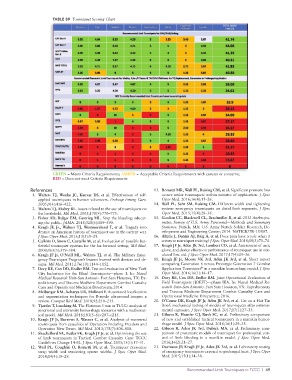
TABLE 89  Tourniquet Scoring Chart


                       GREEN = Meets Criteria Requirements; AMBER = Acceptable Criteria Requirements with caveats or concerns;
                       RED = Does not meet Criteria Requirements

              References                                         13.  Rometti MR, Wall PL, Buising CM, et al. Significant pressure loss
              1.  Walters  TJ,  Wenke  JC,  Kauvar  DS,  et  al.  Effectiveness  of  self-   occurs under tourniquets within minutes of application. J Spec
                 applied tourniquets in human volunteers. Prehosp Emerg Care.   Oper Med. 2016;16(4):15–26.
                 2005;9(4):416–422.                              14.  Wall PL, Sahr SM, Buising CM. Different width and tightening
              2.  Walters TJ, Mabry RL. Issues related to the use of tourniquets on   system: emergency tourniquets on distal limb segments.  J Spec
                 the battlefield. Mil Med. 2005;170(9):770–775.     Oper Med. 2015;15(4):28–38.
              3.  Fisher AD, Bulger EM, Gestring ML. Stop the bleeding: educat-  15.  Gordon CC, Blackwell CL, Bradtmiller B, et al. 2012 Anthropo-
                 ing the public. JAMA. 2018;320(6):589–590.         metric Survey of U.S. Army Personnel—Methods and Summary
              4.  Kragh JF, Jr., Walters TJ, Westmoreland T, et al. Tragedy into   Statistics. Natick, MA: U.S. Army Natick Soldier Research, De-
                 drama: an American history of tourniquet use in the current war.   velopment and Engineering Center; 2014. NATICK/TR-15/007.
                 J Spec Oper Med. 2013;13(3):5–25.               16.  Alterie J, Dennis AJ, Baig A, et al. Does pain have a role when it
              5.  Calkins D, Snow C, Costello M, et al. Evaluation of possible bat-  comes to tourniquet training? J Spec Oper Med. 2018;18(3):71–74.
                 tlefield tourniquet systems for the far-forward setting. Mil Med.   17.  Kragh JF Jr, Aden JK 3rd, Lambert CD, et al. Assessment of user,
                 2000;165(5):379–384.                               glove, and device effects on performance of tourniquet use in sim-
              6.  Kragh JF Jr, O’Neill ML, Walters TJ, et al. The Military Emer-  ulated first aid. J Spec Oper Med. 2017;17(4):29–36.
                 gency Tourniquet Program’s lessons learned with devices and de-  18.  Kragh JF Jr, Moore VK 3rd, Aden JK 3rd, et al. Short report
                 signs. Mil Med. 2011;176(10):1144–1152.            comparing Generation 6 versus Prototype Generation 7 Combat
                                                                                    ®
              7.  Dory RE, Cox DD, Endler BM. Test and evaluation of New York   Application Tourniquet  in a manikin hemorrhage model. J Spec
                 City Industries for the Blind Tourniquets—phase 1. In:  Naval   Oper Med. 2016;16(1):14–17.
                 Medical Research Unit–San Antonio. Fort Sam Houston, TX: Ex-  19.  Dory RE, Cox DD, Endler BM. Joint Operational Evaluation of
                 peditionary and Trauma Medicine Department Combat Casualty   Field Tourniquets (JOEFT)—phase IIIA. In: Naval Medical Re-
                 Care and Operational Medicine Directorate; 2014.   search Unit–San Antonio. Fort Sam Houston, TX: Expeditionary
              8.  Meiburger KM, Acharya UR, Molinari F. Automated localization   and Trauma Medicine Department Combat Casualty Care and
                 and  segmentation  techniques  for  B-mode  ultrasound  images:  a   Operational Medicine Directorate; 2016.
                 review. Comput Biol Med. 2018;92:210–235.       20.  O’Conor DK, Kragh JF Jr, Aden JK 3rd, et al. Cat on a Hot Tin
              9.  Tjardes T, Luecking M. The Platinum 5 min in TCCC: analysis of   Roof: mechanical testing of models of tourniquets after environ-
                 junctional and extremity hemorrhage scenarios with a mathemat-  mental exposure. J Spec Oper Med. 2017;17(1):27–35.
                 ical model. Mil Med. 2018;183(5–6):e207–e215.   21.  Gibson R, Housler GJ, Rush SC, et al. Preliminary comparison
              10.  Kragh JF Jr, Burrows S, Wasner C, et al. Analysis of recovered   of new and established tactical tourniquets in a manikin hemor-
                 tourniquets from casualties of Operation Enduring Freedom and   rhage model. J Spec Oper Med. 2016;16(1):29–35.
                 Operation New Dawn. Mil Med. 2013;178(7):806–810.  22.  Gibson R, Aden JK 3rd, Dubick MA, et al. Preliminary com-
              11.  Shackelford SA, Butler FK, Kragh JF Jr, et al. Optimizing the use   parison of pneumatic models of tourniquet for prehospital con-
                 of  limb  tourniquets  in  Tactical  Combat  Casualty  Care:  TCCC   trol of limb bleeding in a manikin model.  J Spec Oper Med.
                 Guidelines Change 14-02. J Spec Oper Med. 2015;15(1):17–31.  2016;16(2):21–27.
              12.  Wall PL, Coughlin O, Rometti M, et al.  Tourniquet pressures:   23.  Davinson JP, Kragh JF Jr, Aden JK 3rd, et al. Laboratory testing
                 strap width and tensioning system widths.  J Spec Oper Med.   of emergency tourniquets exposed to prolonged heat. J Spec Oper
                 2014;14(4):19–29.                                  Med. 2015;15(1):34–38.

                                                                              Recommended Limb Tourniquets in TCCC  |  49

