


Page 48 - JSOM Winter 2019
P. 48
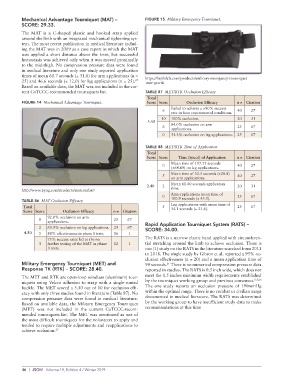
Mechanical Advantage Tourniquet (MAT) –            FIGURE 15  Military Emergency Tourniquet.
          SCORE: 29.33.
          The MAT is a C-shaped plastic and hooked strap applied
          around the limb with an integrated mechanical tightening sys-
          tem. The most recent publication in medical literature includ-
          ing the MAT was in 2009 as a case report in which the MAT
          was applied a short distance above the knee, but successful
          hemostasis was achieved only when it was moved proximally
          to the mid-thigh. No compression pressure data were found
          in medical literature and only one study reported application
          times of mean 60.7 seconds (± 31.0) for arm applications (n =   https://buyh&h.com/products/military-emergency-tourniquet
                                                         67
          25) and 46.6 seconds (± 12.0) for leg applications (n = 25).    -met-gen-iii
          Based on available data, the MAT was not included in the cur-
          rent CoTCCC-recommended tourniquets list.          TABLE 87  MET/RTK Occlusion Efficacy
                                                              Total
          FIGURE 14  Mechanical Advantage Tourniquet.         Score Score     Occlusion Efficacy   n =  Citation
                                                                        Failed to achieve a >80% success
                                                                    6                              40    27
                                                                        rate in four experimental conditions.
                                                                    10  100% occlusion.            20    31
                                                              5.50
                                                                    6   84.0% occlusion on arm     25    67
                                                                        applications.
                                                                    0   33.3% occlusion on leg applications.  25  67

                                                             TABLE 88  MET/RTK Time of Application
                                                              Total
                                                              Score Score  Time (Speed) of Application  n =  Citation
                                                                        Mean time of 117.75 seconds
                                                                    0   (±64.69) on leg applications.  40  27
                                                                        Mean time of 52.5 seconds (±28.8)
                                                                    5                              40    27
                                                                        on arm applications.
                                                                        Mean 61.40 seconds application
                                                              2.40  2                              20    31
          http://www.pyng.com/products/matcombat/                       time.
                                                                        Arm applications mean time of
                                                                    0   100.9 seconds (± 43.5).    25    67
          TABLE 86  MAT Occlusion Efficacy
           Total                                                    5   Leg applications with mean time of   25  67
                                                                        54.1 seconds (± 23.8).
           Score Score     Occlusion Efficacy   n =  Citation
                     92.0% occlusion on arm
                 8                              25    67
                     applications.                           Rapid Application Tourniquet System (RATS) –
                 2   69.5% occlusion on leg applications.  25  67  SCORE: 34.00.
           4.50  5   88% effectiveness in phase I tests.  16  1
                     75% success rates led to the no         The RATS is a narrow elastic band applied with circumferen-
                 3   further testing of the MAT in phase   12  1  tial stretching around the limb to achieve occlusion. There is
                     II tests.                               one (1) study on the RATS in the literature searched from 2011
                                                             to 2018. The single study by Gibson et al. reported a 95% oc-
                                                             clusion effectiveness (n = 20) and a mean application time of
          Military Emergency Tourniquet (MET) and            99 seconds.  There is no numerical compression pressure data
                                                                      21
          Response TK (RTK) – SCORE: 28.40.                  reported in studies. The RATS is 0.5 inch wide, which does not
          The MET and RTK are open-loop windlass (aluminum) tour-  meet the 1.5 inches minimum width requirements established
          niquets using Velcro adhesion to strap with a single-routed   by the tourniquet working group and previous consensus. 6,7,66
          buckle. The MET scored a 5.50 out of 10 for occlusion effi-  The one study reports an occlusion pressure of 190mmHg
          cacy with only three studies found in literature (Table 87). No   within the optimal range. There is no combat or civilian usage
          compression pressure data were found in medical literature.   documented in medical literature. The RATS was determined
          Based on available data, the Military Emergency Tourniquet   by the working group to have insufficient study data to make
          (MET)  was not  included in  the current  CoTCCC-recom-  recommendations at this time
          mended tourniquets list. The MET was mentioned as one of
          the most difficult tourniquets for the volunteers to apply and
          tended to require multiple adjustments and reapplications to
          achieve occlusion. 27


          46  |  JSOM   Volume 19, Edition 4 / Winter 2019

