


Page 50 - JSOM Winter 2019
P. 50
OMNA Tourniquet                                    Warning on Fake Tourniquets
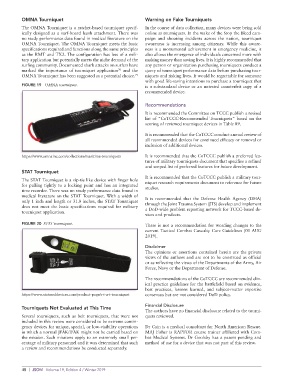
          The OMNA Tourniquet is a ratchet-based tourniquet specif-  In the course of data collection, many devices were being sold
          ically designed as a surf-board leash attachment. There was   online as tourniquets. In the wake of the Stop the Bleed cam-
          no study performance data found in medical literature on the   paign and shooting incidents across the nation, tourniquet
          OMNA Tourniquet. The OMNA Tourniquet meets the basic   awareness is increasing among citizenry. While this aware-
          specifications required and functions along the same principles   ness is a monumental achievement in emergency medicine, it
          as the RMT and TX2. The configuration has less of a mili-  also allows the emergence of individuals concerned more with
          tary application but potentially meets the niche demand of the   making money than saving lives. It is highly recommended that
          surfing community. Documented shark attacks on surfers have   any person or organization purchasing tourniquets conduct a
                                                  70
          marked the importance of tourniquet application  and the   query of tourniquet performance data before purchasing tour-
          OMNA Tourniquet has been suggested as a potential choice. 71  niquets and risking lives. It would be regrettable for someone
                                                             with good life-saving intentions to purchase a tourniquet that
          FIGURE 19   OMNA tourniquet.                       is a substandard device or an untested counterfeit copy of a
                                                             recommended device.

                                                             Recommendations
                                                             It is recommended the Committee on TCCC publish a revised
                                                             list of “CoTCCC-Recommended Tourniquets” based on the
                                                             scoring of reviewed tourniquet devices in Table 89.

                                                             It is recommended that the CoTCCC conduct annual review of
                                                             all recommended devices for continued efficacy or removal or
                                                             inclusion of additional devices.

          https://www.omnainc.com/collections/maritime-tourniquets  It is recommended that the CoTCCC publish a preferred fea-
                                                             tures of military tourniquets document that specifies a refined
                                                             and scoped list of preferred features for future development.
          STAT Tourniquet
                                                             It is recommended that the CoTCCC publish a military tour-
          The STAT Tourniquet is a zip-tie like device with finger hole
          for pulling tightly to a locking point and has an integrated   niquet research requirements document to reference for future
          time recorder. There was no study performance data found in   studies.
          medical literature on the STAT Tourniquet. With a width of
          only 1 inch and length or 31.8 inches, the STAT Tourniquet   It is recommended that the Defense Health Agency (DHA)
          does  not  meet  the  basic  specifications  required  for  military   through the Joint Trauma System (JTS) develop and implement
          tourniquet application.                            a DoD-wide problem reporting network for TCCC-based de-
                                                             vices and products.
          FIGURE 20  STAT tourniquet.                        There is not a recommendation for wording changes to the
                                                             current Tactical Combat Casualty Care Guidelines (01 AUG
                                                             2019).

                                                             Disclaimer
                                                             The opinions or assertions contained herein are the private
                                                             views of the authors and are not to be construed as official
                                                             or as reflecting the views of the Departments of the Army, Air
                                                             Force, Navy or the Department of Defense.

                                                             The recommendations of the CoTCCC are recommended clin-
                                                             ical practice guidelines for the battlefield based on evidence,
                                                             best  practices,  lessons  learned,  and  subject-matter  expertise
          https://www.statmeddevices.com/product-page/s-t-a-t-tourniquet  consensus but are not considered DoD policy.

          Tourniquets Not Evaluated at This Time             Financial Disclosure
                                                             The authors have no financial disclosure related to the tourni-
          Several tourniquets, such as belt tourniquets, that were not   quets reviewed.
          included in this review were considered to be extreme contin-
          gency devices for unique, special, or low-visibility operations   Dr Cain is a medical consultant for North American Rescue.
          in which a normal JFAK/IFAK might not be carried based on   MAJ Fisher is RAPTOR course trainer affiliated with Com-
          the mission. Such missions apply to an extremely small per-  bat Medical Systems. Dr Goolsby has a patent pending and
          centage of military personnel and it was determined that such   method of use for a device that was not part of this review.
          a review and recommendations be conducted separately.


          48  |  JSOM   Volume 19, Edition 4 / Winter 2019

