


Page 56 - JSOM Winter 2019
P. 56
finding changed how we think about interoperability: If a first   He was a lieutenant in World War II as a US Army officer in
          aid provider is among multinational forces that are attempt-  a new unit soon known as Merrill’s Marauders, which trained
          ing to cooperate and coordinate among partner countries and   in India in preparation to fight the enemy in northern Burma.
          someone is injured through an accident, then a situation in   Ogburn notably graduated from Harvard University, worked
          use of a tourniquet model of less familiarity, on average, takes   later at Viking Press then as a writer for the Alfred P. Sloan
          more time, causes more bleeding, and is harder to use. Such   Foundation and as a reviewer at the Book-of-the-Month Club
          outcomes are concrete consequences of low interoperability. It   before he enlisted in the war as a private. He had no expe-
          takes no time, talent, or treasure to suck, but to achieve high   rience operating communications equipment yet was made
          levels of teamwork, it takes all three. If international organi-  leader of the communications platoon (Table 2). He became
          zations like the United Nations, the European Union, or the   disillusioned with reorganizations, but the ensuing combat op-
          African Union are to work together, their interoperability chal-  erations also required reorganizations.  For example, the unit
                                                                                           12
          lenges in first aid may be compounded if partnering groups do   would switch its tasks among patrols, river crossings, attacks,
          not share a common set of standards. The leaders of North At-  hasty defenses, and resupply operations. The unit intermit-
          lantic Treaty Organization (NATO) have pointedly addressed   tently had to replace casualties, reassign roles of individuals,
          standardization in order to use resources efficiently and to en-  and refit teams to resume combat. War severely tested their
          hance the effectiveness of the Alliance’s defense capabilities.   ability to work together coherently and effectively. Trying to
          Standardizing an organization to one tourniquet model among   do so was neither easy nor efficient. After publishing his ar-
          individual members may offer payoffs in the fields of opera-  ticle, he soon expanded it into a book but omitted whether
                                                                                           13
          tional work, procedural skill performance, materiel logistics,   lessons learned from reorganizing on training grounds eased
          and administrative management. However, conceivably asking   any of the later stresses of reorganizing on battlegrounds.
          a person within a team consisting of a Norwegian, a Cana-
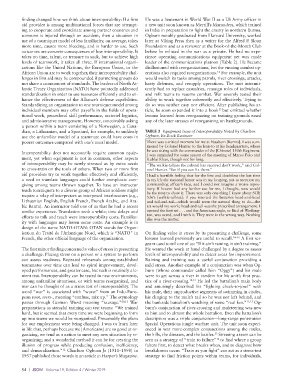
          dian, a Lithuanian, and a Spaniard, for example, to suddenly   TABLE 2  Equipment Issue of Interoperability Noted by Charlton
          use the unfamiliar model of a teammate could have costs in   Ogburn, Ex-Book Reviewer
          poorer outcomes compared with one’s usual model.    There was a critical moment for me at Naubum [Burma]. I was sum-
                                                              moned by Colonel Hunter to the lean-to at his headquarters, where
          Interoperability does not necessarily require common equip-  he was sitting with the commander of the [Chinese] 150th Regiment.
                                                              I was reminded for some reason of the meeting of Marco Polo and
          ment, yet when equipment is not in common, other aspects   Kublai Khan, though not for long.
          of interoperability may be newly stressed as by extra needs   “The walkie-talkies the colonel has received don’t work,” said Col-
          to cross-train on the tools of others. When two or more first   onel Hunter. “See if you can fix them.”
          aid providers try to work together effectively and efficiently,   I had a horrible feeling that for the first and doubtless the last time
          a need to translate languages could further complicate care-  in my life the national honor was in my keeping, not to mention my
          giving among teams thrown together. To have an instructor   commanding officer’s face, and I could not imagine a worse repos-
          teach tourniquets to a diverse group of African soldiers might   itory. If heaven had any further use for me, I thought, now would
          require a relay of interpreters as interposed interlocutors (e.g.,   be the time to show it. There was only one thing I knew about SCR
                                                              536’s [walkie-talkies]: if you inserted the batteries head-and-head
          Lithuanian English, English French, French Arabic, and Ara-  and tail-and-tail—which would seem the natural thing to do—the
          bic Bantu). An instructor told one of us that he had a recent   set would not work; head-and-tail was the prescribed arrangement. I
          similar experience. Translation took a while; time delays and   opened the first set . . . and the American eagle, or Bird of Washing-
          efforts to talk and teach were interoperability costs. Familiar-  ton, was saved, and I with it. They were in the wrong way. Nothing
          ity with languages may lessen some costs. An example is in   else was the matter.
          design of the name NATO-OTAN: OTAN stands for Organ-
          isation du Traité de l’Atlantique Nord, which is “NATO” in   On finding value in stress by its presenting a challenge, some
          French, the other official language of the organization.  lessons learned previously are useful to recall. 14–16  A first ser-
                                                             geant used to tell one of us: “If it ain’t raining, it ain’t training.”
          The first minor finding concerned a value of stress in presenting   He wanted the work at hand challenged by a degree to assess
          a challenge. Placing stress on a person or a system to perform   levels of interoperability and to detect areas for improvement.
          can assess readiness. Repeated rehearsals among established   Raining and training was a useful conjunction providing a
          teammates over time can lead to spiral improvement, devel-  mild stress. Another example of a conjunction was when Og-
          oped performances, and greater ease, but such is routinely a le-  burn  (whose  commander  called  him  “Oggy”)  and  his  mule
          nient test. Interoperability can be tested in new environments,   were to get across a river in tandem for his unit’s first prac-
          among unfamiliar situations, or with teams reorganized, and   tice of a river-crossing. 12,13  He led the battalion’s main body
          war can be thought of as a stress test of interoperability. The   and amusingly described his “fighting cheek-to-jowl” with
          word “war” is associated with “wurst” from an Indo-Euro-  his mule, their unproductive segments of swimming in circles,
          pean root, wers-, meaning “confuse, mix up.” The etymology   his clinging to the mule’s tail so he was not left behind, and
          passes  through  German  Wurst  meaning  “sausage.” 10,11   War   the bankside battalion’s watching of some “real fun.” 12,13  Og-
          preparations as stressful training can test teams: “We trained   burn’s conjunction of river-crossing and muleteering was new
          hard, but it seemed that every time we were beginning to form   to him and to almost the whole battalion. Even the battalion’s
          up into teams we would be reorganized. Presumably the plans   description was a triple conjunction—long-range penetration
          for our employment were being changed. I was to learn later   Special Operations jungle warfare unit. The unit soon experi-
          in life that, perhaps because we [Americans] are so good at or-  enced in war more-complex conjunctions among the mules,
          ganizing, we tend as a nation to meet any new situation by re-  the hills, the diseases, and the battles.  Stressing a team can be
                                                                                          13
          organizing; and a wonderful method it can be for creating the   seen as a strategy of “train to failure”  to find where a group
                                                                                          16
          illusion of progress while producing confusion, inefficiency,   falters first, to detect what breaks when, and to diagnose how
          and demoralization.”  Charlton Ogburn Jr (1911–1998) in   breakdowns occur. “Train as you fight” can act as a stress-test
                           12
          1957 published those words in an article in Harper’s Magazine.   strategy to find friction points within teams, for individuals,
          54  |  JSOM   Volume 19, Edition 4 / Winter 2019

