


Page 61 - JSOM Winter 2019
P. 61
Leveraging Combat Casualty Reporting in the
                          Afghan National Army Special Operations Command for
                      Evidence-Based Changes in the ANASOC School of Excellence


                                          Jonathon Florance *; Matthew Hicks, PA-C  2
                                                            1


              ABSTRACT
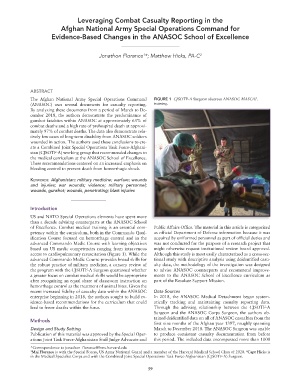
              The Afghan National Army Special Operations Command   FIGURE 1  CJSOTF-A Surgeon observes ANASOC MASCAL
              (ANASOC) uses several documents for casualty reporting.   training.
              By analyzing these documents from a period of March to De-
              cember 2018, the authors demonstrate the predominance of
              gunshot fatalities within ANASOC at approximately 63% of
              combat deaths and a high rate of prehospital death at approxi-
              mately 97% of combat deaths. The data also demonstrate rela-
              tively few cases of long-term disability from ANASOC soldiers
              wounded in action. The authors used these conclusions to cre-
              ate a Combined Joint Special Operations Task Force-Afghani-
              stan (CJSOTF-A) working group that recommended changes to
              the medical curriculum at the ANASOC School of Excellence.
              These recommendations centered on an increased emphasis on
              bleeding control to prevent death from hemorrhagic shock.

              Keywords: Afghanistan; military medicine; warfare; wounds
              and injuries; war wounds; violence; military personnel;
              wounds, gunshot; wounds, penetrating; blast injuries


              Introduction
              US and NATO Special Operations elements have spent more
              than a decade advising counterparts at the ANASOC School
              of Excellence. Combat medical training is an essential com-  Public Affairs Office. The material in this article is categorized
              petency within the curriculum, both in the Commando Qual-  as official Department of Defense information because it was
              ification Course focused on hemorrhage control and in the   acquired by uniformed personnel as part of official duties and
              advanced Commando Medic Course with learning objectives   was not conducted for the purpose of a research project that
              based  on US  medic  competencies  ranging from  intravenous   might otherwise request institutional review board approval.
              access to cardiopulmonary resuscitation (Figure 1). While the   Although this study is most easily characterized as a cross-sec-
              advanced Commando Medic Course provides broad skills for   tional study with descriptive analysis using deidentified casu-
              the robust practice of military medicine, a cursory review of   alty data, the methodology of the investigation was designed
              the program with the CJSOTF-A Surgeon questioned whether   to advise ANASOC counterparts and recommend improve-
              a greater focus on combat medical skills would be appropriate   ments to the ANASOC School of Excellence curriculum as
              after recognizing an equal share of classroom instruction on   part of the Resolute Support Mission.
              hemorrhage control as the treatment of animal bites. Given the
              recent increased fidelity of casualty data within the ANASOC   Data Sources
              enterprise beginning in 2018, the authors sought to build ev-  In 2018, the ANASOC Medical Detachment began system-
              idence-based recommendations for the curriculum that could   atically tracking and maintaining casualty reporting data.
              lead to fewer deaths within the force.             Through the advising relationship between the CJSOTF-A
                                                                 Surgeon and the ANASOC Corps Surgeon, the authors ob-
                                                                 tained deidentified data on all of ANASOC casualties from the
              Methods
                                                                 first nine months of the Afghan year 1397, roughly spanning
              Design and Study Setting                           March to December 2018. The ANASOC Surgeon was unable
              Publication of this material was approved by the Special Oper-  to produce consistent casualty documentation from before
              ations Joint Task Force-Afghanistan Staff Judge Advocate and   this period. The included data encompassed more than 1000
              *Correspondence to jonathon_florance@hms.harvard.edu
                                                                                                       2
              1 Maj Florance is with the Special Forces, US Army National Guard and a member of the Harvard Medical School Class of 2020.  Capt Hicks is
              in the Medical Specialist Corps and with the Combined Joint Special Operations Task Force-Afghanistan (CJSOTF-A) Surgeon.
                                                              59

