


Page 62 - JSOM Winter 2019
P. 62
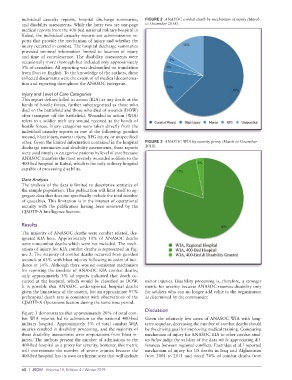
individual casualty  reports, hospital  discharge summaries,   FIGURE 2  ANASOC combat death by mechanism of injury (March
          and disability assessments. While the latter two are one-page   to December 2018).
          medical reports from the 400-bed national military hospital in
          Kabul, the individual casualty reports are administrative re-
          ports that provide the mechanism of injury and whether the
          injury occurred in combat. The hospital discharge summaries
          provided minimal information limited to location of injury
          and time of convalescence. The disability assessments were
          occasionally more thorough but included only approximately
          3% of casualties. All reporting was deidentified on translation
          from Dari to English. To the knowledge of the authors, these
          collected documents were the extent of all medical documenta-
          tion and reporting throughout the ANASOC enterprise.

          Injury and Level of Care Categories
          This report defines killed in action (KIA) as any death at the
          hands of hostile forces, further subcategorized as those who
          died on the battlefield and those who died of wounds (DOW)
          after transport off the battlefield. Wounded in action (WIA)
          refers to a soldier with any wound received at the hands of
          hostile forces. Injury categories were taken directly from the
          individual casualty reports as one of the following: gunshot
          wound, blast injury, mortar injury, RPG injury, or unspecified/
          other. Given the limited information contained in the hospital   FIGURE 3  ANASOC WIA by severity proxy (March to December
          discharge summaries and disability assessments, these reports   2018).
          were used simply to categorize patients by level of care because
          ANASOC transfers the most severely wounded soldiers to the
          400-bed hospital in Kabul, which is the only military hospital
          capable of processing disability.

          Data Analysis
          The analysis of the data is limited to descriptive statistics of
          the sample population. This publication will limit itself to ag-
          gregate data that does not specifically include the total number
          of casualties. This limitation is in the interest of operational
          security with  the publication having been reviewed by the
          CJSOTF-A Intelligence Section.

          Results
          The majority of ANASOC deaths were combat related, des-
          ignated KIA here. Approximately 10% of ANASOC deaths
          were noncombat deaths which were not included. The mech-
          anism of injury for KIA combat deaths is represented in Fig-
          ure 2. The majority of combat deaths occurred from gunshot
          wounds at 63% with blast injuries following in order of inci-
          dence at 14%. Although there was no consistent mechanism
          for reporting the timeline of ANASOC KIA combat deaths,
          only approximately 3% of reports indicated that death oc-
          curred at the hospital, which would be classified as DOW.   minor injuries. Disability processing is, therefore, a stronger
          It is possible that ANASOC underreported hospital deaths   metric for severity because ANASOC reserves disability only
          given the limitations of the system, but an approximate 97%   for soldiers who can no longer add value to the organization
          prehospital death rate is consistent with observations of the   as determined by the commander.
          CJSOTF-A Operations Section during the same time period.
                                                             Discussion
          Figure 3 demonstrates that approximately 20% of total com-
          bat WIA injuries led to admission to the national 400-bed   Given the relatively few cases of ANASOC WIA with long-
          military hospital. Approximately 3% of total combat WIA   term sequelae, decreasing the number of combat deaths should
          injuries resulted in disability processing, and the majority of   be the driving goal for improving medical training. Comparing
          these disability assessments were amputations from blast in-  mechanism of injury for ANASOC KIA to other combat stud-
          juries. The authors present the number of admissions to the   ies helps judge the validity of the data while appreciating dif-
          400-bed hospital as a proxy for severity; however, this metric   ferences between regional conflicts. Eastridge et al.  reported
                                                                                                     1
          will overestimate the number of severe injuries because the   mechanism of injury for US deaths in Iraq and Afghanistan
          400-bed hospital has its own catchment area that will include   from 2001 to 2011 and noted 74% of combat deaths from


          60  |  JSOM   Volume 19, Edition 4 / Winter 2019

