


Page 114 - JSOM Winter 2019
P. 114
Army adopted optional use of the brace for all airborne oper-  airborne students after they completed their fourth of the five
          ations and described the use of the PAB in Army Field Manual   jumps necessary to become airborne qualified. Among stu-
          (FM) 57-220 (Static Line Parachuting Techniques and Train-  dents who wore the PAB, 48% had a favorable opinion, 49%
          ing).  The US Army Airborne School began using the PAB in   had a negative opinion, and 4% were neutral.  Another study
              24
                                                                                                28
          1994. A subsequent study at conducted between November   conducted in 2014 involved 100 soldiers with an average of
          1994 through December 1996 at the 3d Ranger Battalion at Ft   4 years on jump status who were training to be jumpmasters
          Benning, GA, showed that ankle injuries were substantially re-  at the Advanced Airborne School at Ft Bragg, NC. Only 38%
          duced among Rangers wearing the PAB compared with those   of students had heard of the PAB, and among those, 54% had
          not (4.5 vs 1.5 ankle injuries/1000 jumps, RR [braced/not   concerns that would prevent them from using the PAB. Among
          braced] = 0.34, 95% CI = 0.16–0.71). 25            students with a prior ankle sprain, 54% reported being some-
                                                             what or very likely to use some form of ankle bracing. 31
          Despite these positive outcomes, PAB use was discontinued at
          the US Army Airborne School in 2000 because of (1) the cost   In summary, data from six scientific studies involving
          of maintaining the brace, (2) anecdotal reports that the brace   >1,300,000 jumps and two systematic reviews indicated that
          increased injuries in other parts of the lower body, and (3) an-  the PAB reduced ankle injuries and ankle fractures by about
          ecdotal reports that the brace complicated parachute entangle-  half with a return on investment of at least 7:1. These studies
          ments. After the PAB was discontinued at the Airborne School,   were conducted when the Army was using the T-10D para-
          a study was conducted to compare injuries among students   chute; the injury reduction efficacy of the PAB has not been
          while the PAB was in use versus after it was discontinued. It   tested with the newer T-11 parachute or with the newer mili-
          was found that the risk of an ankle injury hospitalization due   tary boots. Although the 2013 edition of FM 3-21.220 (Static
          to parachuting was 1.65 (95% CI = 1.22–2.24) times higher   Line Parachuting Techniques and Training) still listed the PAB
          after the PAB was discontinued. 26                 as an optional item of equipment for parachutists, the latest
                                                             version  does not. DJOrtho no longer manufactures the PAB
                                                                   32
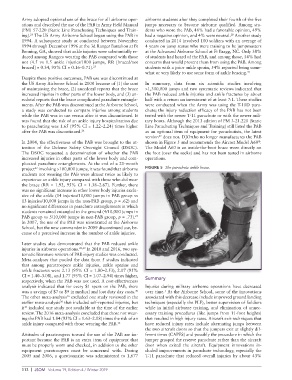
          In 2004, the effectiveness of the PAB was brought to the at-  shown in Figure 5 and recommends the Aircast Model A60 .
                                                                                                            ®
          tention of the Defense Safety Oversight Council (DSOC).   The Model A60 is an inside-the-boot brace worn directly on
          The DSOC requested a determination of whether the PAB   the foot (over the socks) and has not been tested in airborne
          increased injuries in other parts of the lower body and com-  operations.
          plicated parachute entanglements. At the end of a 21-month
          project  involving >100,000 jumps, it was found that airborne   FIGURE 5  The parachute ankle brace.
               27
          students not wearing the PAB were almost twice as likely to
          experience an ankle injury compared with those who did wear
          the brace (RR = 1.92, 95% CI = 1.38–2.67). Further, there
          was no significant increase in other lower body injuries exclu-
          sive of the ankle (14 injuries/10,000 jumps in PAB group vs
          13 injuries/10,000 jumps in the non-PAB group, p = .62) and
          no significant differences in parachute entanglements in which
          students remained entangled to the ground (4/10,000 jumps in
          PAB group vs 5/10,000 jumps in non-PAB group, p = .73).
                                                         27
          In 2007, the use of the PAB was reinstituted at the Airborne
          School, but the new commander in 2009 discontinued use, be-
          cause of a perceived increase in the number of ankle injuries.

          Later  studies  also  demonstrated  that  the  PAB  reduced  ankle
          injuries in airborne operations. 28,29  In 2010 and 2016, two sys-
          tematic literature reviews of PAB injury studies was conducted.
          Meta-analyses that pooled the data from 5 studies indicated
          that among paratroopers ankle injuries, ankle sprains and
            ankle fractures were 2.13 (95% CI = 1.80–2.53), 2.07 (95%
          CI = 1.40–3.08), and 1.77 (95% CI = 1.07–2.94) times higher,   Summary
          respectively, when the PAB was not used. A cost-effectiveness
          analysis indicated that for every $1 spent on the PAB, there   Injuries during military airborne operations have decreased
          was a savings of $7 to $9 in medical and lost duty day costs.    over time.  At the Airborne School, some of the innovations
                                                         30
                                                                     1
          The other meta-analysis  excluded one study reviewed in the   associated with this decrease include improved ground landing
                             16
          earlier meta-analysis  that included self-reported injuries, but   techniques (especially the PLF), better supervision of Soldiers
                          30
          it  included one study not available at the time of the earlier   while in initial airborne training, and elimination of unnec-
           16
          review. The 2016 meta-analysis concluded that those not wear-  essary training procedures (like jumps from 11-foot heights)
          ing the PAB had 1.84 (95% CI = 1.63–2.08) times the risk of an   that resulted in high injury rates. Aircraft exit techniques that
          ankle injury compared with those wearing the PAB. 16  have reduced injury rates include alternating jumps between
                                                             the two aircraft doors so that the jumpers exit at slightly dif-
          Attitudes of paratroopers toward the use of the PAB are im-  ferent times (CAPES) and possibly the procedure in which the
          portant because the PAB is an extra item of equipment that   jumper grasped the reserve parachute rather than the aircraft
          must be properly worn and checked, in addition to the other   door when exited the aircraft. Equipment innovations in-
          equipment paratroopers must be concerned with. During   cluded improvements in parachute technology, especially the
          2005 and 2006, a questionnaire was administered to 1,677   T-11 parachute that reduced overall injuries by about 43%


          112  |  JSOM   Volume 19, Edition 4 / Winter 2019

