


Page 112 - JSOM Winter 2019
P. 112
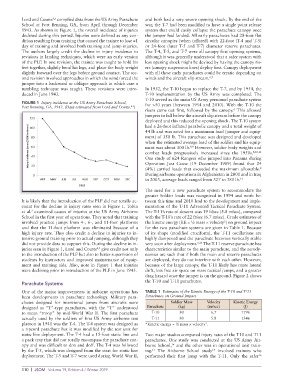
Lord and Coutts  complied data from the US Army Parachute   and both had a very severe opening shock. By the end of the
                       4,5
          School  at  Fort  Benning,  GA,  from  April  through  December   war, the T-7 had been modified to have a single point release
          1943. As shown in Figure 1, the overall incidence of injuries   system that could easily collapse the parachute canopy once
          declined during this period. Injuries were defined as any con-  the jumper had landed. All early parachutes had 28-foot flat
          dition resulting from training that caused the trainee to lose ≥1   circular canopies (when inflated) with 22-foot (T-4 and T-5)
          day of training and involved both training and jump injuries.   or 24-foot (later T-5 and T-7) diameter reserve parachutes.
          The authors largely credit the decline in injury incidence to   The T-4, T-5, and T-7 were all canopy first opening systems,
          revisions in landing techniques, which were an early version   although it was generally understood that a safer system with
          of the PLF. In one revision, the trainee was taught to hold his   less opening shock might be devised by having the canopy ris-
          feet together, slightly bend his legs, and place the body weight   ers (canopy suspension lines) deploy first. Canopy deployment
          slightly forward over the legs before ground contact. The sec-  with all these early parachutes could be erratic depending on
          ond revision involved approaches in which the wind forced the   winds and the aircraft slip stream. 6,7
          jumper into a backward or oblique approach in which case a
          tumbling technique was taught. These revisions were intro-  In 1952, the T-10 began to replace the T-7, and by 1954, the
          duced in June 1943.                                T-10 implementation by the US Army was completed. The
                                                             T-10 served as the main US Army personnel parachute system
          FIGURE 1  Injury incidence at the US Army Parachute School,    for >50 years (between 1954 and 2010). With the T-10 the
                                                       4,5
          Fort Benning, GA, 1943. (Data estimated from Lord and Coutts. )
                                                             risers came out first, followed by the canopy.  This allowed
                                                                                                 6
                                                             jumpers to fall below the aircraft slip stream before the canopy
                                                             deployed and this reduced the opening shock. The T-10 system
                                                             had a 26-foot inflated parabolic canopy and a total weight of
                                                             44 lb and was rated for a maximum load (jumper and equip-
                                                             ment) of 350 lb. This parachute was designed and developed
                                                             when the estimated average load of the soldier and his equip-
                                                             ment was about 300 lb.  However, soldier body weights and
                                                                                8,9
                                                             combat loads progressively increased since the 1950s. 8,10,11
                                                             One study of 624 Rangers who jumped into Panama during
                                                             Operation  Just  Cause  (19  December  1989)  found  that  24
                                                             (4%) carried loads that exceeded the maximum allowable.
                                                                                                            8
                                                             During airborne operations in Afghanistan in 2001 and in Iraq
                                                             in 2003, average loads ranged from 327 to 380 lb. 12
                                                             The need for a new parachute system to accommodate the
                                                             greater Soldier loads was recognized in 1994 and work be-
          It is likely that the introduction of the PLF did not totally ac-  tween this time and 2010 lead to the development and imple-
          count for the decline in injury rates seen in Figure 1. Tobin   mentation of the T-11 Advanced Tactical Parachute System.
          et al.  examined causes of injuries at the US Army Airborne   The T-11’s rate of descent was 19 ft/sec (5.8 m/sec), compared
              2
          School in the first year of operations. They noted that training   with the T-10’s rate of 22 ft/sec (6.7 m/sec). Crude estimates of
          involved practice jumps from 4-, 6-, and 11-foot platforms   the kinetic energy (KE = ½ mass × velocity ) on ground impact
                                                                                              2
          and that the 11-foot platform was eliminated because of a   for the two parachute systems are given in Table 1. Because
          high injury rate. They also credit a decline in injuries to in-  of its shape (modified cruciform), the T-11 oscillations are
          tensive ground training prior to actual jumping, although they   highly dampened and the parachute becomes vertically stable
          did not provide data to support this. During the decline in in-  very soon after deployment. 9,13  The T-11 reserve parachute has
          juries seen in Figure 1, Lord and Coutts  give credit not only   characteristics similar to the main parachute, and the aerody-
                                         4,5
          to the introduction of the PLF but also to better supervision of   namics are such that if both the main and reserve parachutes
          students by instructors and improved maintenance of equip-  are deployed, they do not interfere with each other. However,
          ment and training aids. Also, note in Figure 1 that injuries   because of the large canopy, the T-11 likely has more lateral
          were declining prior to introduction of the PLF in June 1943.  drift, less free air space on mass tactical jumps, and a greater
                                                             drag hazard once the jumper is on the ground. Figure 2 shows
                                                             the T-10 and T-11 parachutes.
          Parachute Systems
          One  of  the  major  improvements  in  airborne  operations  has   TABLE 1  Estimates of the Kinetic Energy of the T-10 and T-11
          been developments in parachute technology. Military para-  Parachutes on Ground Impact
          chutes  designed for  intentional  jumps from  aircrafts  were   Soldier Mass  Velocity  Kinetic Energy
          designed as “T”-type parachutes, with the “T” understood   Parachute   (kg)   (m/sec)       (J)
          to mean “troop” by mid-World War II. The first parachute   T-10   80          6.7          1796
          actually used by the soldiers of first US Army airborne test   T-11   80      5.8          1346
          platoon in 1941 was the T-4. The T-4 system was designed as   *Kinetic energy = ½ mass × velocity .
                                                                                      2
          a ripcord parachute but it was modified by the test unit for
          static line deployment. The T-4 had a 15-foot static line and   Two major studies compared injury rates of the T10 and T11
          a pack tray that did not totally encompass the parachute can-  parachutes.  One  study  was conducted  at  the  US  Army Air-
          opy and was difficult to don and doff. The T-4 was followed   borne School,  and the other was in operational unit train-
                                                                        14
          by the T-5, which was designed from the start for static line   ing.  The Airborne School study  involved trainees who
                                                                                         14
                                                                15
          deployment. The T-5 and T-7 were used during World War II,   performed their first jump with the T-11. Only the safer
                                                                                                            16
          110  |  JSOM   Volume 19, Edition 4 / Winter 2019

