


Page 113 - JSOM Winter 2019
P. 113
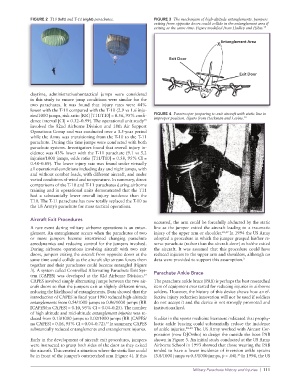
FIGURE 2  T10 (left) and T-11 (right) parachutes.  FIGURE 3  The mechanism of high-altitude entanglements. Jumpers
                                                                 exiting from opposite doors could collide in the entanglement area if
                                                                 exiting at the same time. Figure modified from Hadley and Hibst. 17

                                                                                            Entanglement Area


                                                                       Exit Door


                                                                                                    Exit Door


              daytime,  administrative/nontactical  jumps  were  considered
              in this study to ensure jump conditions were similar for the
              two parachutes. It was found that injury rates were 44%
              lower with the T-11 compared with the T-10 (2.9 vs 1.6 inju-
              ries/1000 jumps, risk ratio [RR] [T11/T10] = 0.56, 95% confi-  FIGURE 4  Paratrooper preparing to exit aircraft with static line in
                                                                                                      18
              dence interval [CI] = 0.32–0.99). The operational unit study    improper position. Figure from Heckman and Levine.
                                                            15
              involved the 82nd Airborne  Division and 18th Air Support
              Operations Group and was conducted over a 3.5-year period
              while the Army was transitioning from the T-10 to the T-11
              parachute. During this time jumps were conducted with both
              parachute systems. Investigators found that overall injury in-
              cidence was 43% lower with the T-11 parachute (9.1 vs 5.2
              injuries/1000 jumps, odds ratio [T11/T10] = 0.58, 95% CI =
              0.48–0.69). The lower injury rate was found under virtually
              all operational conditions including day and night jumps, with
              and without combat loads, with different aircraft, and under
              varied conditions of wind and temperature. In summary, direct
              comparisons of the T-10 and T-11 parachutes during airborne
              training and in operational units demonstrated that the T11
              had  a  substantially  lower  overall  injury  incidence  than  the
              T10. The T-11 parachute has now totally replaced the T-10 as
              the US Army’s parachute for mass tactical operations.


              Aircraft Exit Procedures
                                                                 occurred, the arm could be forcefully abducted by the static
              A rare event during military airborne operations is an entan-  line as the jumper exited the aircraft leading to a traumatic
              glement. An entanglement occurs when the parachutes of two   injury of the upper arm or shoulder. 18,19  In 1994 the US Army
              or more jumpers become intertwined changing parachute   adopted a procedure in which the jumper grasped his/her re-
              aerodynamics and reducing control for the jumpers involved.   serve parachute (rather than the aircraft door) as he/she exited
              During  airborne operations  involving  aircraft  with two exit   the aircraft. It was assumed that this procedure could have
              doors, jumpers exiting the aircraft from opposite doors at the   reduced injuries to the upper arm and shoulders, although no
              same time could collide as the aircraft slip stream forces them   data were provided to support this assumption. 3
              together and their parachutes could become entangled (Figure
              3). A system called Controlled Alternating Parachute Exit Sys-  Parachute Ankle Brace
              tem (CAPES) was developed at the 82d Airborne Division.
                                                            17
              CAPES involved simply alternating jumps between the two air-  The parachute ankle brace (PAB) is perhaps the best researched
              craft doors so that the jumpers exit at slightly different times,   item of equipment ever tested for reducing injuries in airborne
              reducing the likelihood of entanglements. Data showed that the   solders. However, the history of this device shows how an ef-
              introduction of CAPES in fiscal year 1980 reduced high-altitude   fective injury reduction innovation will not be used if soldiers
              entanglements from 0.54/1000 jumps to 0.06/1000 jumps (RR   do not accept it and the device is not strongly promoted and
              [CAPES/no CAPES] = 0.10, 95% CI = 0.04–0.25). The number   institutionalized.
              of high altitude and mid-altitude entanglement injuries was re-
              duced from 0.13/1000 jumps to 0.02/1000 jumps (RR [CAPES/  Studies in the sports medicine literature indicated that prophy-
              no CAPES] = 0.16, 95% CI = 0.04–0.72).  In summary, CAPES   lactic ankle bracing could substantially reduce the incidence
                                             17
              substantially reduced entanglements and entanglement injuries.  of ankle injuries. 20–22  The US Army worked with Aircast Cor-
                                                                 poration (now DJOrtho) to design the outside the boot PAB
              Early in the development of aircraft exit procedures, jumpers   shown in Figure 3. An initial study conducted at the US Army
              were instructed to grasp both sides of the door as they exited   Airborne School in 1993 showed that those wearing the PAB
              the aircraft. This created a situation where the static line could   tended to have a lower incidence of inversion ankle sprains
              be in front of the jumper’s outstretched arm (Figure 4). If this   (3.8/1000 jumps vs 0.5/1000 jumps, p = .04).  In 1994, the US
                                                                                                   23
                                                                                 Military Parachute History and Injuries  |  111

