


Page 110 - JSOM Winter 2019
P. 110
Powassan Virus


                                      Centers for Disease Control and Prevention


            owassan virus is rare but recently was the cause of the death   Treatment
          Pof North Carolina Senator Kay Hagan. The following in-  •  There is no medication to treat Powassan virus infection.
          formation is presented by the US Centers for Disease Control   •  People with severe disease often need to be hospitalized
          and Prevention at https://www.cdc.gov/powassan/index.html.  to receive support for breathing, staying hydrated, or
                                                                  reducing swelling in the brain.
          Powassan virus is spread to people by the bite of an infected   •  If you think you or a family member might have
          tick. Although still rare, the number of reported cases of peo-    Powassan virus disease, see your healthcare provider.
          ple sick from Powassan virus has increased in recent years.
          Most cases in the United States occur in the northeast and   Transmission
          Great Lakes regions from late spring through mid-fall when   Powassan virus is spread to people by the bite of an infected
          ticks are most active. There are no vaccines to prevent or med-  tick. Ticks become infected when they feed on groundhogs,
          icines to treat Powassan virus disease. Reduce your risk of in-  squirrels, mice, or other rodents that have the virus in their
          fection from Powassan virus by avoiding ticks.     blood. Infected ticks can then spread Powassan virus to peo-
                                                             ple and other animals by biting them. People do not develop
                                                             high enough levels of the virus in their blood to infect biting
          Symptoms, Diagnosis, and Treatment
                                                             ticks. As a result, people are considered “dead-end” hosts for
          Symptoms                                           Powassan virus.
            •  Many people infected with Powassan virus do not have
               symptoms.                                     Three types of ticks spread Powassan virus and are primarily
            •  For people with symptoms, the time from tick bite to   found in the eastern half of the United States.
               feeling sick ranges from 1 week to 1 month.
            •  Initial symptoms can include:                   •  Ixodes cookei (groundhog tick)
                  o Fever                                      •  Ixodes marxi (squirrel tick), and
                  o Headache                                   •  Ixodes scapularis (blacklegged or deer tick)
                  o Vomiting
                  o Weakness                                 The groundhog tick and the squirrel tick rarely bite people.
            •  Powassan virus can cause severe disease, including in-  The blacklegged, or deer tick, which feeds mainly on white-
               fection of the brain (encephalitis) or the membranes   footed mice and deer, often bites people. These bites can result
               around the brain and spinal cord (meningitis).  in several types of diseases (e.g., Lyme disease).
            •  Symptoms of severe disease include:
                  o Confusion                                Ticks can attach to any part of the body but are often found in
                  o Loss of coordination                     hard-to-see areas such as the groin, armpits, and scalp.
                  o Difficulty speaking
                  o Seizures                                 Prevent getting sick with Powassan virus by preventing tick
            •  Approximately 1 out of 10 people with severe disease   bites.
               die.
            •  Approximately half of the people who survive severe
               disease have long-term health problems such as:
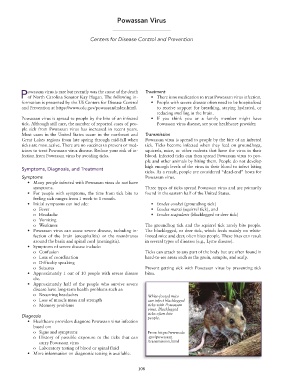
                  o Recurring headaches                       White-footed mice
                  o Loss of muscle mass and strength          can infect blacklegged
                  o Memory problems                           ticks with Powassan
                                                              virus. Blacklegged
                                                              ticks often bite
          Diagnosis                                           people.
            •  Healthcare providers diagnose Powassan virus infection
               based on:
                  o Signs and symptoms                        From https://www.cdc
                  o History of possible exposure to the ticks that can   .gov/powassan
                 carry Powassan virus                         /transmission.html
                  o Laboratory testing of blood or spinal fluid
            •  More information on diagnostic testing is available.


                                                          108

