


Page 108 - JSOM Winter 2019
P. 108
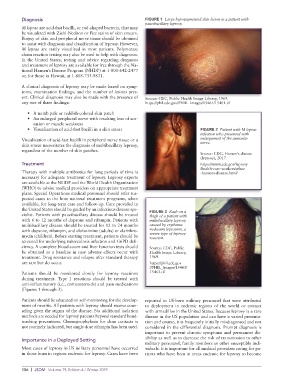
Diagnosis                                          FIGURE 1  Large hypopigmented skin lesion in a patient with
                                                             paucibacillary leprosy.
          M leprae are acid-fast bacilli, or rod-shaped bacteria, that may
          be visualized with Ziehl-Neelson or Fite stains of skin smears.
          Biopsy of skin and peripheral nerve tissue should be obtained
          to assist with diagnosis and classification of leprosy. However,
          M leprae are rarely visualized  in  most patients. Polymerase
          chain reaction testing may also be used to help with diagnosis.
          In the United States, testing and advice regarding diagnosis
          and treatment of leprosy are available for free through the Na-
          tional Hansen’s Disease Program (NHDP) at 1-800-642-2477
          or, for those in Hawaii, at 1-808-733-9831.

          A clinical diagnosis of leprosy may be made based on symp-
          toms, examination findings, and the number of lesions pres-
          ent. Clinical diagnosis may also be made with the presence of   Source: CDC, Public Health Image Library, 1969.
          any one of three findings:                         https://phil.cdc.gov//PHIL_Images/15461/15461.tif
            •  A numb pale or reddish-colored skin patch
            •  An enlarged peripheral nerve with resulting loss of sen-
               sation or muscle weakness
            •  Visualization of acid-fast bacilli in a skin smear                   FIGURE 2  Patient with M leprae
                                                                                    infection who presented with
          Visualization of acid-fast bacilli in peripheral nerve tissue or a        enlargement of the auricular
          skin smear necessitates the diagnosis of multibacillary leprosy,          nerve.
          regardless of the number of skin patches.
                                                                                    Source: CDC, Hansen’s disease
                                                                                    (leprosy), 2017.
          Treatment                                                                 https://www.cdc.gov/leprosy
                                                                                    /health-care-workers/other
          Therapy with multiple antibiotics for long periods of time is             -hansens-disease.html/
          necessary for adequate treatment of leprosy. Leprosy experts
          are available at the NHDP and the World Health Organization
          (WHO) to advise medical providers on appropriate treatment
          plans. Special Operations medical personnel should refer sus-
          pected cases to the host national treatment programs, when
          available, for long-term care and follow-up. Care provided in
          the United States should be guided by an infectious disease spe-  FIGURE 3  Rash on a
          cialist. Patients with paucibacillary disease should be treated   thigh of a patient with
          with 6 to 12 months of dapsone and rifampin. Patients with   multibacillary leprosy
          multibacillary disease should be treated for 12 to 24 months   caused by erythema
          with dapsone, rifampin, and clofazimine (adults) or clarithro-  nodosum leprosum, a
          mycin (children). Before starting treatment, patients should be   severe type of leprosy
                                                               reaction.
          screened for underlying tuberculosis infection and G6PD defi-
          ciency. A complete blood count and liver function tests should   Source: CDC, Public
          be obtained as a baseline in case adverse effects occur with   Health Image Library,
          treatment. Drug resistance and relapse after standard therapy   1969.
          are rare but do occur.                               https://phil.cdc.gov
                                                               //PHIL_Images/15463/
          Patients should be monitored closely for leprosy reactions   15463.tif
          during treatment. Type 1 reactions should be treated with
            anti-inflammatory (i.e., corticosteroids) and pain medications
          (Figures 1 through 3).

          Patients should be educated on self-monitoring for the develop-  reported in US-born military personnel that were attributed
          ment of neuritis. All patients with leprosy should receive coun-  to deployment in endemic regions of the world or contact
          seling given the stigma of the disease. No additional isolation   with armadillos in the United States. Because leprosy is a rare
          methods are needed for leprosy patients beyond standard hand-  disease in the US population and can have a varied presenta-
          washing precautions. Chemoprophylaxis for close contacts is   tion and course, it is frequently initially misdiagnosed and not
          not routinely indicated, but single-dose rifampin has been used.  considered in the differential diagnosis. Prompt diagnosis is
                                                             important to prevent chronic symptoms and permanent dis-
          Importance in a Deployed Setting                   ability as well as to decrease the risk of transmission to other
                                                             military personnel, family members or other susceptible indi-
          Most cases of leprosy in US military personnel have occurred   viduals. It is important for all medical providers caring for pa-
          in those born in regions endemic for leprosy. Cases have been   tients who have been in areas endemic for leprosy to become


          106  |  JSOM   Volume 19, Edition 4 / Winter 2019

