


Page 103 - JSOM Winter 2019
P. 103
by when), the perishable nature of readiness (ready for how   milestones, illnesses, deaths, spouse employment outside the
              long), or the readiness obligations that fall to the individual. 3  home, etc.) will dynamically change what readiness looks like
                                                                 for the family. The ebb and flow of readying families mix with
                 Readiness: The ability of military forces to fight and   the ebb and flow of readying Operators; at times, they col-
                 meet the demands of assigned missions. (See also na-  lide and cause distress and conflict as priorities compete. Each
                 tional military strategy. )                     of the SOF Operators’ and families’ tasks and outcomes are
                                   4
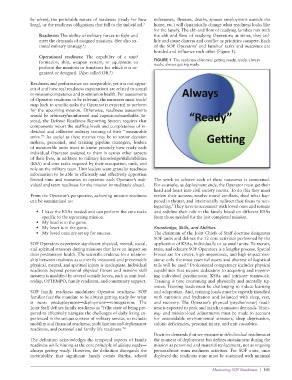
                                                                 braided and influence each other (Figure 1).
                 Operational readiness: The capability of a unit/
                 formation, ship, weapon system, or equipment to   FIGURE 1  The readiness dilemma: getting ready, ready, always
                 perform the missions or functions for which it is or-  ready, always getting ready.
                 ganized or designed. (Also called OR. )
                                              4
              Readiness and performance are inseparable, yet it is not appar-
              ent if and how real readiness expectations are related to actual
              in-mission competence and postmission health. For assessments
              of Operator readiness to be relevant, the measures must track/
              map back to specific tasks the Operator is expected to perform
              for the upcoming mission. Otherwise, readiness assessments
              would be arbitrary/uninformed and capricious/unreliable. In-
              stead, the Defense Readiness Reporting System requires that
              components report the staffing levels and completeness of in-
              dividual and collective military training of their “measurable
              units.”  As useful as these metrics may be to senior decision
                   5
              makers, personnel, and training pipeline managers, leaders
              of measurable units want to know precisely how ready each
              individual Operator assigned to them is across other aspects
              of their lives, in addition to military knowledge/skills/abilities
              (KSA) and core tasks required by their occupation, rank, and
              role on the military team. Unit leaders want granular readiness
              information to be able to efficiently and effectively apportion
              limited time and resources to optimize each Operator’s indi-  The work to achieve each of these outcomes is contextual.
              vidual and team readiness for the mission immediately ahead.  For example, as deployment ends, the Operator must get their
                                                                 head and heart into civil society norms. To do this they must
              From the Operator’s perspective, achieving mission readiness   review their actions, resolve moral conflicts, shed what hap-
              can be summarized as:                              pened in theater, and intentionally redirect their focus to rein-
                                                                 tegrating.  They have to reconnect with loved ones and resume
                                                                        7
                •  I have the KSAs needed and can perform the core tasks   and redefine their role in the family based on different KSAs
                  specific to the upcoming mission.              from those needed for the just completed mission.
                •  My head is in the game.
                •  My heart is in the game.                      Knowledge, Skills, and Abilities
                •  My loved ones are set up for success.         The chairman of the Joint Chiefs of Staff doctrine designates
                                                                 SOF units and defines the 12 core activities performed by the
              SOF Operators experience significant physical, mental, social,   application of KSAs, individually or as small units. To recruit,
              and spiritual stressors during missions that have an impact on   train, and educate SOF Operators is a lengthy process. Special
              their postmission health. The scientific evidence for a relation-  Forces are for covert, high-importance, and high-impact mis-
              ship between readiness as currently measured and preventable   sions: only the most essential assets and shortest of logistical
              physical, mental, and spiritual injury is inadequate. Individual   tails will be used.  Professional competency includes physical
                                                                              8
              readiness beyond personal physical fitness and mission skill   capabilities that require dedication to acquiring and improv-
              mastery is modified by several outside forces, such as unit lead-  ing  individual  psychomotor  KSAs  and  intricate  teamwork.
              ership, OPTEMPO, family readiness, and community support.  Training is time consuming and physically and mentally rig-
                                                                 orous. Training loads must be challenging to induce learning
              SOF family readiness modulates Operator readiness. SOF   and adaptation. And, training loads must be expertly matched
              families face the mandate to be always getting ready for what   with nutrition and hydration and balanced with sleep, rest,
              is next: predeployment—deployment—reintegration.  The   and recovery. The Operator’s physical (psychomotor) readi-
              Joint Staff defines family readiness as “[t]he state of being pre-  ness is expected to peak and match in-mission demands. Train-
              pared to effectively navigate the challenges of daily living ex-  ing- and mission-load adjustments must be made to account
              perienced in the unique context of military service, to include:   for unavoidable environmental stressors, sleep deprivation,
              mobility and financial readiness, mobilization and deployment   caloric deficiencies, personal injury, and unit casualties.
              readiness, and personal and family life readiness.” 6
                                                                 Doctrine demands that we measure unit/individual readiness at
              The definition acknowledges the temporal aspects of family   the moment of deployment but defines sustainment during the
              readiness while hinting at the core principle of always ready—  mission as personnel and materiel replacement, not as ongoing
              always getting ready. However, the definition disregards the   personal/unit team readiness activities. For SOF units, once
              inevitability that significant family events (births, school   deployed the readiness state must be sustained with minimal

                                                                                         Measuring SOF Readiness  |  101

