


Page 99 - JSOM Winter 2019
P. 99
spread of the campaign “Stop the Bleed—Save a Life,” however,   usually involved in UOR activities, after a proper refresh of the-
              the scope of the event soon surpassed the US borders, with the   oretical and practical training sessions to the B-Con protocol,
              involvement of numerous countries and the coordinated partic-  have been tested in the application of the same skills under con-
              ipation of multiple organizations, civilian and military, public   ditions of physical stress. The learners were asked to support
              and private, for more than 800 accredited training events.  the same practical test scenarios, initially in full concentration
                                                                 and subsequently under progressive administration of physi-
              The  CMV  CRI  formally  joined  the  event,  providing  B-Con   cal stress and disturbing factors. The activity has progressively
              courses both on the national territory and in the Operative Area   brought out the complexity of maintaining fine motor skills,
              of Herat (Afghanistan), thanks to its accredited instructors. It   coordinating team activity, and maintaining optimal reaction
              was possible to interface with all the Armed Forces involved.  times. The aim to work on concrete margins for improvement
                                                                 is in fact possible only once you understand your critical level
              The aim of the activity was to enhance the resources available   and any shortcomings in terms of physical preparation.
              on the territory, with a goal of extending the organizational
              and training logistics network, rather than centralizing the ac-  After this first pilot training, an internal commission evaluated
              tivities to a single location. Therefore, training activities have   the result, showing consistent interest in our data. Under eval-
              been provided in several cities across the country.  uation is the likelihood of upgrading the program with this
                                                                 training for the national training courses.
              The activities initially involved lectures, followed by practi-
              cal tests and team-building training, during which importance   Results
              was given to the psychological aspects of the emergency as-
              sistance. At the end of each course, simulations of emergency   Since the first course (21 January 2017) until August 2018, 58
              scenarios were organized, with relief operations under stress,   courses have been held by italian B-Con instructors, in Italy and
              to verify the knowledge and practical skills acquired by the   abroad,  with  1186  participants certified as  B-Con providers.
              learners. The participants have been 209 (overall; 74% mili-  Overall, 52% of these learners (620) operational personnel,
              tary and 26% civilians).                           as military personnel, police, or LE agents. Among these per-
                                                                 sonnel, soldiers of the CMV CRI have been especially involved
                                                                 (51%), thanks to the national commitment to train all enlisted
              Future Scenarios:                                  personnel in the protocol. LE and police personnel form the sec-
              Bleeding Control and “Readiness to Rescue”
                                                                 ond largest group (15%), followed by the Italian army (12%).
              In May 2018, the national course of Mine Risk Education was   Meaningful data come from the Operative Area of Herat, where
              for the first time upgraded with the B-Con Basic 1.0 protocol.   the personnel enlisted in several different armies were trained by
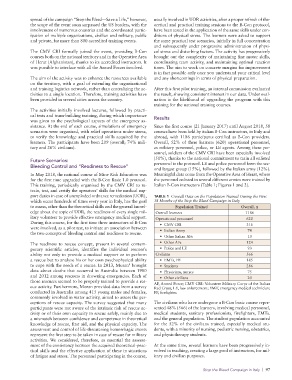
              This training, periodically organized by the CMV CRI to re-  Italian B-Con instructors (Table 1; Figures 1 and 2).
              train, test, and certify the operators’ skills for the medical sup-
              port duties in case of unexploded ordnance remediation (UOR),   TABLE 1  Overall Data on the Population Trained During the First
              which occur hundreds of times every year in Italy, has the goal   18 Months of the Stop the Bleed Campaign in Italy
              to assess, other than the theoretical skills and the general knowl-  Population Trained  Overall, n
              edge about the topic of UOR, the readiness of every single mil-  Overall learners       1186
              itary volunteer to provide effective emergency medical support.   Operational personnel  620
              During this course, for the first time three instructors of B-Con   •  CMV CRI           316
              were involved, as a pilot test, to initiate an association between
              the two concepts of bleeding control and readiness to rescue.  •  Italian Army           74
                                                                   •  Other Italian AFs                13
              The readiness to rescue concept, present in several contem-  •  Other AFs                124
              porary scientific articles, identifies the individual rescuer’s   •  Police and LE       93
              ability not only to provide a medical support or to perform   Civilians                  566
              a rescue but to analyze his or her own psychophysical ability   •  EMTs, FF              185
                                                      9
              to cope with the needs of a rescue. In 2013, Moran  brought   •  Students                286
              data about deaths that occurred in Australia between 1980   •  Physicians, nurses        75
              and 2012 among rescuers in drowning emergencies. Each of   •  Other civilians            20
              those rescuers seemed to be properly trained to provide a res-
              cue activity. Furthermore, Moran provided data from a survey   AF, Armed Force; CMV CRI: Volunteer Military Corps of the Italian
                                                                 Red Cross; LE, law enforcement; EMT, emergency medical technician;
              conducted in Australia among 415 young males and females,   FF, firefighter.
              commonly involved in water activity, aimed to assess the per-
              ceptions of rescue capacity. The survey suggested that many   The civilians who have undergone a B-Con basic course repre-
              participants were not aware of the intrinsic risk of rescue ac-  sented 48% (566) of the learners, involving medical personnel,
              tivity or of their own capacity to rescue safely, mainly due to   medical students, sanitary professionists, firefighters, EMTs.
              a mismatch between confidence and competence in theoretical   and the general population. The student population accounted
              knowledge of rescue, first aid, and the physical capacity. The   for the 52% of the civilians trained, especially medical stu-
              assessment and control of life-threatening hemorrhagic events   dents, with a minority of nursing, pediatric nursing, obstetrics,
              represent the first step to be taken in case of rescue for military   and physiotherapy students.
              activities. We considered, therefore, as essential the assesse-
              ment of the consistency between the acquired theoretical-prac-  At the same time, several learners have been progressively in-
              tical skills and the effective application of these in situations   volved in teaching, creating a large pool of instructors, for mil-
              of fatigue and stress. The personnel participating in the course,   itary and civilian purposes.

                                                                                     Stop the Bleed Campaign in Italy  |  97

