


Page 105 - JSOM Winter 2019
P. 105
directly benefit unit military performance as well. The ability   by data with some recommended changes to strategies and
              of the Operator to have his/her head in the game is directly   policies. Specifically, define performance expectations as the
              influenced by the level of concern about what is happening   foundation of readiness measurement with attention to the
              in the family. Family readiness and community connections   mission coming up (Ready for What by When). Separate the
              rarely influence go/no go decisions but can significantly influ-  measurement of operational readiness from medical readiness.
              ence in-mission performance.                       Measure operational readiness based on Operator and system
                                                                 assets, rather than only Operator deficiencies. Correlate mea-
              Significant scientific measurement gaps exist with regard to   sures  of in-mission  performance  to measures  of  operational
              assessing family readiness. For example, measures of post-de-  readiness.  Create  the capability  to conduct  readiness  imple-
              ployment reintegration are needed, particularly instruments   mentation research to benefit all components (Table 1).
              that can predict reintegration struggles and guide what sup-
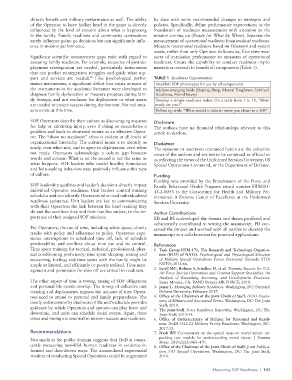
              port and services are needed.  Like psychological perfor-  TABLE 1  Readiness Opportunities
                                      28
              mance instruments, a significant deficit bias exists as most of   Establish SOF phenotypes for use by all components
              the instruments in the academic literature were developed to   Address emerging fields (Doping, Sleep, Mental Toughness. Spiritual
              diagnose family dysfunction or measure progress during fam-  Readiness, Moral Injury)
              ily therapy, and not readiness for deployment or what assets   Develop a simple readiness index: On a scale from 1 to 10, “How
              are needed to ensure success during deployment. No real mea-  ready are you?”
              sure exists at this time.                          Follow up with: “What would it take to move you closer to a 10?”
              SOF Operators describe their culture as discouraging requests   Disclosure
              for help or admitting injury, even if doing so exacerbates a   The authors have no financial relationships relevant to this
              problem and leads to shortened tenure as an effective Opera-  article to disclose.
              tor. The “show no weakness” ethos is evident at all levels of
              organizational hierarchy. The cultural norm is to identify as   Disclaimer
              ready, even when not, and to agree to deployment, even when   The opinions or assertions contained herein are the collective
              not ready. Operators acknowledge a culture gap between   views of the authors and are not to be construed as official or
              words and actions. What is on the record is not the same as   as reflecting the views of the Uniformed Services University, US
              what happens. SOF leaders who model healthy boundaries   Special Operations Command, or the Department of Defense.
              and help-seeking behaviors may positively influence this type
              of culture.                                        Funding
                                                                 Funding was provided by the Preservation of the Force and
              SOF leadership qualities and leader’s decisions directly impact   Family Behavioral Health Program award number HU0001-
              individual Operator readiness. Unit leaders control training   15-2-0053 to the Consortium for Health and Military Per-
              schedules and can identify Operators who need individualized   formance: A Defense Center of Excellence at the Uniformed
              readiness assistance. Unit leaders are key to communicating   Services University.
              with their Operators the link between the hard training they
              do and the sacrifices they and their families endure, to the im-  Author Contributions
              portance of their assigned SOF missions.           KB and BS codeveloped the themes and theses proffered and
                                                                 substantially contributed to writing the manuscript. PD con-
              For Operators, the use of time, including white space, closely   ceived the project and worked with all parties to develop the
              tracks with policy and adherence to policy. Operators expe-  manuscript as a collaboration for practical applications.
              rience interruptions to scheduled time off, lack of schedule
              predictability and conflicts about time use and its control.   References
              Time spent training for tactical, technical, professional, phys-  1.  Task Group HFM-171, The Research and Technology Organisa-
              ical conditioning proficiency; time spent sleeping, resting and   tion (RTO) of NATO. Psychological and Physiological Selection
              recovering, fueling; and time spent with the family might be   of Military Special Operations Forces Personnel.  Brussels: STO/
              ample or limited, and efficiently or poorly utilized. Time man-  NATO; 2012:66.
              agement and permission for time off are critical to readiness.  2.  Lytell MC, Robson S, Schulker D, et al. Training Success for U.S.
                                                                   Air Force Special Operations and Combat Support Specialties: An
                                                                   Analysis of Recruiting, Screening, and Development Processes.
              The other aspect of time is timing, timing of SOF obligations   Santa Monica, CA: RAND Project AIR FORCE; 2018.
              and personal life events overlap. The timing of collective unit   3.  Junor L. Managing Military Readiness. Washington, DC: National
              training and deployments impacts the amount of time Opera-  Defense University; February 2017.
              tors need to attend to personal and family preparedness. The   4.  Office of the Chairman of the Joint Chiefs of Staff. DOD Dictio-
              timely and trustworthy disclosure of the unit’s schedule provides   nary of Military and Associated Terms. Washington, DC: The Joint
              guidance by which Operators and spouses can plan leave and   Staff; 2019.
              downtime, and units can schedule social events. Again, these   5.  The Joint Staff. Force Readiness Reporting. Washington, DC: The
                                                                   Joint Staff; 2011:54.
              times and timing are essential to mission success and readiness.  6.  Office of Undersecretary of Defense for Personnel and Readi-
                                                                   ness. DoDI 1342.22 Military Family Readiness. Washington, DC:
                                                                   2017:33.
              Recommendations                                    7.  Nash WP. Commentary on the special issue on moral injury: un-
              Not much in the public domain suggests that DoD is consis-  packing two models for understanding moral injury.  J Trauma
                                                                   Stress. 2019;32(3):465–470.
              tently measuring non-KSA human readiness in evidence-in-  8.  Office of the Chairman of the Joint Chiefs of Staff. Joint Publica-
              formed and data-driven ways. The accumulated experiential   tion  3-05  Special  Operations.  Washington,  DC:  The  Joint Staff;
              wisdom of conducting Special Operations could be augmented   2014.

                                                                                         Measuring SOF Readiness  |  103

