


Page 117 - JSOM Winter 2019
P. 117
tools and equipment at disposal, and learning objective.   dilemmas, and the whole “movie” is needed to gain the proper
              In the Swiss Armed Forces, training is divided into three   mindset for participants. Further, equipment necessary for the
              phases: learning phase, consolidation phase, and application    instructor directing the overall exercise, management of the
              phase.                                             student and the exercise, and, finally, various limitations to the
                                                                 exercise set the rules of the “game.”
              While considering the objective of the lesson, the mnemonic
              “SMART” is used—Specific, Measurable, Attainable, Realis-  The theme should not be too broad and kept concise, focusing
              tic and Time bound. For the student, four key points have to   on training efforts such as Tactical Combat Casualty Care in
              be clear—content, conditions, evaluation standard, and final   urban areas or prolonged field care in austere conditions.
              behavior. 4
                                                                 Each student can have individual goals assigned, connected
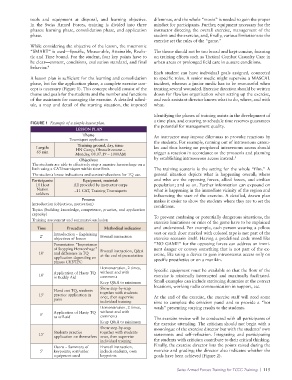
              A lesson plan is sufficient for the learning and consolidation   to specific roles. A senior medic might supervise a MASCAL
              phase, but for the application phase, a complete exercise con-  incident, whereas a junior medic has to be resourceful when
              cept is necessary (Figure 1). This concept should consist of the   treating several wounded. Exercise direction should be written
              theme and goals for the students and the number and functions   down for flawless organization when setting up the exercise,
              of the assistants for managing the exercise. A detailed sched-  and each assistant director knows what to do, where, and with
              ule, a map and detail of the starting situation, the imposed   what.

                                                                 Identifying the phases of training assists in the development of
                                                                 a time plan, and ensuring to schedule time reserves guarantees
              FIGURE 1  Example of a simple lesson plan.         the potential for management quality.
                                LESSON PLAN
                                   Theme                         An instructor may impose dilemmas to provoke reactions by
                              Tourniquet application             the students. For example, running out of intravenous cannu-
                                 Training ground, day, time:
                Length:                                          las and thus having no peripheral intravenous access should
                65 min          HN Camp, Obstacle course –       trigger a reaction in accordance to the protocols and planning
                                Monday, 08.07.19 – 1000AM                                         5
                                  Objectives:                    by establishing intraosseous access instead.
              The students are able to effectively stop a massive hemorrhage on a
              limb using a CAT/tourniquet within time limit.     The training scenario is the setting for the whole “film.” A
              The students know indications and contraindications for TQ use.  general situation depicts what is happening overall; where
              Participants:        Equipment, material:          and who are the opposing forces, allied forces, and civilian
                10 Host        All provided by instructor corps  population; and so on. Further information can expound on
                Nation          –11 CAT, Training Tourniquets    what is happening in the immediate vicinity of the region and
                soldiers                                         influencing the start of the exercise. A detailed, drawn plan
                                   Process:                      makes it easier to show the students where they are to set the
              Introduction (objectives, motivation)              conditions.
              Topics (building knowledge, competence, practice, and application
              capacity)                                          To prevent confusing or potentially dangerous situations, the
              Training assessment and summary/conclusion
                                                                 exercise limitations or rules of the game have to be explained
                Time         Procedure      Methodical indication  and understood. For example, each person wearing a yellow
                       Introduction – Explaining                 vest or each door marked with colored tape is not part of the
                 2'                       Frontal instruction
                       objectives of lesson                      exercise scenario itself. Having a predefined code word like
                       Presentation “Importance                  “NO GAME” for the opposing forces can address an immi-
                       of Stopping Hemorrhage”   Frontal instruction, Q&A   nent danger or convey something that is not part of the ex-
                 10'   and difference in TQ   at the end of presentation  ercise, like using a device to gain intraosseous access only on
                       application depending on                  specific prosthetics or on a manikin.
                       phases CUF/TFC
                                          Demonstration, 2 times,    Specific equipment must be available so that the flow of the
                       Application of Hasty TQ  without and with
                 10'                                             exercise is minimally interrupted and maximally facilitated.
                       in Buddy Aid       comments
                                          Keep Q&A to minimum    Small examples can include stationing dummies at the correct
                                          Show step-by-step      locations, working radio communication in support, etc.
                       Hand out TQ, students   together with students
                 15'   practice application in   once, then supervise   At the end of the exercise, the exercise staff will need some
                       pairs
                                          individual training    time to complete the criticism panel and to provide a “hot
                                          Demonstration, 2 times,    wash” presenting varying results to the students.
                       Application of Hasty TQ  without and with
                 5'
                       as self-aid        comments               The exercise review will be conducted with all participants of
                                          Keep Q&A to minimum    the exercise attending. The criticism should not begin with a
                                          Show step-by-step      monologue of the exercise director but with the students’ own
                       Students practice   together with students
                 15'                                             statements  and self-reflection.  Integrating  and participating
                       application on themselves once, then supervise
                                          individual training    the students with criticism contribute to their critical thinking.
                       Outro – Summary of   Frontal instruction,   Finally, the exercise director lists the points raised during the
                 5'    keypoints; sort/order   include students, own   exercise and grading; the director also indicates whether the
                       equipment used     keypoints              goals have been achieved (Figure 2).

                                                                          Swiss Armed Forces Training for TCCC Training  |  115

