


Page 56 - JSOM Summer 2019
P. 56
For thigh applications, the highest peak strap pressures hap-  TABLE 3  Associations Between Strength or Experience and Secured
          pened with the hold below and pull down technique (p <   Strap Pressure
          .0001 for technique and for tourniquet, with p = .2999 for                  Spearman r Value  p Value
          interaction when including the pulling outward only tech-  Above tangential
          niques, and p < .0001 for technique and for tourniquet, with   Applier strength versus secured pressure
          p = .1280 for interaction when excluding the pulling outward   C-A-T7            0.33        .15
          only techniques; Figure 4A). However, this technique also had   Tac RMT          0.59       .0064*
          the greatest difference between the peak pressures and the
          secured-strap pressures (p < .0001 for technique, p = .4523   TMT                0.52       .020*
          for tourniquet, and p = .2491 for interaction when including   Parabelt          0.79      <.0001*
          the pulling outward only techniques; and p < .0001 for tech-  SOFTTW             0.13        .58
          nique, p = .2442 for tourniquet, and p = .0924 for interaction   Applier experience versus secured pressure
          when excluding the pulling outward only techniques; Figure   C-A-T7              0.16        .49
          4C). This coincides with feelings of appliers that significant   Tac RMT         0.31        .19
          strap-pressure loss occurred while getting the two fingers out   TMT             0.26        .26
          from between the tourniquet strap and the thigh. We were un-  Parabelt          0.087        .71
          able to do this strap hold with the hanging weight gel appli-  SOFTTW            0.24        .30
          cations, because the tackiness of the gel precluded removal of
          the two fingers involved in strap holding from between the   Below tangential
          strap and the gel.                                   Applier strength versus secured pressure
                                                                C-A-T7                    –0.037       .88
          For gel applications, techniques involving an outward pulling   Tac RMT         –0.17        .47
          direction (Figure 3), with all of the hanging weight supported   TMT            –0.074       .76
          by the portion of the strap directly over the No. 1 neonatal   Parabelt         0.0023       .99
          blood pressure cuff on the opposite side of the gel from the   SOFTTW            0.31        .18
          weights, resulted in the highest peak strap pressures (p < .0001   Applier experience versus secured pressure
          for technique, tourniquet, and interaction; Figure 4B). As ex-  C-A-T7           0.14        .55
          pected, the best capture of strap pressure (i.e., least difference   Tac RMT     0.47       .035*
          between peak and secured strap pressure) occurred with the
          tangential pulling direction (p < .0001 for technique, tourni-  TMT              0.41        .073
          quet, and interaction; Figure 4D).                    Parabelt                   0.54       .014*
                                                                SOFTTW                     0.36        .12
          Applier Strength or Experience                      Above out then tangential
          and Secured-Strap Pressures                          Applier strength versus secured pressure
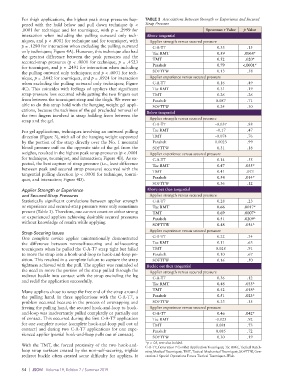
          Statistically significant correlations between applier strength   C-A-T7         0.28        .23
          or experience and secured-strap pressure were only sometimes   Tac RMT           0.66       .0017*
          present (Table 3). Therefore, one cannot count on either strong   TMT            0.69       .0007*
          or experienced appliers achieving desirable secured pressures   Parabelt         0.51       .0209*
          without knowledge of results while applying.
                                                                SOFTTW                     0.48       .034*
                                                               Applier experience versus secured pressure
          Strap-Securing Issues
          One complete novice applier unintentionally demonstrated   C-A-T7                0.22        .34
          the difference between non–self-securing and self-securing   Tac RMT             0.11        .63
          tourniquets when he pulled the C-A-T7 strap tight but failed   TMT              0.028        .91
          to move the strap into a hook-and-loop to hook-and-loop po-  Parabelt            0.10        .67
          sition. This resulted in a complete failure to capture the strap   SOFTTW        0.16        .50
          tightness achieved with the pull. The applier was reminded of   Buckle out then tangential
          the need to move the portion of the strap pulled through the   Applier strength versus secured pressure
          redirect buckle into contact with the strap encircling the leg
          and redid the application successfully.               C-A-T7                     0.36        .12
                                                                Tac RMT                    0.48       .033*
          Many appliers chose to wrap the free end of the strap around   TMT               0.52       .018*
          the pulling hand. In three applications with the C-A-T7, a   Parabelt            0.51       .023*
          problem occurred because in the process of unwrapping and   SOFTTW               0.33        .15
          freeing the pulling hand, the secured hook-and-loop to hook-  Applier experience versus secured pressure
          and-loop was inadvertently pulled completely or partially out   C-A-T7           0.46       .042*
          of contact. This occurred during the first C-A-T7 application   Tac RMT         -0.025       .92
          for one complete novice (complete hook-and-loop pull out of   TMT               0.081        .73
          contact) and during two C-A-T7 applications for one expe-  Parabelt             0.085        .72
          rienced applier (partial hook-and-loop pulls out of contact).
                                                                SOFTTW                     0.30        .19
          With the TMT, the forced proximity of the two hook-and-  *p < .05, text also bolded.
                                                             C-A-T7, Generation 7 Combat Application Tourniquet; Tac RMT, Tactical Ratch-
          loop strap surfaces created by the non–self-securing, triglide   eting Medical Tourniquet; TMT, Tactical Mechanical Tourniquet; SOFTTW, Gen-
          redirect buckle often created some difficulty for appliers. It   eration 3 Special Operations Forces Tactical Tourniquet–Wide.


          54  |  JSOM   Volume 19, Edition 2 / Summer 2019

