


Page 57 - JSOM Summer 2019
P. 57
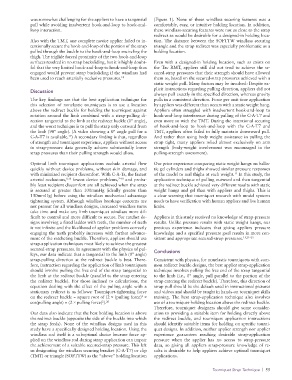
was somewhat challenging for the appliers to have a tangential   (Figure 1). None of these windlass securing features was a
              pull while avoiding inadvertent hook-and-loop to hook-and-  comfortable, easy, or intuitive holding location. In addition,
              loop interaction.                                  these windlass-securing features were not as close to the strap
                                                                 redirect as would be desirable for a designed-in holding loca-
              Also with the TMT, one complete novice applier failed to in-  tion. The distance between the SOFTTW windlass securing
              tentionally secure the hook-and-loop of the portion of the strap   triangle and the strap redirect was especially problematic as a
              pulled through the buckle to the hook-and-loop encircling the   holding location.
              thigh. The triglide forced proximity of the two hook-and-loop
              surfaces resulted in no strap backsliding, but it is highly doubt-  Even with a designed-in holding location, such as exists on
              ful that the very limited hook-and-loop to hook-and-loop thus   the Tac RMT, appliers still did not tend to achieve the se-
              engaged would prevent strap backsliding if the windlass had   cured-strap pressures that their strength should have allowed
              been used to reach arterially occlusive pressures. 18  them to, based on the secured-strap pressures achieved with a
                                                                 static weight pull. Many factors may be involved: Despite ex-
                                                                 plicit instructions regarding pulling direction, appliers did not
              Discussion
                                                                 always pull exactly in the specified direction, whereas gravity
              The key findings are that the best application technique for   pulls in a consistent direction. Force per unit time application
              this selection of nonelastic tourniquets is to use a location   by appliers was different than occurs with a static weight hang.
              above the redirect buckle for holding the tourniquet against   Appliers often struggled with inadvertent hook-and-loop to
              rotation around the limb combined with a strap-pulling di-  hook-and-loop interference during pulling of the C-A-T7 and
              rection tangential to the limb at the redirect buckle (0° angle),   even more so with the TMT. During the intentional securing
              and the worst technique is to pull the strap only outward from   of hook-and-loop to hook-and-loop with the C-A-T7 and
              the limb (90° angle). (A video showing a 0° angle pull for a   TMT, appliers often failed to fully maintain downward pull.
              C-A-T7 is available. ) A secondary finding is that, regardless   And rather than using body weight assistance in pulling the
                             19
              of strength and tourniquet experience, appliers without access   strap tight, many appliers relied almost exclusively on arm
              to strap-pressure data generally achieve substantially lower   strength (body-weight involvement was encouraged in the
              strap pressures than their pulling strength would allow.  pulling-strength assessment).
              Optimal limb tourniquet applications occlude arterial flow   Our prior experience comparing static weight hangs on ballis-
              quickly without device problems, without skin damage, and   tic gel cylinders and thighs showed similar pressure responses
              with minimized recipient discomfort. With C-A-Ts, the fastest   of the model to real thighs at each weight.  In this study, the
                                                                                                  11
              arterial occlusions, 8,18  fewest device problems, 7–10  and proba-  application technique of pulling outward and then tangential
              bly least recipient discomfort are all achieved when the strap   at the redirect buckle achieved very different results with static
              is secured at greater than 100mmHg (ideally greater than   weight hangs and gel than with appliers and thighs. This is
              150mmHg) before using the windlass mechanical advantage   a clear warning that tourniquet research with model systems
              tightening system. Although windlass breakage concerns are   needs to have verification with human appliers and live human
              not present for all windlass designs, increased windlass turns   limbs.
              take time and make any limb tourniquet windlass more dif-
              ficult to control and more difficult to secure. For ratchet de-  Appliers in this study received no knowledge of strap- pressure
              signs involving a fixed ladder with teeth, the number of teeth   results. Unlike pressure results with static weight hangs, our
              is not infinite and the likelihood of applier problems correctly   previous experience indicates that giving appliers pressure
              engaging the teeth probably increases with farther advance-  knowledge and a specified pressure goal results in more con-
              ment of the ratcheting buckle. Therefore, appliers should use   sistent and appropriate secured-strap pressures. 13,21–23
              strap-application techniques most likely to achieve the greatest
              secured-strap pressures. In agreement with the physics of pul-  Conclusions
              leys, our data indicate that a tangential to the limb (0° angle)
              strap-pulling direction at the redirect buckle is best. There-  Consistent with physics, for nonelastic tourniquets with com-
              fore, instruction regarding the application of limb tourniquets   mon redirect buckle designs, the best applier strap-application
              should involve pulling the free end of the strap tangential to   technique involves pulling the free end of the strap tangential
              the limb at the redirect buckle (parallel to the strap entering   to the limb (i.e., 0° angle, pull parallel to the portion of the
              the redirect buckle). For those inclined to calculations, the   strap entering the redirect buckle). Therefore, this direction of
              equation dealing with the effect of the pulling angle with a   strap pull should be the default used in instructional pictures
              stationary redirect is as follows: Tourniquet-tightening force   and videos and should be taught in hands-on tourniquet skills
              on the redirect buckle = square root of (2 ´ (pulling force)  ´   training. The best strap-application technique also involves
                                                            2
              cos(pulling angle) + (2 ´ pulling force) ). 20     use of a tourniquet-holding location above the redirect buckle.
                                           2
                                                                 Therefore, tourniquet designers should give some consider-
              Our data also indicate that the best holding location is above   ation to providing a suitable item for holding directly above
              the redirect buckle (opposite the side of the buckle into which   the redirect buckle, and tourniquet application instructions
              the strap feeds). None of the windlass designs used in this   should identify suitable items for holding on specific tourni-
              study have a specifically designed holding location. Using the   quet designs. In addition, neither applier strength nor applier
              windlass rod itself is a suboptimal choice because force ap-  experience guarantees reaching desirable strap- application
              plied on the windlass rod during strap application can impair   pressure when the applier has no access to strap-pressure
              the achievement of a suitable secured-strap pressure. This left   data, so giving all appliers strap-pressure knowledge of re-
              us designating the windlass securing bracket (C-A-T7) or clip   sults is desirable to help appliers achieve optimal tourniquet
              (TMT) or triangle (SOFTTW) as the “above” holding location   applications.

                                                                                         Tourniquet Strap Technique  |  55

