


Page 55 - JSOM Summer 2019
P. 55
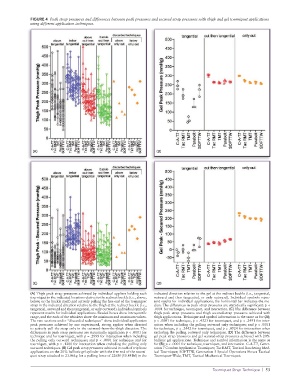
FIGURE 4  Peak strap pressures and differences between peak pressures and secured-strap pressures with thigh and gel tourniquet applications
              using different application techniques.


               (A)                                                (B)


               (C)                                                (D)

              (A) Thigh peak strap pressures achieved by individual appliers holding each   indicated direction relative to the gel at the redirect buckle (i.e., tangential,
              tourniquet in the indicated location relative to the redirect buckle (i.e., above,   outward and then tangential, or only outward). Individual symbols repre-
              below, or the buckle itself) and actively pulling the free end of the tourniquet   sent results for individual applications; the horizontal bar indicates the me-
              strap in the indicated direction relative to the thigh at the redirect buckle (i.e.,   dian. The differences in peak strap pressures are statistically significant: p <
              tangential, outward and then tangential, or only outward). Individual symbols   .0001 for technique, tourniquet, and interaction. (C) The difference between
              represent results for individual applications. Shaded boxes show interquartile   thigh peak strap pressures and thigh secured-strap pressures achieved with
              range, and the ends of the whiskers show the minimum and maximum values.   thigh applications. Technique and symbol information is the same as for (A);
              The two sections under “discarded techniques” show individual application   p < .0001 for technique, p = .4523 for tourniquet, and p = .2491 for inter-
              peak pressures achieved by one experienced, strong applier when directed   action when including the pulling outward only techniques; and p < .0001
              to actively pull the strap only in the outward-from-the-thigh direction. The   for technique, p = .2442 for tourniquet, and p = .0924 for interaction when
              differences in peak strap pressures are statistically significant: p < .0001 for   excluding the pulling outward only techniques. (D) The difference between
              technique and for tourniquet, with p = .2999 for interaction when including   gel peak strap pressures and gel secured-strap pressures achieved with 20%
              the pulling only outward techniques; and p < .0001 for technique and for   ballistic gel applications. Technique and symbol information is the same as
              tourniquet, with p = .1280 for interaction when excluding the pulling only   for (B); p < .0001 for technique, tourniquet, and interaction. C-A-T7, Gener-
              outward techniques. (B) Gel peak strap pressures achieved in each of triplicate   ation 7 Combat Application Tourniquet; Tac RMT, Tactical Ratcheting Med-
              applications on the 20% ballistic gel cylinder with the free end of the tourni-  ical Tourniquet; SOFTTW, Generation 3 Special Operations Forces Tactical
              quet strap attached to 23.06kg for a pulling force of 226N (50.84lbf) in the     Tourniquet–Wide; TMT, Tactical Mechanical Tourniquet.

                                                                                         Tourniquet Strap Technique  |  53

