


Page 51 - JSOM Summer 2019
P. 51
Two tourniquets were donated by their respective compa-  under the tourniquet strap approximately 180° from the re-
              nies for this or prior studies: the Tactical Ratcheting Medical   direct buckle and connected to a gas pressure sensor system
              Tourniquet (Tac RMT; 10 November 2015; m2  Inc., www   (Vernier Gas Pressure Sensor, Vernier LabPro interface, and
                                                    ®
              .ratchetingbuckles.com) and the Parabelt (Lot PT1116-21-  Logger Pro Software; Vernier Software and Technology, www
              04, RevMedX,  www.revmedx.com). The other three tour-  .vernier.com). Pressure was recorded every tenth of a second
              niquets  were purchased:  the  Generation  7 C-A-T  (C-A-T7,    on thighs and every second on the gel. Secured-strap pressure
              Lot 120B207; C-A-T Resources Inc., http://combattourniquet   was taken with the applier’s hands off the tourniquet. The
              .com/), the Tactical Mechanical Tourniquet (TMT; Lot   pressure graph was not visible to appliers, and no data were
              040517; Combat Medical,  https://combatmedicalsystems.  shared with appliers during applications.
              com), and the Generation 3 SOF  Tactical Tourniquet–Wide
                                        ®
              (SOFTTW; 3 April 2017; Tactical Medical  Solutions, www   Tourniquet Recipient Thighs and Ballistic Gel
                                               ®
              .tacmedsolutions.com).                             Tourniquets were applied to left and right thighs of authors
                                                                 PW and CB at locations with circumferences of 46.0, 46.5,
              Redirect Buckles and Straps                        and 48.0cm. Recipients were seated with a 90° angle between
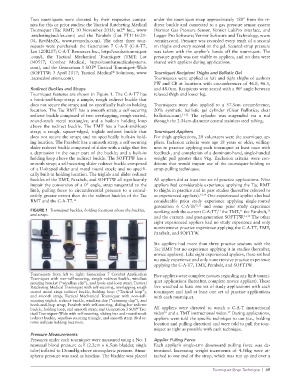
              Tourniquet features are shown in Figure 1. The C-A-T7 has   relaxed thigh and lower leg.
              a hook-and-loop strap; a simple, rough redirect buckle that
              does not secure the strap; and no specifically built-in holding   Tourniquets were also applied to a 57.5cm circumference,
              location. The Tac RMT has a smooth strap; a self-securing   20% synthetic ballistic gel cylinder (Clear Ballistics;  clear
              redirect buckle composed of two overlapping, rough-coated,   ballistics.com). 11,12  The cylinder was suspended via a rod
              round-stock metal rectangles; and a built-in holding loop   through the 2.54cm-diameter central stainless steel tubing.
              above the redirect buckle. The TMT has a hook-and-loop
              strap;  a rough, square-edged,  triglide  redirect buckle that   Tourniquet Appliers
              does not secure the strap; and no specifically built-in hold-  For thigh applications, 20 volunteers were the tourniquet ap-
              ing location. The Parabelt has a smooth strap; a self-securing   pliers. Inclusion criteria were age 18 years or older, willing-
              slider redirect buckle composed of slider with a ridge that fits   ness to practice applying each tourniquet at least once with
              a depression in the outer part of the buckle; and a built-in   feedback, and completion of a dominant-hand, single-handed
              holding loop above the redirect buckle. The SOFTTW has a   weight pull greater than  9kg. Exclusion  criteria were con-
              smooth strap; a self-securing slider redirect buckle composed   ditions  that  would  impair  use  of  the  tourniquet-holding  or
              of a U-shaped slider and metal round stock; and no specifi-  strap-pulling techniques.
              cally built-in holding location. The triglide and slider redirect
              buckles of the TMT, Parabelt, and SOFTTW all significantly   All appliers did at least one set of practice applications. Nine
              impair the conversion of a 0° angle, strap tangential to the   appliers had considerable experience applying the Tac RMT
              limb, pulling force to circumferential pressure to a consid-  to thighs in practice and in past studies (hereafter referred to
              erably greater extent than do the redirect buckles of the Tac   as experienced appliers). 13,14  One experienced applier also had
              RMT and the C-A-T7. 11                             considerable prior study experience applying single-routed
                                                                 generation 6 C-A-Ts 12,15  and some prior study experience
              FIGURE 1  Tourniquet buckles, holding locations above the buckles,   working with the current C-A-T7,  the TMT,  the Parabelt,
                                                                                                               11
                                                                                                    11
                                                                                           11
              and straps.
                                                                 and the current- and past-generation SOFTTW. 11,15  The other
                                                                 eight experienced appliers had no study experience and only
                                                                 nonextensive practice experience applying the C-A-T7, TMT,
                                                                 Parabelt, and SOFTTW.
                                                                 Six appliers had more than three practice sessions with the
                                                                 Tac RMT but no experience applying it in studies (hereafter,
                                                                 novice appliers). Like eight experienced appliers, these six had
                                                                 no study experience and only nonextensive practice experience
                                                                 applying the C-A-T7, TMT, Parabelt, and SOFTTW.
              Tourniquets from left to right: Generation 7 Combat Application   Five appliers were complete novices regarding any limb tourni-
              Tourniquet with non–self-securing, simple redirect buckle, windlass   quet applications (hereafter, complete novice appliers). These
              securing bracket (“windlass clip”), and hook-and-loop strap; Tactical
              Ratcheting Medical Tourniquet with self-securing, overlapping rough   five watched at least one set of study applications with each
              coated metal rings redirect buckle, holding loop (“Tactical loop”),   tourniquet and had at least one set of practice applications
              and smooth strap; Tactical Mechanical Tourniquet with non–self-   with each tourniquet.
              securing triglide redirect buckle, windlass clip (“retaining clip”), and
              hook-and-loop strap; Parabelt with self-securing, sliding-bar redirect
              buckle, holding loop, and smooth strap; and Generation 3 SOF  Tac-  All appliers were directed to watch a C-A-T instructional
                                                         ®
                                                                     16
                                                                                               17
              tical Tourniquet–Wide with self-securing, sliding bar and round-stock   video  and a TMT instructional video.  During applications,
              redirect buckle, windlass securing triangle, and smooth strap. Red ar-  appliers were told the specific technique to use (i.e., holding
              rows indicate holding locations.                   location and pulling direction) and were told to pull the tour-
                                                                 niquet as tight as possible with each technique.
              Pressure Measurements
              Pressures under each tourniquet were measured using a No. 1   Applier Pulling Force
              neonatal blood pressure cuff (2.2cm × 6.5cm bladder, single   Each applier’s single-arm downward pulling force was de-
              tube) inflated to 15mmHg above atmospheric pressure. Atmo-  termined. Increasing weight increments of 4.56kg were at-
              spheric pressure was used as baseline. The bladder was placed   tached to one end of the strap, which was run up and over a

                                                                                         Tourniquet Strap Technique  |  49

