


Page 53 - JSOM Summer 2019
P. 53
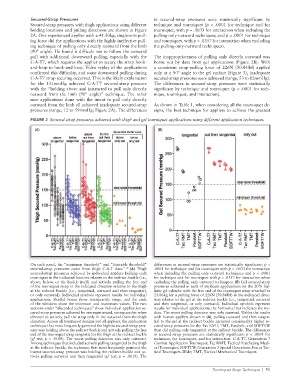
Secured-Strap Pressures                            in  secured-strap  pressures  were  statistically  significant  by
              Secured-strap pressures with thigh applications using different   technique and tourniquet (p < .0001 for technique and for
              holding locations and pulling directions are shown in Figure   tourniquet, with p = .0033 for interaction when including the
              2A. One experienced applier with a 41.50kg, single-arm pull-  pulling-only-outward techniques; and p < .0001 for technique
              ing force did the applications with the highly ineffective pull-  and tourniquet, with p = .0357 for interaction when excluding
              ing technique of pulling only directly outward from the limb   the pulling-only-outward techniques).
              (90° angle). He found it difficult not to follow the outward
              pull with additional downward pulling, especially with the   The inappropriateness of pulling only directly outward was
              C-A-T7, which requires the applier to secure the strap hook-  borne out by data from gel applications (Figure 2B). With
              and-loop to hook-and-loop. Video replay of the applications   a consistent strap-pulling force of 226N (50.84lbf) applied
              confirmed this difficulty, and some downward pulling during   only at a 90° angle to the gel surface (Figure 3), inadequate
              C-A-T7 strap securing occurred. This is the likely explanation     secured-strap pressures were achieved (range, 53 to 82mmHg).
              for the 131mmHg achieved C-A-T7 secured-strap pressure   The differences in secured-strap pressures were statistically
              with the “holding above and instructed to pull only directly   significant by technique and tourniquet (p < .0001 for tech-
              outward from the limb (90° angle)” technique. The other   nique, tourniquet, and interaction).
              nine applications done with the intent to pull only directly
              outward from the limb all achieved inadequate secured-strap   As shown in Table 1, when considering all the tourniquet de-
              pressures (range, 12 to 59mmHg; Figure 2A). The differences   signs, the best technique for appliers to achieve the greatest
              FIGURE 2  Secured strap pressures achieved with thigh and gel tourniquet applications using different application techniques.

               (A)                                                (B)


              On each panel, the “minimum threshold” and “desirable threshold”   differences in secured-strap pressures are statistically significant: p <
              secured-strap pressures come from thigh C-A-T data. 7–10   (A)  Thigh   .0001 for technique and for tourniquet with p = .0033 for interaction
              secured-strap pressures achieved by individual appliers holding each   when including the pulling only outward techniques and  p < .0001
              tourniquet in the indicated location relative to the redirect buckle (i.e.,   for technique and for tourniquet with p = .0357 for interaction when
              above, below, or the buckle itself) and actively pulling the free end   excluding the pulling only outward techniques. (B) Gel secured-strap
              of the tourniquet strap in the indicated direction relative to the thigh   pressures achieved in each of triplicate applications on the 20% bal-
              at the redirect buckle (i.e., tangential, outward and then tangential,   listic gel cylinder with the free end of the tourniquet strap attached to
              or only outward). Individual symbols represent results for individual   23.06kg for a pulling force of 226N (50.84lbf) in the indicated direc-
              applications. Shaded boxes show interquartile range, and the ends   tion relative to the gel at the redirect buckle (i.e., tangential, outward
              of the whiskers show the minimum and maximum values. The two   and then tangential, or only outward). Individual symbols represent
              sections under “discarded techniques” show individual application se-  results for individual applications; the horizontal bar indicates the me-
              cured-strap pressures achieved by one experienced, strong applier when   dian. The worst pulling direction was only outward. Unlike the results
              directed to actively pull the strap only in the outward-from-the-thigh   with human appliers shown in (A), pulling outward and then tangen-
              direction. Across all tourniquet designs and all appliers, the application   tial to the gel at the redirect buckle garnered considerably higher se-
              technique that most frequently garnered the highest secured-strap pres-  cured-strap pressures for the Tac RMT, TMT, Parabelt, and SOFTTW
              sure was holding above the redirect buckle and actively pulling the free   than did pulling only tangential at the redirect buckle. The differences
              end of the tourniquet strap tangential to the thigh at the redirect buckle   in secured-strap pressures are statistically significant:  p < .0001 for
               2
              (χ  test, p = .0109). The worst pulling direction was only outward.   technique, for tourniquet, and for interaction. C-A-T7, Generation 7
              Among techniques that included actively pulling tangential to the thigh   Combat Application Tourniquet; Tac RMT, Tactical Ratcheting Medi-
              at the redirect buckle, the technique that most frequently garnered the   cal Tourniquet; SOFTTW, Generation 3 Special Operations Forces Tac-
              lowest secured-strap pressure was holding the redirect buckle and ac-  tical Tourniquet–Wide; TMT, Tactical Mechanical Tourniquet.
                                              2
              tively pulling outward and then tangential (χ  test, p = .0119). The
                                                                                         Tourniquet Strap Technique  |  51

