


Page 61 - JSOM Summer 2019
P. 61
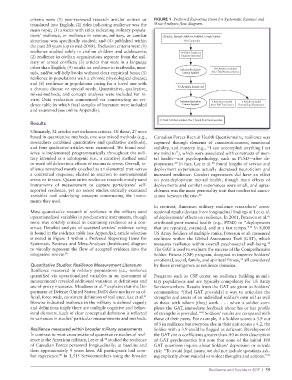
criteria were (1) peer-reviewed research articles written or   FIGURE 1  Preferred Reporting Items for Systematic Reviews and
              translated into English; (2) titles indicating resilience was the   Meta-Analyses flow diagram.
              main topic; (3) articles with titles indicating military popula-
              tions’ resilience, or resilience in veteran, military, or combat   CINAHL, PsycInfo, Mil/Gov, PubMed, Google Scholar
              situations was specifically studied; and (4) published within   138 Citation(s)
              the past 20 years (up to mid-2018). Exclusion criteria were (1)
              resilience studied solely in civilian children and adolescents;   134 Non-Duplicate
              (2) resilience in civilian organizations separate from the mil-  Citations Screened
              itary or armed conflicts; (3) articles that were in a language
              other than English; (4) works on resilience in textbooks, man-  Inclusion/Exclusion   101 Articles Excluded
              uals, and/or self-help books without clear empirical basis; (5)   Criteria Applied  After Title/Abstract Screen
              resilience in populations with a chronic physiological disease;
              and (6) resilience in populations caring for a loved one with
              a chronic disease or special needs. Quantitative, qualitative,   33 Articles Retrieved
              mixed-methods,  and  concept analyses  were  included for  re-
              view. Data evaluation commenced via constructing an evi-      Inclusion/Exclusion
                                                                                                     1 Article Excluded
                                                                                         2 Articles Excluded
              dence table by which final samples of literature were included   Criteria Applied  After Full Text Screen  During Data Extrraction
              and examined (see online Appendix).
                                                                   32 Total Articles Included, Plus 2 found from hand-searches
              Results
              Ultimately, 32 articles met inclusion criteria. Of those, 27 were
              based in quantitative methods, one was mixed methods (e.g.,   Canadian Forces Recruit Health Questionnaire, resilience was
              researchers combined quantitative and qualitative methods),   captured through elements of conscientiousness, emotional
              and four qualitative articles were examined. We found resil-  stability, and mastery (e.g., “I can accomplish anything I set
              ience is implemented programmatically throughout the mili-  my mind to”), which were associated with constructs of men-
              tary intended as a salutogenic (i.e., a curative) method used   tal health—not psychopathology,  such as PTSD—after de-
              to ward off deleterious effects of traumatic stress. Overall, re-  ployments.  In fact, Lee et al.  found lengths of service and
                                                                                        40
                                                                         40
              silience remained mostly couched as an elemental trait versus   deployment experiences actually decreased neuroticism and
              a contextual response, elicited in reaction to environmental   increased resilience. Combat experiences did have an effect
              stress or threats. Quantitative resilience research mostly used   on post-deployment mental health, though main effects of
              instruments of measurement to capture participants’ self-   deployments and combat experiences were small, and agree-
              reported resilience, yet no recent studies critically examined   ableness was the main personality trait that moderated associ-
              variables and underlying concepts constructing the instru-  ations between the two. 40
              ments they used.
                                                                 In contrast, American military resilience researchers’ cross-
              Most quantitative research of resilience in the military used   sectional results deviate from longitudinal findings of Lee et al.
              operationalized variables in psychometric instruments, though   of deployments’ effects on resilience. In 2011, Peterson et al.
                                                                                                               41
              none  was notably  critical  in  examining  resilience  as  a con-  attributed poor mental health (e.g., PTSD) to “deployments
              struct. Detailed analysis of accepted articles’ evidence rating   that are repeated, extended, and at a fast tempo.”  In 8,000
                                                                                                        41
              is found in the evidence table (see Appendix); article selection   US Army Soldiers of multiple ranks, Peterson et al. measured
              is noted in Figure 1 within a Preferred Reporting Items for   resilience within the Global Assessment Tool (GAT), which
              Systematic Reviews and Meta-Analyses (healthcare) diagram   measures resilience within overall psychosocial well-being.
                                                                                                               41
              to visually represent the flow of accepted evidence into the   The GAT is used to evaluate the success of the Comprehensive
              integrative review. 38                             Soldier Fitness (CSF) program, designed to improve Soldiers’
                                                                 emotional, social, family, and spiritual fitness,  all considered
                                                                                                    41
              Quantitative Studies: Resilience Measurement Literature  by those investigators as resilience domains.
              Resilience  measured  in  military  populations  (i.e.,  resilience
              quantified via operationalized variables in an instrument of   Programs such as CSF center on resilience building in mili-
              measurement) revealed additional variation in definitions and   tary populations and are typically compulsory for US Army
              use of proxy measures. Meadows et al.  explains that the De-  Servicemembers. Results from the GAT are given to Soldiers’
                                            39
              partment of Defense (United States; DoD) does not have an of-  commanders: “[the] GAT provide[s] a way to articulate the
              ficial, force-wide, consistent definition of resilience. Lee et al.    strengths and assets of an individual soldier’s own self as well
                                                            31
              likewise indicated resilience in the military is defined vaguely   as those with whom [they] work . . . when a soldier com-
              and definitions imply there are multiple cognitive and behav-  pletes the GAT, immediate feedback about his or her profile
              ioral elements. Lack of clear conceptual definition is reflected   of strengths is provided.”  Soldiers’ results are compared with
                                                                                    41
              in variances in studies’ particular measurements and methods.  those of their peers. For example, if a Soldier scores a 3.9 out
                                                                 of 5 in resilience but everyone else in their unit scores a 4.2, the
              Resilience measured within broader military assessments  Soldier with a 3.9 could be flagged as deficient. Developers of
              In contrast to most cross-sectional quantitative studies of resil-  the GAT cite α coefficients greater than .80 in their description
              ience in the American military, Lee et al.  studied the resilience   of GAT psychometrics but note that none of the initial 180
                                            40
              of Canadian Forces personnel longitudinally: at baseline and   GAT questions inquire about Soldiers’ depression or suicide
              then approximately  4 years later. All participants  had com-  risk: “To avoid legal issues, we did not include questions ask-
              bat experience.  In 1,315 Servicemembers using the broader   ing explicitly about suicidal or violent thoughts and actions.” 41
                         40
                                                                                       Resilience and Suicide in SOF  |  59

