


Page 101 - JSOM Winter 2018
P. 101
responses for confidence (indications and technique) were   A total of 96 simulated leg hemorrhage scenarios were man-
              compared between groups.                           aged by 48 corpsmen. A total of 10 measurements for five
                                                                 corpsmen from the TT group were discarded because of per-
                                                                 fusion system failure on a single day of testing. The failure
              Statistical Methodology
                                                                 was not the result of the tourniquets or corpsmen application
              Data were analyzed using OS X El Capitan 10.11.6/Micro-  of the tourniquets. None of the PCT group measurements re-
              soft Excel 15.24 (Microsoft Corp., www.microsoft.com). Uni-  quired exclusion.
              variate continuous data between two groups were compared
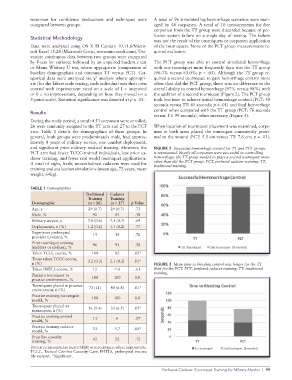
              by F-test for variance followed by an unpaired Student t test   The PCT group was able to control simulated hemorrhage
              or Mann Whitney U test, where appropriate (comparison of   with one tourniquet more frequently than was the TT group
              baseline demographics and outcomes TT versus PCT). Cat-  (96.0% versus 83.0%; p = .03). Although the TT group re-
              egorical data were analyzed via χ  analysis where appropri-  quired a second tourniquet to gain hemorrhage control more
                                         2
              ate (for the Likert scale testing, each individual was their own   often than did the PCT group, there was no difference in the
              control with improvement rated on a scale of 1 = improved   overall ability to control hemorrhage (97% versus 98%) with
              or 0 = no improvement, depending on how they moved on a   the addition of a second tourniquet (Figure 2). The PCT group
              5-point scale). Statistical significance was denoted at p ≤ .05.  took less time to achieve initial hemorrhage control (PCT: 39
                                                                 seconds versus TT: 45 seconds; p = .01) and final hemorrhage
                                                                 control when compared with the TT group (PCT: 76 seconds
              Results
                                                                 versus TT: 99 seconds), when necessary (Figure 3).
              During the study period, a total of 53 corpsmen were enrolled;
              26 were randomly assigned to the TT arm and 27 to the PCT   When location of tourniquet placement was examined, corps-
              arm. Table 1 details the demographics of these groups. In   men in both arms placed the tourniquet consistently proxi-
              general, both groups were predominately male, had approx-  mal to the wound (PCT: 5.5 cm versus TT: 7.6 cm; p = .03).
              imately 8 years of military service, one combat deployment,
              and significant prior military medical training. However, the   FIGURE 2  Successful hemorrhage control for TT and PCT groups
              PCT arm had fewer TCCC-trained individuals, less prior ca-  is represented. Nearly all corpsmen were successful in controlling
              daver training, and fewer real world tourniquet applications.   hemorrhage; the TT group needed to place a second tourniquet more
              A total of eight, fresh, nonembalmed cadavers were used for   often than did the PCT group. PCT, perfused-cadaver training; TT,
              training and evaluation simulations (mean age, 72 years; mean   traditional training.
              weight, 64kg).


              TABLE 1 Demographics
                                    Traditional   Cadaver
                                     Training  Training
              Demographic            (n = 26)  (n = 27)  p Value
              Age, y                 29 (0.7)  29 (0.7)  .73
              Male, %                  92        83      .38
              Military service, y    7.8 (0.6)  7.5 (0.7)  .69
              Deployments, n (%)     1.2 (0.2)  1.1 (0.2)  .77
              Experience prehospital
              provider (civilian), %   15        19      .76
              Prior tourniquet training
              (military or civilian), %  96      93      .58
              Taken TCCC course, %     100       82     .02*
              Times taken TCCC course,   3.2 (0.3)  2.1 (0.3)  .01*
              n (%)                                              FIGURE 3  Mean time to bleeding control was longer for the TT
              Taken PHTLS course, %    12       7.4      .61     than for the PCT. PCT, perfused-cadaver training; TT, traditional
              Placed a tourniquet in                             training.
              practice environment, %  100      100      1.0
              Tourniquets placed in practice
              environment, n (%)      73 (11)  40 (6.8)  .01*
              Practice training mannequin
              model, %                 100      100      1.0
              Tourniquets placed on   56 (9.4)  33 (6.5)  .05*
              mannequin, n (%)
              Practice training animal   13      0       .07
              model, %
              Practice training cadaver   23    3.7     .04*
              model, %
              Prior live casualty
              training, %              42        22      .12
              Data arerepresented as mean (SEM) or percentages, where appropriate.
              TCCC, Tactical Combat Casualty Care; PHTLS, prehospital trauma
              life support. *Significant.

                                                                    Perfused-Cadaver Tourniquet Training for Military Medics  |  99

