


Page 102 - JSOM Winter 2018
P. 102
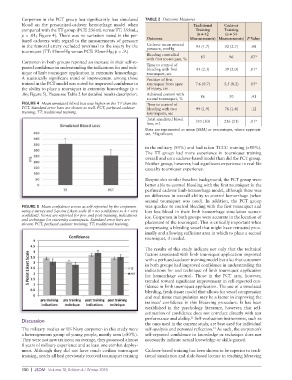
Corpsmen in the PCT group lost significantly less simulated   TABLE 2  Outcome Measures
          blood on the pressurized-cadaver hemorrhage model when                 Traditional   Cadaver
          compared with the TT group (PCT: 256mL versus TT: 355mL;                Training    Training
          p = .01; Figure 4). There was no variation noted in the per-            (n = 42     (n = 54
          fused cadavers with regard to the measurements of pressure   Outcome  Measurements) Measurements) P Value
          in the femoral artery occluded proximal to the injury by the   Cadaver mean arterial   95 (1.7)  92 (2.7)  .98
          tourniquet (TT: 95mmHg versus PCT: 92mmHg; p = .9.)  pressure, mmHg
                                                              Bleeding controlled   83          96      .03*
                                                              with first tourniquet, %
          Corpsmen in both groups reported an increase in their self-re-
          ported confidence in understanding the indications for and tech-  Time to control of   45 (2.3)  39 (2.0)  .01*
                                                              bleeding with first
          nique of limb tourniquet application in extremity hemorrhage.   tourniquet, sec
          A statistically significant trend of improvement among those   Position of first
          trained in the PCT model was noted for improved confidence in   tourniquet from apex   7.6 (0.7)  5.5 (0.2)  .03*
          the ability to place a tourniquet in extremity hemorrhage (p =   of injury, cm
          .06; Figure 5). Please see Table 2 for detailed results description.  Achieved control with
                                                              second tourniquet, %  86          50       .41
          FIGURE 4  Mean simulated blood loss was higher in the TT than the   Time to control of
          PCT. Standard error bars are shown as well. PCT, perfused-cadaver   bleeding with two   99 (1.9)  76 (1.4)  .12
          training; TT, traditional training.                 tourniquets, sec
                                                              Total simulated blood   355 (30)  256 (21)  .01*
                                                              loss, mL
                                                             Data are represented as mean (SEM) or percentages, where appropri-
                                                             ate. *Significant.

                                                             in the military (93%) and had taken TCCC training (>80%).
                                                             The TT group had more experience in tourniquet training
                                                             overall and on a cadaver-based model than did the PCT group.
                                                             Neither group, however, had significant experience in real-life
                                                             casualty tourniquet experience.

                                                             Despite this similar baseline background, the PCT group were
                                                             better able to control bleeding with the first tourniquet in the
                                                             perfused cadaver limb-hemorrhage model, although there was
                                                             no difference in overall ability to control hemorrhage (when
                                                             second tourniquet was used). In addition, the PCT group
          FIGURE 5  Mean confidence scores as self-reported by the corpsmen   was quicker to control bleeding with the first tourniquet and
          using a survey and 5-point Likert scale (0 = no confidence to 4 = very   lost less blood in their limb hemorrhage simulation scenar-
          confident). Scores are reported for pre- and post-training, indications   ios. Corpsmen in both groups were accurate in the location of
          and technique for extremity tourniquets. Standard error bars are   placement of the tourniquet. This is critically important when
          shown. PCT, perfused-cadaver training; TT, traditional training.
                                                             compressing a bleeding vessel that might have retracted prox-
                                                             imally and allowing sufficient area in which to place a second
                                                             tourniquet, if needed.
                                                             The results of this study indicate not only that the technical
                                                             factors associated with limb tourniquet application improved
                                                             with a perfused-cadaver training model but also that corpsmen
                                                             in both groups had improved confidence in understanding the
                                                             indications for and technique of limb tourniquet application
                                                             for hemorrhage control. Those in the PCT arm, however,
                                                             trended toward significant improvement in self-reported con-
                                                             fidence in limb tourniquet application. The use of a simulated
                                                             bleeding, fresh-tissue model that allows for vessel compression
                                                             and real tissue manipulation may be a factor in improving the
                                                             trainees’ confidence in this lifesaving procedure. It has been
                                                             established in the psychology literature, however, that self-
                                                             estimation of confidence does not correlate directly with test
                                                             performance and ability.  Self-evaluation instruments, such as
                                                                                11
          Discussion
                                                             the ones used in the current study, are best used for individual
          The military medics or US Navy corpsmen in this study were   self-analysis and personal reflection.  As such, the corpsmen’s
                                                                                         12
          a heterogeneous group of young people, mostly men (>80%).   self-reported confidence in knowledge or technique does not
          They were not new trainees; on average, they possessed almost   necessarily indicate actual knowledge or skills gained.
          8 years of military experience and at least one combat deploy-
          ment. Although they did not have much civilian tourniquet   Cadaver-based training has been shown to be superior to tradi-
          training, nearly all had previously received tourniquet training   tional simulation and slide-based lecture in teaching lifesaving


          100  |  JSOM   Volume 18, Edition 4 / Winter 2018

