


Page 105 - JSOM Winter 2018
P. 105
The Benefits of Reflexology
                              for the Chronic Pain Patient in a Military Pain Clinic


                                     Connie Kern, NBCR, IMRT; Amy McCoart, RN, BSN*;
                                        Thomas Beltranm, MA; Michael Bartoszek, MD


              ABSTRACT
              Background: Chronic pain is a major cause of disability across   In practice of reflexology, it is believed that there are reflex
              the military, especially for the combat Soldier. More than two-  points that correspond to every gland, organ, muscle, tissue,
              thirds of Americans with chronic pain are now using comple-  and body system. In addition, through mastery and applica-
              mentary medicine. Methods: Patients with chronic pain opting   tion of reflexology techniques, it is thought that the blood and
              for reflexology as part of their treatment plan received bilateral   lymph circulation to these can be influenced toward homeo-
                                                                              4
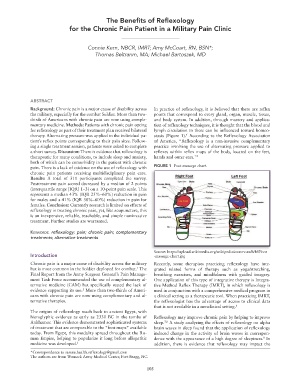
              therapy. Alternating pressure was applied to the individual pa-  stasis (Figure 1).  According to the Reflexology Association
              tient’s reflex points corresponding to their pain sites. Follow-  of America, “Reflexology is a non-invasive complementary
              ing a single treatment session, patients were asked to complete   practice involving the use of alternating pressure applied to
              a short survey. Discussion: There is evidence that reflexology is   reflexes within reflex maps of the body, located on the feet,
              therapeutic for many conditions, to include sleep and anxiety,   hands and outer ears.” 5
              both of which can be comorbidity in the patient with chronic
              pain. There is a lack of evidence on the use of reflexology with   FIGURE 1  Foot massage chart.
              chronic pain patients receiving multidisciplinary pain care.
              Results:  A  total  of  311  participants  completed  the  survey.
              Posttreatment pain scored decreased by a median of 2 points
              (interquartile range [IQR] 1–3) on a 10-point pain scale. This
              represents a median 43% (IQR 25%–60%) reduction in pain
              for males and a 41% (IQR 30%–60%) reduction in pain for
              females. Conclusion: Currently research is limited on effects of
              reflexology in treating chronic pain, yet, like acupuncture, this
              is an inexpensive, reliable, teachable, and simple noninvasive
              treatment. Further studies are warranted.

              Keywords:  reflexology; pain; chronic pain; complementary
              treatments; alternative treatments


                                                                 Source: https://upload.wikimedia.org/wikipedia/commons/b/bf/Foot
              Introduction                                       -massage-chart.jpg
              Chronic pain is a major cause of disability across the military   Recently, some therapists  practicing reflexology have inte -
              but is most common in the Soldier deployed for combat.  The   grated related forms of therapy such as yoga/stretching,
                                                          1
              Final Report from the Army Surgeon General’s Pain Manage-  breath ing exercises, and mindfulness with guided imagery.
              ment Task Force recommended the use of complementary al-  One application of this type of integrative therapy is Integra-
              ternative medicine (CAM) but specifically stated the lack of   tive Method Reflex Therapy (IMRT), in which reflexology is
              evidence supporting its use.  More than two-thirds of Ameri-  used in conjunction with a comprehensive medical program in
                                   2
              cans with chronic pain are now using complementary and al-  a clinical setting as a therapeutic tool. When practicing IMRT,
              ternative therapies.                               the reflexologist has the advantage of access to clinical data
                                                                 that is not available in a nonclinical setting. 6
              The origins of reflexology reach back to ancient Egypt, with
              hieroglyphic evidence as early as 2330 BC in the tombs of   Reflexology may improve chronic pain by helping to improve
              Ankhamor. This evidence demonstrated sophisticated systems   sleep.  A study analyzing the effects of reflexology on alpha
                                                                     7,8
              of treatment that are comparable to the “foot maps” available   brain waves in sleep found that the application of reflexology
              today. From Egypt, this modality spread throughout the Ro-  induced change in the activity of brain waves in correspon-
              man Empire, helping to popularize it long before allopathic   dence with the appearance of a high degree of sleepiness.  In
                                                                                                              8
              medicine was developed. 3                          addition, there is evidence that reflexology  may impact the
              *Correspondence to serene.health.reflexology@gmail.com
              The authors are from Womack Army Medical Center, Fort Bragg, NC.

                                                              103

