


Page 100 - JSOM Winter 2018
P. 100
application of tourniquets when compared  with traditional   Material,  https://www.dickblick.com/,)  with  salt  and  water.
          instructional models alone. A secondary aim of this study was   While nonpulsatile, this method allows tourniquet placement
          to evaluate the confidence of the trainees in their self-reported   without tubing rupture associated with positive displacement
          understanding of the indications for and technical abilities to   pumps.
          apply tourniquets to exsanguinating limb injury after training.
                                                             After the instruction and practice sessions (TT or PCT), each
                                                             corpsman was brought to an unmarked and covered cadaver
          Methods
                                                             (with hospital gown and sheet). Once the gown and sheet
          This study was performed after approval by the Institutional   were removed (to simulate injury and wound exposure) and
          Review Board at the Keck School of Medicine of USC and in   extremity hemorrhage was identified, each of the corpsmen
          accordance with the Keck School of Medicine of USC Fresh   performed tourniquet application on the right and left lower
          Tissue Dissection Laboratory (FTDL) policies. From Janu-  extremity in separate timed events. The time taken to place the
          ary 2016 to November 2016, US Navy corpsmen rotating at   tourniquet(s) and stop the bleeding was recorded. After the
          NTTC were recruited to participate. Fifty-three corpsmen vol-  tourniquet(s) was/were secured, a trauma surgeon blinded to
          unteered for the study. Demographic data were collected and   the teaching method assessed the position of the tourniquet(s).
          included age, sex, experience (years), deployment history, and
          previous tourniquet experience in training and real-life situa-  Correct application and positioning required that the tour-
          tions. Each of the corpsmen was then randomly assigned to   niquet be applied in accordance with TCCC guidelines and
          one of two limb-tourniquet instruction methods: traditional   manufacturer instructions and that the tourniquet be placed at
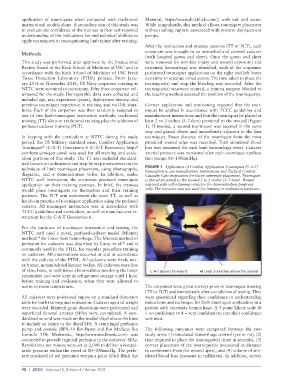
          training (TT) alone or traditional training plus the addition of   least 2 to 3 inches (5–7.6cm) proximal to the wound (Figure
          perfused-cadaver training (PCT).                   1). If needed, a second tourniquet was secured in the same
                                                             way and placed above and immediately adjacent to the first
          In keeping with the curriculum at NTTC during the study   tourniquet.  Exact  distance  of  the  tourniquet  from  the  most
          period, the US Military standard-issue, Combat Application   proximal wound edge was recorded. Total simulated blood
          Tourniquet  (C-A-T) Generation 6 (C-A-T Resources; http://  loss was measured for each limb hemorrhage event. Cadaver
                   ®
          combattourniquet.com/) was used for all training and evalu-  arterial pressure was measured after each tourniquet applica-
          ation portions of this study. The TT arm included standard-  tion (range, 80–100mmHg).
          ized lecture on indications and step-by-step instructions on the
          technique of limb tourniquet placement, using photographs,   FIGURE 1  Application of Combat Application Tourniquet (C-A-T)
          diagrams, and a demonstration video. In addition, under   Generation 6, per manufacturer instructions and Tactical Combat
                                                             Casualty Care instruction for lower extremity placement. Tourniquet
          NTTC staff instruction, the corpsmen practiced tourniquet   is placed proximal to the wound 2 to 3 inches (5–7.6cm). Wound
          application on their training partners. In brief, the trainees   exposed with self-retaining retractor for demonstration purposes
          would place tourniquets on themselves and their training   only. The retractor was not used for training or evaluation purposes.
          partners. The PCT arm underwent the same TT, as well as
          hands-on practice of tourniquet application using the perfused
          cadaver. All tourniquet instruction was in accordance with
          TCCC guidelines and curriculum, as well as manufacturer in-
          struction for the C-A-T Generation 6.

          For the purposes of tourniquet instruction and testing, the
          NTTC staff used a novel, perfused-cadaver model (Minneti
          method)  for lower limb hemorrhage. The Minneti method of
                10
          perfusion for cadavers was described by Carey et al.  and is
                                                   10
          commonly used in the FTDL for vascular procedure training
          on cadavers. All interventions occurred at and in accordance
          with the policies of the FTDL. All cadavers were fresh, nev-
          er-frozen, nonembalmed human bodies. All cadavers were free
          of skin, bone, or soft-tissue abnormalities involving the lower
          extremities and were kept in refrigerated storage until 1 hour
          before training and evaluation, when they were allowed to
          warm to room temperature.                          The corpsmen were given surveys prior to tourniquet training
                                                             (TT or PCT) and immediately after completion of testing. They
          All cadavers were positioned supine on a standard dissection   were questioned regarding their confidence in understanding
          table for both training and evaluation. Cadaver age and weight   indications and technique for limb tourniquet application in a
          were recorded. Bilateral groin dissections were performed and   patient with extremity hemorrhage. A 5-point Likert scale (0
          superficial femoral arteries (SFAs) were cannulated. A stan-  = no confidence to 4 = very confident) to rate their confidence
          dardized wound was made on the medial thigh above the knee   was used.
          to include an injury to the distal SFA. A centrifugal perfusion
          pump and console (BPX-50 Bio-Pump and Bio Medicus Bio   The following outcomes were compared between the two
          Console 550; Medtronic, http://www.medtronic.com) was   study arms: (1) simulated hemorrhage control (yes or no), (2)
          connected to provide regional perfusion in the cadavers’ SFAs.   time required to place the tourniquet(s) (time in seconds), (3)
          Revolutions per minute were set at 2,000 to deliver a nonpul-  correct placement of the tourniquet(s) (measured as distance
          satile pressure within the vessel of 80–100mmHg. The perfu-  in centimeters from the wound apex), and (4) volume of sim-
          sate consisted of red premium tempura paint (Dick Blick Art   ulated blood loss (measure in milliliters). In addition, survey


          98  |  JSOM   Volume 18, Edition 4 / Winter 2018

