


Page 96 - JSOM Winter 2018
P. 96
test allowed us to measure how quickly and accurately each   that the true magnitude of the effect at POST were substan-
          participant could compute a simple mathematical problem.   tially greater or smaller than PRE values and were assessed as
          The four-digit number appeared on the top of the first column   follows: <1%, almost certainly not; 1% to 5%, very unlikely;
          of a three-column sheet of paper. Participants were provided   5% to 25%, unlikely; 25% to 75%, possibly; 75% to 95%,
          the sheet of paper and asked to complete as many calculations   likely; 95% to 99%, very likely; and >99%, almost certainly.
                                                                                                            15
          as possible in 2 minutes. The participant and timer/scorer sat   If there was a >5% chance that the true value was either greater
          opposite each other during testing. The answers to the calcu-  or lesser, the effect was considered mechanistically unclear. In
          lations were written beneath the initial number. Regardless of   other words, the results of PSE supplementation were deemed
          answer provided, participants were then required to subtract   unclear if the values for its confidence interval overlapped
          the number 7 from that new number. Participants were not   multiple thresholds; therefore, the effect could be substantially
          told if their answer was correct. The number of correct an-  positive or negative, but there is a lack of data, large standard
          swers was recorded. Intraclass correlations for this assessment   deviations in the values, or both.  The smallest nontrivial
                                                                                        14
          have been determined in our laboratory to be R > 0.81. 12  change (i.e., the smallest worthwhile change), was set at 20%
                                                             of the grand standard deviation for all PRE values.  Because of
                                                                                                   14
          Executive function and target engagement           the small sample size, the determination of the effect of supple-
          To assess executive function under pressure, participants were   mentation on executive functioning during target acquisition
          required to make a decision to shoot or not to shoot on the   was made using the Fisher exact test.
          basis of target recognition after undergoing a cognitive and
          physical stress. Each participant entered the shooting range   Results
          alone. During each assessment period, the participant was re-
          quired to put together a puzzle that contained the face of a   All participants consumed either PSE or PL, as required, and
          “terrorist.” After completing the puzzle, participants were re-  compliance was 100%. The effect of supplementation on the
          quired to sprint up and down three flights of stairs and return   mean differences  in change  scores in jump power, eye-hand
          to the shooting range. The puzzle was designed to provide an   coordination, and reactive agility are presented in Table 1.
          element of cognitive stress; the stair sprint provided an element   Changes in both peak and mean jump power from PRE to
          of physical stress. Upon re-entering the shooting range, the   POST were unclear, suggesting that changes in jump power
          participant was required to correctly recognize his target from   were similar in participants consuming PSE and those in the
          among 10 possible targets and deliver 10 shots (change of   PL group. In addition, changes in eye-hand coordination (av-
          magazine after five shots) to the head from 10m. The shooting   erage reaction time and the number of hits) and reactive agility
          instructor selected the puzzle randomly and the puzzle used   (average reaction time per light and total time) were unclear
          for the PRE assessment could have been different than that   in participants consuming PSE compared with those in the PL
          used for the POST assessment. Decision-making ability (i.e.,   group. Interestingly, close evaluation of the average reaction
          recognize and engage the correct target) was assessed. In addi-  time per light for reactive agility revealed that all five partic-
          tion, the time required to construct the puzzle, sprint the stair,   ipants in the PSE group had a reduced POST time, whereas
          and engage the target was recorded.                only three of five participants in the PL group experienced a
                                                             similar effect. Although the changes between the groups were
          Statistical Analysis                               unclear, it is interesting to note that the average change was
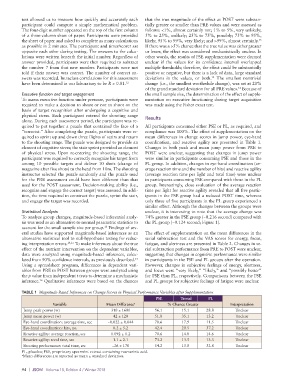
          To analyze group changes, magnitude-based inferential analy-  74% greater in the PSE group (−0.216 second) compared with
          sis was used as an alternative to normal parametric statistics to   the PL group (−0.124 second; Figure 1).
          account for the small sample size per group.  Findings of sev-
                                            13
          eral studies have supported magnitude-based inferences as an   The effect of supplementation on the mean differences in the
          alternative statistical tool to null-hypothesis testing for reduc-  serial subtraction test and the VAS scores for energy, focus,
          ing interpretation errors. 14,15  To make inferences about the true   fatigue, and alertness are presented in Table 2. Changes in se-
          effect of the nutrient intervention on the dependent variables,   rial subtraction performance from PRE to POST were unclear,
          data were analyzed using magnitude-based inferences, calcu-  suggesting that changes in cognitive performance were similar
          lated from 90% confidence intervals, as previously described.    in participants in the PSE and PL groups after the operation.
                                                         14
          Using a spreadsheet program, differences in dependent vari-  However, changes in subjective feelings of energy, alertness,
          ables from PRE to POST between groups were analyzed using   and focus were “very likely,” “likely,” and “possibly better”
          the p value from independent t tests to determine a mechanistic   for PSE than PL, respectively. Comparisons between the PSE
          inference.  Qualitative inferences were based on the chances   and PL groups for subjective feelings of fatigue were unclear.
                 16
          TABLE 1  Magnitude-Based Inferences on Change Scores in Physical Performance Variables after Supplementation
                                                                 PSE        Trivial    PL
                       Variable              Mean Difference a        % Chance Greater          Interpretation
           Jump peak power (w)                 310 ± 1600        56.1       15.1      28.8        Unclear
           Jump mean power (w)                  42 ± 120         51.8       35.1      13.2        Unclear
           Eye-hand coordination: average time, sec  −0.022 ± 0.044  70.6   17.9      11.5        Unclear
           Eye-hand coordination: hits, no.     0.2 ± 5.2        42.4       20.5      37.2        Unclear
           Reactive agility: average reaction, sec  0.092 ± 0.2  70.6       14.8      14.6        Unclear
           Reactive agility: total time, sec    1.1 ± 2.1        73.2       13.5      13.3        Unclear
           Shooting performance: total time, sec  −26 ± 170      54.2       13.0      32.8        Unclear
          PL, placebo; PSE, proprietary spearmint extract containing rosmarinic acid.
          a Mean differences are reported as mean ± standard deviation.


          94  |  JSOM   Volume 18, Edition 4 / Winter 2018

