


Page 94 - JSOM Fall 2018
P. 94
An Ongoing Series
Norovirus
Mark W. Burnett, MD
INTRODUCTION
A dream ocean liner vacation turns into a “ship of stools.”
Soldiers are prevented from traveling home from Kuwait after
dozens develop vomiting and diarrhea. More than a thousand
Olympic Village workers are quarantined after widespread
gastroenteritis develops on the eve of the recent Winter Games
in Korea. Illnesses caused by norovirus have frequently been in
the news. As the most common cause of gastroenteritis in both
the United States and worldwide, with more than 100 million
illnesses and 200,000 deaths annually, it is a topic worthy of
study.
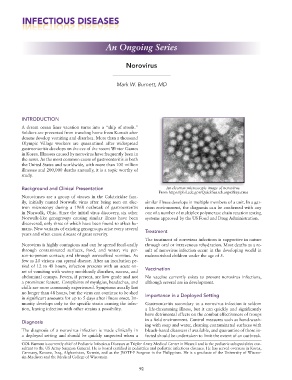
Background and Clinical Presentation An electron microscopic image of norovirus.
From https://phil.cdc.gov/QuickSearch.aspx?key=true
Noroviruses are a group of viruses in the Calciviridae fam
ily, initially named Norwalk virus after being seen on elec similar illness develops in multiple members of a unit. In a gar
tron microscopy during a 1968 outbreak of gastroenteritis rison environment, the diagnosis can be confirmed with any
in Norwalk, Ohio. Since the initial virus discovery, six other one of a number of multiplex polymerase chain reaction testing
Norwalklike genogroups causing similar illness have been systems approved by the US Food and Drug Administration.
discovered, only three of which have been found to affect hu
mans. New variants of existing genogroups arise every several Treatment
years and often cause disease of great severity.
The treatment of norovirus infections is supportive in nature
Norovirus is highly contagious and can be spread fecalorally through oral or intravenous rehydration. Most deaths as a re
through contaminated surfaces, food, and water; via per sult of norovirus infection occur in the developing world in
sontoperson contact; and through aerosolized vomitus. As malnourished children under the age of 5.
few as 20 virions can spread disease. After an incubation pe
riod of 12 to 48 hours, infection presents with an acute on Vaccination
set of vomiting with watery nonbloody diarrhea, nausea, and
abdominal cramps. Fevers, if present, are low grade and not No vaccine currently exists to prevent norovirus infections,
a prominent feature. Complaints of myalgias, headaches, and although several are in development.
chills are more commonly experienced. Symptoms usually last
no longer than 48 hours, but the virus can continue to be shed Importance in a Deployed Setting
in significant amounts for up to 5 days after illness onset. Im
munity develops only to the specific strain causing the infec Gastroenteritis secondary to a norovirus infection is seldom
tion, leaving infection with other strains a possibility. a lifethreatening illness, but it can quickly and significantly
have detrimental effects on the combat effectiveness of troops
Diagnosis in a field environment. Control measures such as handwash
ing with soap and water, cleaning contaminated surfaces with
The diagnosis of a norovirus infection is made clinically in bleachbased cleansers if available, and quarantine of those in
a deployed setting and should be quickly suspected when a fected should be undertaken to limit the extent of an outbreak.
COL Burnett is currently chief of Pediatric Infectious Diseases at Tripler Army Medical Center in Hawaii and is the pediatric subspecialties con
sultant to the US Army Surgeon General. He is board certified in pediatrics and pediatric infectious diseases. He has served overseas in Korea,
Germany, Kosovo, Iraq, Afghanistan, Kuwait, and as the JSOTFP Surgeon in the Philippines. He is a graduate of the University of Wiscon
sinMadison and the Medical College of Wisconsin.
92

