


Page 98 - JSOM Fall 2018
P. 98
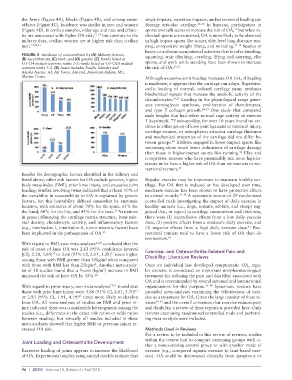
the Army (Figure 4A), blacks (Figure 4B), and among senior single impacts, repetitive impacts, and/or torsional loading can
officers (Figure 4C). Incidence was similar in men and women damage articular cartilage. 25–30 In humans, participation in
(Figure 4D). In civilian samples, older age and race and ethnic sports (overall) seems to increase the risk of OA, but when in
31
ity are associated with higher OA risk, 17–19 but contrary to the dividual sports are examined, OA is more likely to be observed
military data, civilian women are at higher risk than civilian in highimpact sports like soccer, elitelevel longdistance run
men. 17,20,21 ning, competitive weight lifting, and wrestling. 32–34 Studies of
heavy or arduous occupational activities that involve kneeling,
FIGURE 4 Incidence of osteoarthritis by (A) Military Service, squatting, stair climbing, crawling, lifting and carrying, elite
(B) race/ethnicity, (C) rank, and (D) gender. (C) Ranks listed as
O1-O4 include warrent ranks 1-3; ranks listed as O5-O10 include sports, and work while standing have been shown to increase
warrant ranks 3-4. (B) Asian includes Pacific Islander and the risk of OA. 23,35
Alaska Native. AF, Air Force; Am Ind, American Indian; MC,
Marine Corps. Although excessive joint loading increases OA risk, if loading
is moderate, it appears that the cartilage can adapt. Repetitive,
cyclic loading of normal, isolated cartilage tissue produces
biochemical signals that increase the anabolic activity of the
chrondrocytes. 36,37 Loading in the physiological range gener
ates proteoglycan synthesis, proliferation of chondrocytes,
and type II collagen growth. 36–39 One study that compared
male beagles that had either normal cage activity or exercise
5 days/week, 75 minutes/day, for over 10 years found no evi
dence in either group of knee joint ligament or meniscal injury,
cartilage erosion, or osteophytes; articular cartilage thickness
and mechanical properties of the cartilage did not differ be
tween groups. Athletes engaged in lowerimpact sports like
40
swimming show much lower indications of cartilage damage
than those in higherimpact sports like running. Elite and
41
competitive runners who have presumably run more highin
tensity miles have a higher risk of OA than nonrunners or rec
reational runners. 34
Besides the demographic factors identified in the military and
listed above, other risk factors for OA include genetics, higher Regular exercise may be important to maintain healthy car
body mass index (BMI), prior knee injury, and excessive joint tilage. For OA that is induced or has developed over time,
loading. Studies involving twins indicated that at least 50% of moderate exercise has been shown to have protective effects
the variability in susceptibility to OA is explained by genetic in animal models. 42–44 A systematic review of 29 randomized
factors, but this heritability differed somewhat by anatomic controlled trials investigating the impact of daily exercise in
location, with estimates of about 70% for the spine, 65% for healthy animals (i.e., dogs, rodents, rabbits, and sheep) sug
the hand, 60% for the hip, and 45% for the knee. Variations gested that, in regard to cartilage composition and thickness,
22
in genes influencing the cartilage matrix structure, bone min there were (1) inconclusive effects from a low daily exercise
eral density, chondrocyte activity, and inflammatory factors dose, (2) positive effects from a moderate daily exercise, and
(e.g., interleukin1, interleukin6, tumor necrotic factor) have (3) negative effects from a high daily exercise dose. Rec
45
been implicated in the pathogenesis of OA. 23 reational runners tend to have a lower risk of OA than do
nonrunners. 34
With regard to BMI, two metaanalyses 17,21 concluded that the
risk of onset of knee OA was 2.63 (95% confidence interval Exercise- and Osteoarthritis-Related Pain and
[CI], 2.28, 3.05) or 2.66 (95% CI, 2.15, 3.28) times higher Disability: Literature Reviews
17
21
among those with BMI greater than 30kg/m when compared
2
with those with BMI less than 25kg/m . Another metaanaly Once an individual has developed symptomatic OA, regu
2
sis of 18 studies found that a 5unit (kg/m ) increase in BMI lar exercise is considered an important nonpharmacological
2
increased the risk of knee OA by 35%. 24 treatment for reducing the pain and disability associated with
OA and is recommended by several national and international
With regard to prior injury, two metaanalyses 17,21 found that organizations for this purpose. 46–48 Systematic reviews have
those with prior knee injury were 3.86 (95% CI, 2.61, 5.70) provided metaanalyses examining the effectiveness of exer
17
or 2.83 (95% CI, 1.91, 4.19) times more likely to develop cise as a treatment for OA. Given the large number of these re
21
knee OA. All metaanalyses of studies on BMI and prior in views 49–64 and the overall consensus that exercise reduces pain
jury indicated there was considerable heterogeneity among the and disability, a review of these reports is provided here. Only
studies (i.e., differences in the exact risk ratios or odds ratios reviews examining randomized controlled trials and perform
between studies), but virtually all studies included in these ing metaanalysis were included.
metaanalyses showed that higher BMI or previous injury in
creased OA risk. Methods Used in Reviews
For a review to be included in this review of reviews, studies
within the review had to compare exercising groups with ei
Joint Loading and Osteoarthritis Development
ther a nonexercising control group or with another mode of
Excessive loading of joints appears to increase the likelihood exercise (e.g., compared aquatic exercise to landbased exer
of OA. Experimental studies using animal models indicate that cise). OA could be determined clinically from symptoms or
96 | JSOM Volume 18, Edition 3 / Fall 2018

