


Page 91 - JSOM Fall 2018
P. 91
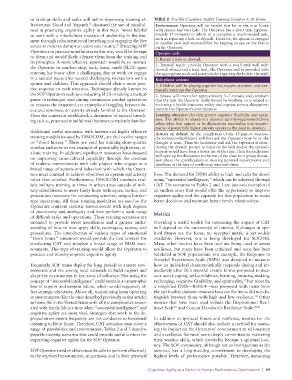
to familiar skills and tasks will aid in improving training ef TABLE 2 Possible Cognitive Agility Training Scenario 1: At Home
fectiveness. Good and Yeganeh discussed the use of mindful Environment: Operator will be briefed that he or she is at home
13
ness in practicing cognitive agility in this way: “most helpful with spouse and two kids. The Operator has a short time (approx
to start with a mindfulness practice of anchoring in the mo imately 15 minutes) in which to a complete a muchneeded task,
ment through calm intentional breathing and engaging the five such as repairing a hole in drywall. However, the spouse is engaged
senses in order to disrupt an automatic routine.” Directing SOF in another task and responsibility for keeping an eye on the kids is
on the Operator.
Operators to practice mindfulness in this way would be foreign Operator task:
to them and would likely alienate them from the training and
its principles. A more effective approach would be to instruct 1. Repair a hole in drywall.
the Operator to conduct stop, look, listen, smell (SLLS) upon 2. Drywall repair: provide Operator with a small stud wall with
drywall affixed and a large hole. The Operator will be provided with
entering his house after a challenging day at work or engage the appropriate tools and materials for repairing the hole in the wall.
in a tactical pause after several challenging interactions with a Role player actions:
spouse and children. This approach should elicit a more posi 1. Children will be playing together but require attention and con
tive response to each situation. Techniques already known to tinually interrupt the Operator.
the SOF Operators such as conducting SLLS or taking a tactical 2. Spouse will enter after approximately 5–7 minutes and complain
pause (a technique used during continuous combat operations that the task the Operator really should be working on is related to
to reassess the situation) are examples of toggling between fo reviewing a health insurance policy and express serious disappoint
cus and openness, an activity already familiar to the Operator. ment in the Operator’s prioritization.
Once the context is established, a discussion of tactical breath Learning objective: Develop greater cognitive flexibility and open
ing (a.k.a., practiced mindfulness) becomes completely familiar. ness. The ability to abandon a planned activity/requirement/chore
when what first appear to be distractions materialize into require
ments of potentially higher priority speaks to the need to develop.
Additional useful scenarios, with known and highly effective
training modalities used by USSOCOM, are the livefire ranges Actions on debrief: At the completion of the 15minute window,
the instructor/facilitators will first ask the Operator how he or she
or “shoot houses.” These are used for training closequarter thought it went. Then the facilitator will ask the Operator if aban
combat and serve as one example of potentially high stress, re doning the drywall project to focus on the kids and/or the spouse’s
alistic training. In addition, significant resources have focused request would have been a better use of the time. Then the facilitator
on improving crosscultural capability through the creation will open up the discussion to the rest of the class for a group discus
sion about the complications of meeting personal requirements and
of realistic environments with role players who engage in a deadlines in the face of conflicting responsibilities.
broad range of actions and behaviors with which the Opera
tors must contend to achieve objectives in operational activity lives. The demand for DDM ability is high and calls for devel
other than combat. Furthermore, USSOCOM conducts real oping “successful intelligence,” which can be achieved through
istic military training at times in urban areas outside of mili CAT. The scenarios in Tables 2 and 3 are just two examples of
tary installations to more finely hone techniques, tactics, and an endless array that would offer the opportunity to improve
procedures necessary for conducting sensitive, surgical strike– cognitive agility and the capacity for this population to make
type operations. All these training modalities are used so the better decisions and maintain better family relationships.
Operators confront realistic environments with high degrees
of uncertainty and ambiguity and then perform a wide range Metrics
of difficult tasks and operations. These training scenarios are
intended to provide stress inoculation and a greater under Providing a useful toolkit for measuring the impact of CAT
standing of how to best apply skills, techniques, tactics, and will depend on the outcome(s) of interest. If changes in spir
procedures. The introduction of various types of emotional itual fitness are the focus, no accepted metric is yet widely
“shoot house” situations would provide the best context for available. However, one is being developed for SOCOM.
conducting CAT and simulate a broad range of DDM envi Many other metrics have been and are being used to assess
ronments. This type of training would allow the Operator to resilience, but many have been criticized and none has been
practice and thereby improve cognitive agility. validated in SOF populations. For example, the Response to
Stressful Experiences Scale (RSES) was designed to measure
Frequently, SOF teams deploy for long periods in austere envi how an individual characteristically responds during and im
ronments and live among local nationals to build rapport and mediately after life’s stressful events. It was proposed to mea
shape the environment in key areas of influence. Not using the sure active coping, selfconfidence, learning, meaningmaking,
concept of “successful intelligence” could result in a catastrophic recharging, cognitive flexibility, and spirituality, but recently,
17
loss of rapport and mission failure, which would negatively af a simplified RSES—RSES4—was proposed with items from
fect strategic objectives. Above all, transitioning from operating the spirituality domain removed because the items did not dis
in environments (like the ones described previously in this article) tinguish between those with high and low resilience. Other
18
to home life in the United States with all the complexities associ metrics that have been used include the Dispositional Resil
ated with family life is a time when “successful intelligence” and ience Scale and Connor Davidson’s Resilience Scale. 20,21
19
cognitive agility are most vital. Strategies that work in the de
ployed environment frequently are not conducive to functional In addition to spiritual fitness and resilience, metrics for the
orienting to life at home. Therefore, CAT scenarios must cover a effectiveness of CAT should also include a method for assess
range of possibilities and environments. Tables 2 and 3 describe ing the impact on the Operators’ commitment to selfmastery
possible training scenarios that could provide useful context for and excellence. Samurai were deeply committed to mastering
improving cognitive agility for the SOF Operator. their warrior skills, which inevitably became a spiritual jour
ney. The SOF community, although not as homogenous as the
SOF Operators and enablers must be able to perform effectively samurai, has a longstanding commitment to developing the
in the deployed environment, in garrison, and in their personal highest levels of performance possible. Therefore, measuring
Cognitive Agility as a Factor in Human Performance Optimization | 89

