


Page 92 - JSOM Fall 2018
P. 92
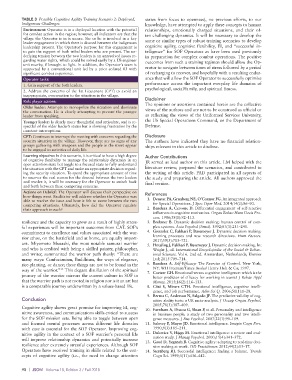
TABLE 3 Possible Cognitive Agility Training Scenario 2: Deployed, states from focus to openness), no previous efforts, to our
Indigenous Challenges knowledge, have attempted to apply these concepts to human
Environment: Operator is in a deployed location with the potential relationships, emotionally charged situations, and their of
for combat action in the region; however, all indicators are that the ten challenging dynamics. It will be necessary to develop the
village the Operator is in is secure. She or he is involved in a key same or similar types of robust training scenarios to develop
leader engagement in which there is discord between the indigenous
leadership present. The Operator’s purpose for this engagement is cognitive agility, cognitive flexibility, EI, and “successful in
to gain the support of both tribal leaders who are present. The un telligence” for SOF Operators as have been used previously
derlying tension between the two leaders is an unresolved issues re in preparation for complex combat operations. The positive
garding water rights, which could be solved easily by a US engineer outcomes from such a training regimen should allow the Op
unit nearby, if brought to light. In addition, the Operator’s team is
supported by a conventional unit led by a prior enlisted 03 with erator to navigate between times of stress followed by a period
significant combat experience. of recharging to recover, and hopefully with a resulting endur
Operator tasks: ance that will allow the SOF Operator to successfully optimize
1. Gain support of the both leaders. performance across the important everyday life domains of
2. Address the concerns of the 1st Lieutenant (CPT) to avoid an psychological, social/family, and spiritual fitness.
inappropriate, overreaction to the situation in the village.
Role player actions: Disclaimer
The opinions or assertions contained herein are the collective
Older leader: Attempts to monopolize the situation and dominate views of the authors and are not to be construed as official or
the conversation. He is clearly attempting to prevent the younger
leader from speaking. as reflecting the views of the Uniformed Services University,
Younger leader: Is clearly more thoughtful and articulate, and is re the US Special Operations Command, or the Department of
spectful of the older leader’s status but is showing frustration by the Defense.
constant interruptions.
CPT: Continues to interrupt the meeting with concerns regarding the Disclosure
security situation in the village. However, there are no signs of any The authors have indicated they have no financial relation
groups gathering with weapons and the people in the street appear ships relevant to this article to disclose.
to be engaged in activities of daily life.
Learning objective: In this scenario, it is critical to have a high degree Author Contributions
of cognitive flexibility to manage the relationship dynamics in an JR served as lead author on this article. LM helped with the
open attention state but toggle to a focused state to fully understand
the situation with the CPT and make an appropriate decision regard literature review, prepared the scenarios, and contributed to
ing the security situation. To spend the appropriate amount of time the writing of this article. PAD participated in all aspects of
to uncover the real reason for the discord between the two leaders the study and preparing the article. All authors approved the
and resolve it, it will be necessary for the Operator to switch back final version.
and forth between these competing concerns.
Actions on Debrief: The Operator will discuss their perspective on References
how things went. Facilitator will address whether the Operator was
able to resolve the issue and how it felt to move between the two 1. Deuster PA, Grunberg NE, O’Connor FG. An integrated approach
competing situations. Ultimately, how did the Operator regulate for Special Operations. J Spec Oper Med. 2014;14(2):86–90.
their approach to each? 2. Bandura A, Cervone D. Differential engagement of selfreactive
influences in cognitive motivation. Organ Behav Hum Decis Pro-
cess. 1986;38(1):92–113.
resilience and the capacity to grow as a result of highly stress 3. Brehmer B. Dynamic decision making: human control of com
ful experiences will be important outcomes from CAT. SOF’s plex systems. Acta Psychol (Amst). 1992;81(3):211–241.
commitment to excellence and values associated with the war 4. Gonzalez C, Fakhari P, Busemeyer J. Dynamic decision making:
rior ethos, on the battlefield and at home, are equally import learning processes and new research directions. Hum Factors.
2017;59(5):713–721.
ant. Miyomoto Musashi, the most notable samurai warrior 5. Hotaling J, Fakhari P, Busemeyer J. Dynamic decision making. In:
and who is credited with being a skilled painter, philosopher, Wright J, ed. International Encyclopedia of the Social & Behav-
and writer, summarized the warrior path thusly: “There are ioral Sciences. Vol 6. 2nd ed. Amsterdam, Netherlands; Elsevier
many ways: Confucianism, Buddhism, the ways of elegance, Ltd; 2015:709–714.
riceplanting, or dance; these things are not to be found in the 6. Bandura A. Self-Efficacy: The Exercise of Control. New York,
way of the warrior.” This elegant distillation of the spiritual NY: WH Freeman/Times Books/ Henry Holt & Co; 1997.
22
journey of the warrior mirrors the current culture in SOF in 7. Coetzer GH. Emotional versus cognitive intelligence: which is the
better predictor of efficacy for working in teams? J Behav Appl
that the warrior path is not rooted in religion nor is it an art but Manag. 2015;16(2):116–133.
is a comparable journey underwritten by a valuesbased life. 8. Côté S, Miners CTH. Emotional intelligence, cognitive intelli
gence, and job performance. Adm Sci Q. 2006;51(1):1–28.
9. Bertua C, Anderson N, Salgado JF. The predictive validity of cog
Conclusion nitive ability tests: a UK metaanalysis. J Occup Organ Psychol.
2005;78(3):387–409.
Cognitive agility shows great promise for improving EI, cog 10. Furnham A, Dissou G, Sloan P, et al. Personality and intelligence
nitive awareness, and communications skills critical to success in business people: a study of two personality and two intelli
for the SOF mission sets. Being able to toggle between open gence measures. J Bus Psychol. 2007;22(1):99–109.
and focused mental processes across different life domains 11. Salovey P, Mayer JD. Emotional intelligence. Imagin Cogn Pers.
with ease is essential for the SOF Operator. Improving cog 1990;9(3):185–211.
nitive agility in the context of a SOF warrior’s personal life 12. Dulewicz V, Higgs M. Emotional intelligence: a review and eval
uation study. J Manag Psychol. 2000;15(4):341–372.
will improve relationship dynamics and potentially increase 13. Good D, Yeganeh B. Cognitive agility: adapting to realtime deci
resilience after extremely stressful experiences. Although SOF sion making at work. OD Practitioner. 2012;44(2):13–17.
Operators have received training in skills related to the con 14. Sternberg RJ. Successful intelligence: finding a balance. Trends
cepts of cognitive agility (i.e., the need to change attention Cogn Sci. 1999;3(11):436–442.
90 | JSOM Volume 18, Edition 3 / Fall 2018

