


Page 67 - JSOM Summer 2018
P. 67
aboard an M3SC. Motion sickness (also known as seasickness,   simulation part (Simulaids, https://www.simulaids.com/). For
              kinetosis, or vestibular motion sickness) is a common physi-  the abdominal procedure, the manikin’s liver was connected to
              ological phenomenon that can occur in healthy personnel in   an electric blood pump to provide a constant blood pressure
              response to physical, visual, or virtual motion stimuli.  This   and flow for damage control and blood loss measurement.
                                                        3,4
              complex syndrome can elicit signs and symptoms including   STOPS developed a left-leg attachment with a faux femur in-
              nausea, vomiting, cold sweating, pallor, increases in salivation,   sert to surgically stabilize the displaced transverse fracture of
              drowsiness, headache, and even severe pain.  In some cases of   shaft of femur and developed an artificial right-leg attachment
                                                5
              severe motion sickness, many aspects of manual performance   for the partial traumatic amputation of the lower leg to simu-
              and cognitive tasks are substantially impaired. 6  late these injuries (Figure 1).

              Research done by the Office of Naval Research, Warfighter
              Protection and Applications Division, showed that Naval sur-
              geons and duty corpsmen could execute simple medical pro-
              cedures (including open-wound suture and intravenous access
              insertion) under mild-to-moderate sea motion conditions with-
              out significant errors in performance. To investigate the effects
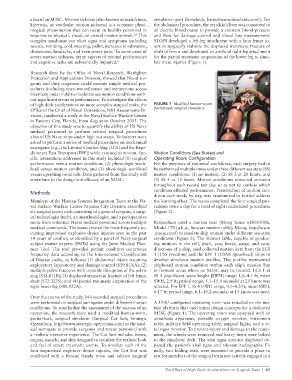
              of high deck accelerations on more complex surgical tasks, the   FIGURE 1  Modified human-worn
              Office of the Chief of Naval Operations, N81 Assessments Di-  partial-task surgical simulator.
              vision, conducted a study at the Naval Surface Warfare Center
              in Panama City, Florida, from August to October 2015. The
              objective of this study was to quantify the ability of US Navy
              medical personnel to perform critical surgical procedures
              aboard US Navy ships under high sea states. Volunteers were
              asked to perform a series of medical procedures on mechanical
              surrogates (e.g., the Littoral Combat Ship [LCS] and the Expe-
              ditionary Fast Transport [EPF]) while exposed to motion. Spe-  Motion Conditions (Sea States) and
              cific interactions addressed in this study included (1) surgical   Operating Room Configuration
              performance versus motion condition, (2) physiologic work-  For the purposes of statistical confidence, each surgery had to
              load versus motion condition, and (3) physiologic workload   be performed multiple times under three different sea state (SS)
              versus operating room role. Data gathered from this study will   motion conditions: (1) no motion, (2) SS 3 at 20 knots, and
              contribute to the design and efficacy of an M3SC.  (3) SS 4 at 15 knots. Motion conditions remained constant
                                                                 throughout each record test day so as not to confuse which
                                                                 condition affected performance. Presentation of motion con-
              Methods
                                                                 dition each week, by day, was randomized to further address
              Members of the Human Systems Integration Team at the Na-  the learning effect. The teams completed the four surgical pro-
              val Surface Warfare Center Panama City Division assembled   cedures twice a day for a total of eight randomized procedures
              six surgical teams each consisting of a general surgeon, a surgi-  (Figure 2).
              cal technologist (tech), an anesthesiologist, and a perioperative
              nurse from volunteer Naval medical personnel across multiple   Researchers used a motion base (Moog Series 6DOF500E,
              medical commands. The teams treated the most frequently oc-  Model 170 [a.k.a., Stewart motion table]; Moog, http://www
              curring improvised explosive device injuries seen in the past   .moog.com/) to emulate ship motion under different sea-state
              10 years of conflict, as identified by a panel of Navy surgical   conditions (Figure 3). The Stewart table, capable of produc-
              subject matter experts (SMEs) using the Joint Medical Plan-  ing motions in the roll, pitch, yaw, heave, surge, and sway
              ners Tool. The tool provided patient condition occurrence   directions of a ship, used collected motion data from the LCS
              frequency data according to the International Classification   1 (USS Freedom) and the EPF 1 (USNS Spearhead) ships to
              of Disease codes, as follows: (1) abdominal injury requiring   develop simulator motion profiles. The profiles represented
              exploratory laparotomy and damage control (S39.81XA); (2)   shipboard motion condition within each ship’s mission bay
              multiple pelvic fractures with unstable disruption of the pelvic   in forward areas where an M3SC may be located. LCS 1 at
              ring (S32.811B); (3) displaced transverse fracture of left femur   SS 3 (significant wave height [SWH] range: 1.6–4.1 ft; mean
              shaft (S72.322S); and (4) partial traumatic amputation of the   SWH, 2.9 ft; period range, 5.1–15.4 seconds) at 20 knots was
              right lower leg (S88.922A).                        selected. For EPF 1, SS 4 (SWH range, 4.1–8.2-ft; mean SWH,
                                                                 6.17 ft; period range, 6.1–16.2 seconds) at 15 knots was used.
              Over the course of the study, 144 recorded surgical procedures
              were performed on surgical surrogates under different motion   A 10-ft  configured operating room was installed on the mo-
                                                                      2
              conditions. To standardize the assessment of the success of an   tion platform that used initial design concepts for a dedicated
              operation,  the research  team  used  a modified  human-worn,   M3SC (Figure 4). The operating room was equipped with an
              partial-task, surgical simulator (Surgical Cut Suit; Strategic   anesthesia apparatus, portable oxygen monitor, instrument
              Operations, http://www.strategic-operations.com) as the med-  table, military field operating table, surgical lights, and a vi-
              ical surrogate to provide surgeons and rescue personnel with   tal signs monitor. To prevent injury and damage to the equip-
              a realistic operative experience. The Cut Suit includes bones,   ment, the wheels were removed and heavy items were bolted
              organs, muscle, and skin designed to simulate the realistic look   to the simulator deck. The vital signs monitor displayed de-
              and feel of severe traumatic events. To simulate each of the   picted the patient’s vital signs and relevant radiographs. Fi-
              four improvised explosive device injuries, the Cut Suit was   nally, two folding seats were mounted to provide a place to
              combined with a Rescue  Randy torso and add-on surgical   rest for members of the surgical team not actively engaged in a

                                                                     The Effect of High Deck Accelerations on Surgical Tasks  |  65

