


Page 63 - JSOM Summer 2018
P. 63
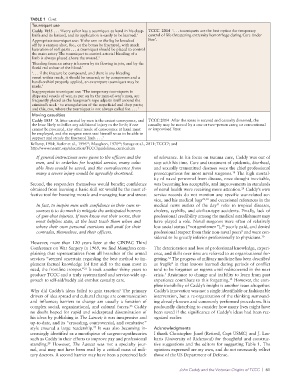
TABLE 1  Cont.
              Tourniquet use
              Caddy 1855 . . . ‘Every sailor has a tourniquet at hand in his clasp-  TCCC  2014  ‘. . . tourniquets are the best option for temporary
              knife and its laniard, and its application is easily to be learned.’  control of life-threatening extremity hemorrhage during Care Under
              Appropriate tourniquet use: ‘If the arm or the leg be knocked   Fire’.
              off by a cannon-shot, &c., or the bones be fractured, with much
              laceration of soft parts . . . a tourniquet should be placed to control
              the main artery The tourniquet to control arterial bleeding of a
              limb is always placed above the wound.’
              ‘Bleeding from an artery is known by its flowing in jets, and by the
              florid red colour of the blood.’
              ‘. . . if the fracture be compound, and there is any bleeding
              vessel within reach, it should be secured; or by compresses and a
              handkerchief properly applied, an extempore tourniquet may be
              made.’
              Inappropriate tourniquet use: ‘The temporary tourniquets in
              ships and vessels of war, as put on by the man-of-war’s man, are
              frequently placed as the hangman’s rope adjusts itself around the
              criminal’s neck - to strangulation of the superficial and deep parts;
              and this, too, where the tourniquet is not always called for. . . . ’
              Moving casualties
              Caddy 1855  ‘A litter carried by men is the easiest conveyance, and  TCCC 2014  After the scene is secured and casualty disarmed, the
              the least likely to inflict any additional injury to the limb; if one   casualty may be moved by a one or two–person carry, or conventional
              cannot be procured, any other mode of conveyance at hand must   or improvised litter.
              be employed, and the surgeon must seat himself so as to be able to
              support and steady the fractured limb. . . .’
              Bellamy, 1984; Butler et al., 1996 ; Maughon, 1970 ; Savage et al., 2011; TCCC ; and
                                                                      2
                                                  22
                                     33
              http://www.naemt.org/education/TCCC/guidelines_curriculum
                If general instructions were given to the officers and the   of relevance. In his focus on trauma care, Caddy was out of
                men, and to orderlies for hospital service, many valu-  step with his time. Care and treatment of epidemic, diarrheal,
                able lives would be saved, and the convalescence from   and sexually transmitted diseases were the chief professional
                many a severe injury would be agreeably shortened.  preoccupations for most naval surgeons.  The high mortal-
                                                                                                 10
                                                                 ity of naval personnel from disease, once thought inevitable,
              Second, the responders themselves would benefit; confidence   was becoming less acceptable, and improvements in standards
              obtained from learning a basic skill set would be the most ef-  of naval health were receiving more attention.  Caddy’s own
                                                                                                     28
              fective tool for boosting morale and managing fear and stress:  service records do not mention any specific war-related ser-
                                                                 vice, and his medical logs 29,30  and occasional references in the
                                                                                          31
                In fact, to inspire men with confidence in their own re-  medical news outlets of the day  refer to tropical diseases,
                sources is to do much to mitigate the anticipated horrors   cholera, syphilis, and civilian-type accidents. Finally, lack of
                of gun-shot injuries. If men know not their worst, their   professional credibility among the medical establishment may
                most helpless state, at the least teach them when and   have played a role. Naval surgeons were often of relatively
                                                                                             10
                where their own personal exertions will avail for their   low social status (“not gentlemen”),  poorly paid, and denied
                comrades, themselves, and their officers.        professional respect from their non-naval peers  and were con-
                                                                                                     9
                                                                 sidered to be greatly inferior professionally to physicians. 10
              However, more than 120 years later at the CINPAC Third
              Conference on War Surgery in 1969, we find Maughon com-  The deterioration and loss of professional knowledge, experi-
              plaining that representatives from all branches of the armed   ence, and skills over time are referred to as organizational for-
              services “seemed uncertain regarding the best method to im-  getting.  The progress of military medicine has been described
                                                                      32
              plement factual knowledge [of first aid] to the man most in   as fragile  in that lessons learned during periods of conflict
                                                                        8
              need, the frontline trooper.”  It took another thirty years to   tend to be forgotten or regress until rediscovered in the next
                                    25
              produce TCCC and a truly systematized and service-wide ap-  crisis.  Resistance to change and inability to learn from past
                                                                     1
              proach to self-aid/buddy aid combat casualty care.  experience contribute to this forgetting.  However, the com-
                                                                                                32
                                                                 plete invisibility of Caddy’s insight is another issue altogether.
              Why did Caddy’s ideas failed to gain traction? The primary   Caddy’s innovation was not a single identifiable or fashionable
              drivers of idea spread and cultural change are communication   intervention, but a re-organization of the thinking surround-
              and influence; barriers to change are usually a function of   ing already-known and commonly performed procedures. It is
              complex social, organizational, and cultural forces.  Caddy   profoundly disturbing to consider how many lives might have
                                                       26
              no doubt hoped for rapid and widespread dissemination  of   been saved if the significance of Caddy’s ideas had been rec-
              his ideas by publishing in The Lancet; it was inexpensive and   ognized earlier.
              up-to-date, and its “crusading, controversial, and combative”
              style ensured a large readership.  It was also becoming in-  Acknowledgments
                                        27
              creasingly identified as a mouthpiece of surgeon-apothecaries   I thank Christopher Josef (Retired, Capt USMC) and J. Las-
              such as Caddy in their efforts to improve pay and professional   karis (University of Richmond) for thoughtful and construc-
              standing.  However,  The Lancet  was not a specialty jour-  tive suggestions and the editors for suggesting Table 1. The
                     28
              nal, and may not have been read by a critical mass of mili-  opinions expressed are my own, and do not necessarily reflect
              tary doctors. A second barrier may have been a perceived lack   those of the US Department of Defense.
                                                                           John Caddy and the Victorian Origins of TCCC  |  61

