


Page 103 - JSOM Summer 2018
P. 103
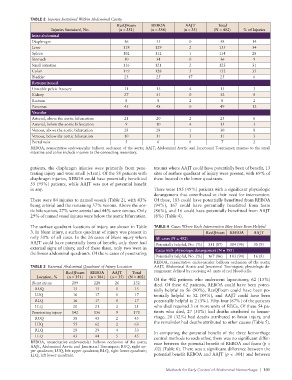
TABLE 2  Injuries Sustained Within Abdominal Cavity
                                                 ResQFoam       REBOA         AAJT         Total
                      Injuries Sustained, No.     (n = 351)    (n = 384)     (n = 35)    (N = 402)    % of Injuries
              Intra-abdominal
              Diaphragm                             36            55           0            58           14
              Liver                                 118          129           2            135          34
              Spleen                                102          112           1            114          28
              Stomach                               30            34           0            36            9
              Small intestine                       116          121           2            123          31
              Colon                                 119          128           5            132          33
              Bladder                               23            25           17           25            6
              Retroperitoneal
              Unstable pelvic fracture              11            13           4            13            3
              Kidney                                27            31           0            32            8
              Rectum                                 8            8            2            8             2
              Pancreas                              45            48           0            49           12
              Vascular
              Arterial, above the aortic bifurcation  21          20           2            23            6
              Arterial, below the aortic bifurcation  9           10           4            13            3
              Venous, above the aortic bifurcation  28            28           1            30            8
              Venous, below the aortic bifurcation  10            11           3            11            3
              Portal vein                            5            6            0            7             2
              REBOA, resuscitative endovascular balloon occlusion of the aorta; AAJT, Abdominal Aortic and Junctional Tourniquet; injuries to the small
              intestine and colon include injuries to the connecting mesentery.

              patients, the diaphragm injuries were primarily from pene-  trauma where AAJT could have potentially been of benefit, 13
              trating injury and were small (<1cm). Of the 58 patients with   sites of surface quadrant of injury were present, with 69% of
              diaphragm injuries, REBOA could have potentially benefitted   these located in the lower quadrants.
              55 (95%) patients, while AAJT was not of potential benefit
              in any.                                            There were 195 (49%) patients with a significant physiologic
                                                                 derangement that contributed to their need for intervention.
              There were 84 injuries to named vessels (Table 2), with 43%   Of these, 183 could have potentially benefitted from REBOA
              being arterial and the remaining 57% venous. Above the aor-  (94%), 167 could have potentially benefitted from foam
              tic bifurcation, 27% were arterial and 44% were venous. Only   (86%), and 16 could have potentially benefitted from AAJT
              29% of named vessel injures were below the aortic bifurcation.  (8%) (Table 4).

              The surface quadrant locations of injury are shown in Table   TABLE 4  Cases Where Each Intervention May Have Been Helpful
              3. In blunt injury, a surface quadrant of injury was present in         ResQFoam  REBOA     AAJT
              only 30% of all cases. In the 26 cases of blunt injury where   All cases (N = 402)
              AAJT could have potentially been of benefit, only three had   Potentially helpful, No. (%)  351 (87)  384 (96)  35 (9)
              external signs of injury, and of these three, only two were in
              the lower abdominal quadrants. Of the ie cases of penetrating   Cases with physiologic derangement (N = 195)
                                                                 Potentially helpful, No. (%)  167 (86)  183 (94)  16 (8)
                                                                 REBOA, resuscitative endovascular balloon occlusion of the aorta;
              TABLE 3  External Abdominal Quadrant of Injury Location  AAJT, Abdominal Aortic and Junctional Tourniquet; physiologic de-
                            ResQFoam    REBOA  AAJT     Total    rangement defined by receiving ≥3 units of red blood cells.
                Location, %  (n = 351)  (n = 384)  (n = 35)  (N = 402)  Of the  402 patients  who underwent  laparotomy, 62 (15%)
              Blunt injury     209      228     26      232      died. Of these 62 patients, REBOA could have been poten-
               RUQ             15       15       1       15      tially helpful to 56 (90%), ResQFoam could have been po-
               LUQ             16       17       0       17      tentially helpful to 52 (84%), and AAJT could have been
               RLQ             16       17       0       17      potentially helpful in 2 (3%). Fifty-four (87%) of the patients
               LLQ             20       21       2       21      who died required 3 or more units of RBCs. Of these 54 pa-
              Penetrating injury  142   156      9      170      tients who died, 27 (50%) had deaths attributed to hemor-
               RUQ             38       43       2       45      rhage, 20 (32%) had deaths attributed to brain injury, and
               LUQ             55       62       2       63      the remainder had deaths attributed to other causes (Table 5).
               RLQ             28       29       4       33      In comparing the potential benefit of the three hemorrhage
               LLQ             43       44       5       45      control methods to each other, there was no significant differ-
              REBOA, resuscitative endovascular balloon occlusion of the aorta;   ence between the potential benefit of REBOA and foam (p =
              AAJT, Abdominal Aortic and Junctional Tourniquet; RUQ, right up-  .02) (Table 6). There was a significant difference between the
              per quadrant; LUQ, left upper quadrant; RLQ, right lower quadrant;
              LLQ, left lower quadrant.                          potential benefit REBOA and AAJT (p < .001) and between

                                                                     Methods for Early Control of Abdominal Hemorrhage  |  101

