


Page 108 - JSOM Summer 2018
P. 108
pathogenic microorganisms.  Repetitive self-inflicted trauma   Initially, the exudate is a clear (serous) discharge; over time,
                                1,4
          (i.e., licking, chewing, scratching) damages the skin barrier   it becomes suppurative and may dry and crust on the surface.
          and erodes the superficial dermal surface, creating a favorable   Often, the hair appears matted (i.e., glued together from the
          environment for bacterial colonization for commensal and   exudate) around and over the open wound.  Because this is not
                                                                                              5
          noncommensal microbial organisms. Over time, bacterial colo-  folliculitis or furunculosis, lesions are not usually surrounded
          nization causes a secondary bacterial infection.  The secondary   by pustules; however, small papules (satellite lesions) may be
                                              1
          bacterial infection, which is intensely pruritic, further perpetu-  present surrounding the lesion.  They appear primarily around
                                                                                    2,5
          ates the cycle of itch, scratch, and self-mutilation.  the lateral aspect of the head, periaural region (i.e., around the
                                                             ears), caudal dorsal trunk, extremities, perianal region, and tail
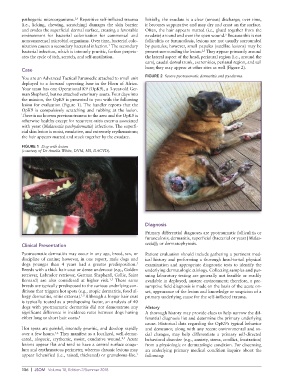
                                                             base; they may appear at other sites as well (Figure 2).
          Case
          You are an Advanced Tactical Paramedic attached to small unit   FIGURE 2  Severe pyotraumatic dermatitis and pyoderma.
          deployed to a forward operating base in the Horn of Africa.
          Your team has one Operational K9 (OpK9), a 3-year-old Ger-
          man Shepherd, but no attached veterinary assets. Four days into
          the mission, the OpK9 is presented to you with the following
          lesion for evaluation (Figure 1). The handler reports that the
          OpK9 is compulsively scratching and rubbing at the lesion.
          There is no known previous trauma to the area and the OpK9 is
          otherwise healthy except for recurrent otitis externa associated
          with yeast (Malassezia pachydermatis) infections. The superfi-
          cial skin lesion is moist, exudative, and extremely erythematous;
          the hair appears matted and stuck together by the exudate.

          FIGURE 1  Dog with lesion
          (courtesy of Dr Amelia White, DVM, MS, DACVD).


                                                             Diagnosis
                                                             Primary differential diagnoses are pyotraumatic folliculitis or
                                                             furunculosis; dermatitis, superficial (bacterial or yeast [Malas-
          Clinical Presentation                              sezia]); or dermatophytosis.

          Pyotraumatic dermatitis may occur in any age, breed, sex, or   Patient evaluation should include gathering a pertinent med-
          discipline of canine; however, in one report, male dogs and   ical history and performing a thorough head-to-tail physical
                                                         5
          dogs younger than 4 years had a greater predisposition.    examination and appropriate diagnostic tests to identify the
          Breeds with a thick hair coat or dense undercoat (e.g., Golden   underlying dermatologic etiology. Collecting samples and pur-
          retriever, Labrador retriever, German Shepherd, Collie, Saint   suing laboratory testing are generally not feasible or readily
                                              1,5
          Bernard)  are also considered  at higher  risk.  These  same   available in deployed, austere environment; therefore, a pre-
          breeds are typically predisposed to the various underlying con-  sumptive field diagnosis is made on the basis of the acute on-
          ditions that triggers hot spots (e.g., atopic dermatitis, food al-  set, appearance of the lesion and knowledge or suspicion of a
          lergy dermatitis, otitis externa). Although a longer hair coat   primary underlying cause for the self-inflicted trauma.
                                   1,5
          is typically touted as a predisposing factor, an analysis of 40
          dogs with pyotraumatic dermatitis did not demonstrate any   History
          significant difference in incidence rates between dogs having   A thorough history may provide clues to help narrow the dif-
          either long or short hair coats. 6                 ferential diagnosis list and determine the primary underlying
                                                             cause. Historical data regarding the OpK9’s typical behavior
          Hot spots are painful, intensely pruritic, and develop rapidly   and demeanor, along with any recent environmental and so-
                        1,2
          over a few hours.  They manifest as a localized, well-demar-  cial  changes, may  help differentiate  a  primary self-directed
          cated, alopecic, erythemic,  moist, exudative  wound.   Acute   behavioral disorder (e.g., anxiety, stress, conflict, frustration)
                                                   2,5
          lesions appear flat and tend to have a central surface coagu-  from a physiologic or dermatologic condition. For discerning
          lum and erythematous perimeter, whereas chronic lesions may   an underlying primary medical condition inquire about the
          appear lichenified (i.e., raised, thickened) or granuloma-like.    following:
                                                         1

          106  |  JSOM   Volume 18, Edition 2/Summer 2018

