


Page 109 - JSOM Summer 2018
P. 109
•  Onset and duration of clinical signs (e.g., lesion appear-  more  than one  Malassezia organism  supports  a secondary
                  ance, self-directed behavior such as licking, chewing,   yeast infection.
                  and scratching at location of interest)
                •  Known, preexisting allergic diseases (e.g., atopy, food   Deep skin scrapings
                  allergies). For previously diagnosed conditions, inquire   Skin scraping samples the epidermis (full thickness) and the
                  about the prescribed treatment plan (e.g., medications,   contents of the hair follicles. It is commonly used for ruling
                  diet). Are these treatments or diets provided as prescribed?  out mite infestations (e.g., Demodex) in dogs. The presence of
                •  Known, preexisting ear infections or anal gland dis-  more than one Demodex mite (live or dead), as well as frag-
                  eases. Are there associated prescribed treatments? Are   ments of mites or mite eggs, confirms demodicosis (Box 2).
                  these treatments administered as prescribed?
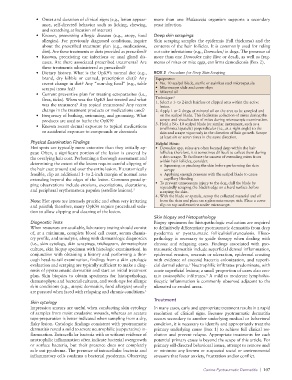
                •  Dietary history. What is the OpK9’s normal diet (e.g.,   BOX 2  Procedure for Deep Skin Scraping
                  brand,  dry  kibble  or  canned,  prescription  diet)?  Any   Equipment:
                  recent change in diet? Any “non-dog food” (e.g., table   •  No. 10 scalpel blade, sterile or stainless steel microspatula
                  scraps) items fed?                             •  Microscope slide and cover slips
                •  Current preventive plan for treating ectoparasites (i.e.,   •  Mineral oil
                  fleas, ticks). When was the OpK9 last treated and what   Technique: 7
                  was the treatment? Any topical treatments? Any recent   1. Select a 1- to 2-inch hairless or clipped area within the active
                                                                   lesion.
                  change in the treatment products or medications used?  2. Apply 1 or 2 drops of mineral oil on the area to be sampled and
                •  Frequency of bathing, swimming, and grooming. What   on the scalpel blade. This facilitates collection of mites during the
                  products are used to bathe the OpK9?             scrape and visualization of mites during microscopic examination.
                •  Known recent dermal exposure to topical medications   3. Hold a No. 10 scalpel blade (or similar instrument, such as a
                                                                   small metal spatula) perpendicular (i.e., at a right angle) to the
                  or accidental exposure to compounds or chemicals  skin and scrape vigorously in the direction of hair growth. Scrape
                                                                   at least six or seven times in the same direction.
              Physical Examination Findings                      Helpful Hints:
              Hot spots are typically more extensive than they initially ap-  •  Demodex spp. mites are often located deep within the hair
              pear. Often, a significant portion of the lesion is covered by   follicles; therefore, it is sometimes difficult to collect them during
              the overlying hair coat. Performing a thorough assessment and   a skin scrape. To facilitate the success of extruding mites from
              determining the extent of the lesion require careful clipping of   within hair follicles, consider:
                                                                      o Squeezing or pinching the skin before performing the skin
              the hair coat around and over the entire lesion. If anatomically   scrape
              feasible, clip an additional 1- to 2-inch margin of normal area     o Applying enough pressure with the scalpel blade to cause
              extending beyond the edges of the lesion. Common postclip-  capillary bleeding
              ping observations include erosions, excoriations, ulcerations,   •  To prevent unnecessary injury to the dog, dull the blade by
              and peripheral erythematous papules (satellite lesions). 5  repeatedly scraping the blade’s edge on a hard surface before
                                                                   scraping the skin.
                                                                 4. With the blade or spatula, scoop the collected material and oil
              Note: Hot spots are intensely pruritic and often very irritating   from the skin and place on a glass microscope side. Place a cover
              and painful; therefore, many OpK9s require procedural seda-  slip on top and examine under microscope.
              tion to allow clipping and cleaning of the lesion.
                                                                 Skin biopsy and histopathology
              Diagnostic Tests                                   Biopsy specimens for histopathologic evaluation are required
              When resources are available, laboratory testing should consist   to definitively differentiate pyotraumatic dermatitis from deep
              of, at a minimum, complete blood cell count, serum chemis-  pyoderma  or  pyotraumatic  folliculitis/furunculosis.  Histo-
              try profile, and urinalysis, along with dermatologic diagnostics   pathology is necessary to guide therapy when dealing with
              (i.e., skin cytology, skin scrapings, trichogram, dermatophyte   chronic and relapsing cases. Findings associated with pyo-
              culture, skin biopsy specimen with histologic examination). In   traumatic dermatitis include superficial dermal inflammation,
              conjunction with obtaining a history and performing a thor-  epidermal erosion, necrosis or ulceration, epidermal crusting
              ough head-to-tail examination, findings from a skin cytologic   with evidence of coccoid bacteria colonization, and superfi-
              evaluation and scraping are typically sufficient to make a diag-  cial dermal edema.  Neutrophilic infiltrates predominate, with
                                                                               5
              nosis of pyotraumatic dermatitis and start an initial treatment   acute superficial lesions; a small proportion of cases also con-
              plan. Skin biopsies to obtain specimens for histopathology,   tain eosinophilic infiltrates.  A mild to moderate lymphohis-
                                                                                      5
              dermatophyte and bacterial cultures, and work-ups for allergic   tiocytic inflammation is commonly observed adjacent to the
              skin conditions (e.g., atopic dermatitis, food allergies) usually   ulcerated or eroded areas.
              are pursued when faced with relapsing and chronic conditions. 1
                                                                 Treatment
              Skin cytology
              Impression smears are useful when conducting skin cytology   In many cases, early and appropriate treatment results in a rapid
              of samples from moist exudative wounds, whereas an acetate   resolution of clinical signs. Because pyotraumatic dermatitis
              tape preparation is better indicated when sampling from a dry,   occurs secondary to another underlying medical or behavioral
              flaky lesion. Cytologic findings consistent with pyotraumatic   condition, it is necessary to identify and appropriately treat the
              dermatitis reveal a mild to severe neutrophilic (suppurative) in-  primary underlying cause (Box 1) to achieve full clinical res-
              flammation. Extracellular bacteria with or without evidence of   olution and prevent relapse. Appropriate treatments for each
              neutrophilic inflammation often indicate bacterial overgrowth   potential primary cause is beyond the scope of this article. For
              or surface bacteria, but their presence does not completely   primary self-directed behavioral issues, attempt to remove and/
              rule out pyoderma. The presence of intracellular bacteria and   or minimize any known or suspected social or environmental
              inflammatory cells confirms a bacterial pyoderma. Observing   stressors that foster anxiety, frustration and/or conflict.

                                                                                     Canine Pyotraumatic Dermatitis  |  107

