


Page 110 - JSOM Summer 2018
P. 110
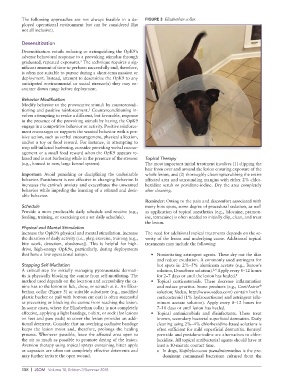
The following approaches are not always feasible in a de-  FIGURE 3  Elizabethan collar.
          ployed operational environment but can be considered (list
          not all inclusive).

          Desensitization
          Desensitization entails reducing or extinguishing the OpK9’s
          adverse behavioral response to a provoking stimulus through
          graduated, repeated exposures.  The technique requires a sig-
                                  3
          nificant amount of time to perform successfully and, therefore,
          is often not suitable to pursue during a short-term mission or
          deployment. Instead, attempt to desensitize the OpK9 to any
          anticipated environmental or social stressor(s) they may en-
          counter down range before deployment.

          Behavior Modification
          Modify behavior to the provocative stimuli by countercondi-
          tioning and positive reinforcement.  Counterconditioning in-
                                      3
          volves attempting to evoke a different, but favorable, response
          in the presence of the provoking stimuli by having the OpK9
          engage in a competitive behavior or activity. Positive reinforce-
          ment encourages or supports the wanted behavior with a pos-
          itive action, such as verbal encouragement, physical affection,
          and/or a toy or food reward. For instance, in attempting to
          stop self-inflicted barbering, consider providing verbal encour-
          agement or a small food reward when the OpK9 appears re-
          laxed and is not barbering while in the presence of the stressor   Topical Therapy
          (e.g., housed in new, large kennel system).        The most important initial treatment involves (1) clipping the
                                                             hair from over and around the lesion ensuring exposure of the
          Important: Avoid punishing or disciplining the undesirable   whole lesion, and (2) thoroughly cleaning/scrubbing the entire
          behavior. Punishment is not effective in changing behavior. It   affected area and surrounding margins with either 2% chlor-
          increases the canine’s anxiety and exacerbates the unwanted   hexidine scrub or povidone-iodine. Dry the area completely
          behavior while impeding the learning of a relaxed and desir-  after cleaning.
          able behavior.
                                                             Reminder: Owing to the pain and discomfort associated with
          Schedule                                           many hots spots, some degree of procedural sedation, as well
          Provide a more predictable daily schedule and routine (e.g.,   as application of topical anesthetics (e.g., lidocaine, pramox-
          feeding, training, or exercising on a set daily schedule).  ine, tetracaine) is often needed to initially clip, clean, and treat
                                                             the lesion.
          Physical and Mental Stimulation
          Increase the OpK9’s physical and mental stimulation. Increase   The need for additional topical treatments depends on the se-
          the duration of daily activity (i.e., play, exercise, training [e.g.,   verity of the lesion and underlying cause. Additional topical
          bite work, detection, obedience]).  This is helpful for high-  treatments may include the following:
          drive, high-energy OpK9s, particularly, during deployments
          that have a low operational tempo.                   •  Nonirritating astringent agents. These dry out the skin
                                                                  and reduce exudation. A commonly used astringent for
          Stopping Self-Mutilation                                hot spots is: 2%–5% aluminum acetate (e.g., Burow’s
          A critical step for initially managing pyotraumatic dermati-  solution, Domeboro solution).  Apply every 8–12 hours
                                                                                         2,8
          tis is physically blocking the canine from self-mutilating. The   for 2–7 days or until the lesion has healed. 8
          method used depends on the location and accessibility the ca-  •  Topical corticosteroids. These decrease inflammation
          nine has to the lesion to lick, chew, or scratch at it. An Eliza-  and reduce pruritus. Some products (e.g., Cort/Astrin
                                                                                                            ®
          bethan collar (Figure 3) or suitable substitute (e.g., modified   solution; Vedco, http://www.vedco.com) contain both a
          plastic bucket or pail with bottom cut out) is often successful   corticosteroid (1% hydrocortisone) and astringent (alu-
          at preventing or blocking the canine from reaching the lesion.   minum  acetate  solution).  Apply  every  8–12  hours  for
          In some cases, where the Elizabethan collar is not completely   7–10 days or until lesion has healed.
          effective, applying a light bandage, t-shirt, or sock (for lesions   •  Topical antimicrobials and disinfectants. These treat
          on feet and paw pads) to cover the lesion provides an addi-  known, secondary bacterial superficial dermatitis. Daily
          tional deterrent. Consider that an overlying occlusive bandage   cleaning using 2%–4% chlorhexidine-based solutions is
          keeps the lesion moist and, therefore, prolongs the healing   often sufficient for mild superficial dermatitis. Benzoyl
          process. Whenever  possible, leave the affected area open to   peroxide and povidone-iodine are alternatives to chlor-
          the air as much as possible to promote drying of the lesion.   hexidine. All topical antibacterial agents should have at
          Aversion therapy using topical sprays containing bitter apple   least a 10-minute contact time.
          or capsaicin are often not completely effective deterrents and     o In dogs, Staphylococcus pseudintermedius is the pre-
          may further irritate the open wound.                      dominant commensal bacterium  cultured from the


          108  |  JSOM   Volume 18, Edition 2/Summer 2018

