


Page 102 - JSOM Summer 2018
P. 102
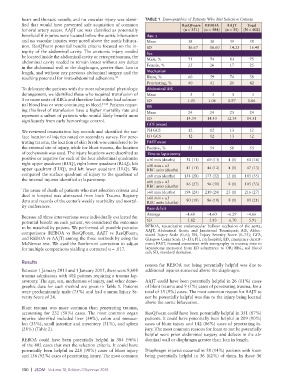
heart and thoracic vessels; and no vascular injury was identi-  TABLE 1  Demographics of Patients Who Met Selection Criteria
          fied that would have prevented safe acquisition of common         ResQFoam  REBOA    AAJT    Total
          femoral artery access. AAJT use was classified as potentially      (n = 351)  (n = 384)  (n = 35)  (N = 402)
          beneficial if injuries were located below the aortic bifurcation   Age, y
          and no vascular injuries were noted above the aortic bifurca-  Mean  38       38      39      38
          tion. ResQFoam potential benefit criteria focused on the in-  SD     16.67    16.60   14.25   16.48
          tegrity of the abdominal cavity. The anatomic injury needed   Sex
          be located inside the abdominal cavity or retroperitoneum, the
          abdominal cavity needed to remain intact without any defect   Male, %  75     74      83      75
          in the abdominal wall or the diaphragm, greater than 1cm in   Female, %  25   26      17      25
          length, and without any previous abdominal surgery and the   Mechanism
          resulting potential for intra-abdominal adhesions. 20  Blunt, %      60       59      74      58
                                                              Penetrating, %   40       41      26      42
          To delineate the patients with the most substantial physiologic   Abdominal AIS
          derangement, we identified those who required transfusion of   Mean   3        3       3       3
          3 or more units of RBCs and therefore had either had substan-  SD   1.05     1.06    0.97    1.06
          tial blood loss or were continuing to bleed. 21,22  Patients requir-  ISS
          ing this level of transfusion have a higher mortality rate and
          represent a subset of patients who would likely benefit most   Mean  24       24      23      24
          significantly from early hemorrhage control.        SD              14.34    14.43   12.34   14.51
                                                              GCS (mean)

          We reviewed resuscitation bay records and identified the sur-  PH GCS  12     12      13      12
          face location of injuries noted on secondary survey. For pene-  ED GCS   12   12      13      12
          trating trauma, the location of skin break was considered to be   FAST exam
          the external site of injury, while for blunt trauma, the location   Positive, %  55  54  50   53
          of ecchymosis was used. The injury locations were described as   Time to laparotomy
          positive or negative for each of the four abdominal quadrants:   ≤30 min (deaths)  54 (11)  60 (13)  4 (1)  64 (14)
          right upper quadrant (RUQ), right lower quadrant (RLQ), left   ≤30 min + ≥3
          upper quadrant (LUQ), and left lower quadrant (LLQ). We   RBC units (deaths)  41 (11)  44 (12)  4 (1)  47 (13)
          compared the surface quadrant of injury to the quadrant of   ≤60 min (deaths)  154 (28)  173 (32)  12 (1)  185 (35)
          the internal injuries identified at laparotomy.
                                                              ≤60 min + ≥3    86 (27)  96 (30)  8 (1)  105 (33)
                                                              RBC units (deaths)
          The cause of death of patients who met selection criteria and   >60 min (deaths)  194 (24)  210 (24)  23 (1)  216 (27)
          died in hospital was abstracted from both Trauma Registry
          data and records of the center’s weekly morbidity and mortal-  >60 min + ≥3    80 (18)  86 (18)  8 (1)  89 (21)
                                                              RBC units (deaths)
          ity conferences.                                    Base deficit
                                                              Average         –4.68    –4.60   –6.29   –4.66
          Because all three interventions were individually evaluated for
          potential benefit on each patient, we considered the outcomes   SD   5.82    5.83     6.70    5.91
          to be matched by patient. We performed all possible pairwise   REBOA, resuscitative endovascular balloon occlusion of the aorta;
          comparisons (REBOA vs ResQFoam, AAJT vs ResQFoam,   AAJT, Abdominal Aortic and Junctional Tourniquet; AIS, Abbre-
                                                             viated Injury Scale (0–6); ISS, Injury Severity Score (0–75); GCS,
          and REBOA vs AAJT) among the three methods by using the   Glasgow Coma Scale (3–15); PH, prehospital; ED, emergency depart-
          McNemar test. We used the Bonferroni correction to adjust   ment; FAST, focused assessment with sonography in trauma; time to
          for multiple comparisons yielding a corrected α = .017.  laparotomy measured from ED admittance to OR; RBC, red blood
                                                             cell; SD, standard deviation.

          Results
                                                             reason for REBOA not being potentially helpful was due to
          Between 1 January 2013 and 1 January 2015, there were 9,608   additional injuries sustained above the diaphragm.
          trauma admissions with 402 patients requiring a trauma lap-
          arotomy. The age, sex, mechanism of injury, and other demo-  AAJT could have been potentially helpful in 26 (11%) cases
          graphic data for each method are given in Table 1. Patients   of blunt trauma and 9 (5%) cases of penetrating trauma, for a
          were predominantly male (75%) and had a mean Injury Se-  total of 35 (9%) cases. The most common reason for AAJT to
          verity Score of 24.                                not be potentially helpful was due to the injury being located
                                                             above the aortic bifurcation.
          Blunt trauma was more common than penetrating trauma,
          accounting for 232 (58%) cases. The most common organ   ResQFoam could have been potentially helpful in 351 (87%)
          injuries identified included liver (34%), colon and mesoco-  patients. It could have potentially been helpful in 209 (90%)
          lon (33%), small intestine and mesentery (31%), and spleen   cases of blunt injury and 142 (86%) cases of penetrating in-
          (28%) (Table 2).                                   jury. The most common reasons for foam to not be potentially
                                                             helpful were prior abdominal surgery and defects in the ab-
          REBOA could have been potentially helpful in 384 (96%)   dominal wall or diaphragm greater than 1cm in length.
          of the 402 cases that met the selection criteria. It could have
          potentially been helpful in 228 (98%) cases of blunt injury   Diaphragm injuries occurred in 58 (14%) patients with foam
          and 156 (92%) cases of penetrating injury. The most common   being potentially  helpful in 36 (62%) of  them. In  those 36


          100  |  JSOM   Volume 18, Edition 2/Summer 2018

