


Page 101 - JSOM Summer 2018
P. 101
In a second method, the Abdominal Aortic and Junctional   Each of these three  novel methods for obtaining temporary
              Tourniquet (AAJT ; Compression Works LLC, Birmingham,   hemorrhage control in NCTH uses a unique approach. Their
                            ™
              AL) (Figure 2) is applied to the mid-abdomen of a patient.   potential applicability has never been openly evaluated and
              A pneumatic bladder is then inflated, putting pressure on the   compared in the context of a cohort of real trauma patients.
              aortic bifurcation, until distal pulses are no longer felt.  This   How many trauma patients may benefit from the use of each
                                                        17
              device requires minimal training, can be placed by nonmedical   device has not been definitively established and remains theo-
              personnel, and was designed for field application.  retical.  The goals of this work were to assess what percentage
                                                                      19
                                                                 of patients with NCTH, who lived long enough to receive a
              FIGURE 2  The Abdominal Aortic and Junctional Tourniquet    trauma laparotomy, could have potentially been benefited by
              (AAJT; Compression Works LLC, Birmingham, AL;      the use of one of these three interventions and to determine
              https://compressionworks.com).                     which method had the greatest potential applicability. It was
                                                                 hypothesized that REBOA would have the greatest potential
                                                                 benefit within the NCTH trauma population.

                                                                 Methods
                                                                 This was a single-center (Memorial Hermann Hospital, Hous-
                                                                 ton, TX) retrospective study using Trauma Registry data of
                                                                 injured patients who went directly from the ED to the OR for
                                                                 a laparotomy between 1 January 2013 and 1 January 2015.
                                                                 The operative notes were individually reviewed by one of the
                                                                 authors (JBH) to determine the location(s) of injury identified
                                                                 during surgery. For each patient, each temporary hemorrhage
                                                                 control method underwent a binary categorization of being
                                                                 potentially beneficial or not potentially beneficial for preoper-
                                                                 ative hemorrhage control based on the intraoperative findings.
              Image courtesy of Dr John Croushorn and Dr Richard Schwartz (per-  The potential benefit of each temporary hemorrhage control
              sonal communication).
                                                                 technique in patients with the most substantial physiologic
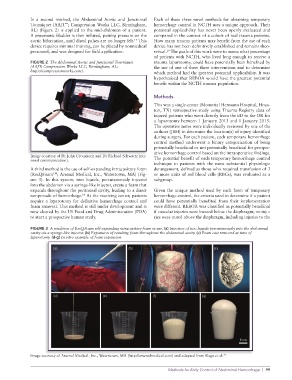
              A third method is the use of self-expanding intracavitary foam   derangement, defined as those who required transfusion of 3
              (ResQFoam ; Arsenal Medical, Inc., Watertown, MA) (Fig-  or more units of red blood cells (RBCs), was evaluated as a
                       TM
              ure 3). In this system, two liquids, percutaneously injected   subgroup.
              into the abdomen via a syringe-like injector, create a foam that
              expands throughout the peritoneal cavity, leading to a direct   Given the unique method used by each form of temporary
              tamponade of hemorrhage.  At the receiving center, patients   hemorrhage control, the criteria used to determine if a patient
                                   18
              require a laparotomy for definitive hemorrhage control and   could  have  potentially  benefited  from  their  implementation
              foam removal. This method is still under development and is   were different. REBOA was classified as potentially beneficial
              now cleared by the US Food and Drug Administration (FDA)   if vascular injuries were located below the diaphragm; no inju-
              to start a prospective human study.                ries were noted above the diaphragm, including injuries to the

              FIGURE 3  A rendition of ResQFoam self-expanding intracavitary foam in use. (a) Injection of two liquids percutaneously into the abdominal
              cavity via a syringe-like injector. (b) Expansion of resulting foam throughout the abdominal cavity. (c) Foam cast removed at time of
              laparotomy. (d-g) In vitro example of foam expansion.


              Image courtesy of Arsenal Medical, Inc., Watertown, MA (http://arsenalmedical.com) and adapted from Rago et al. 24

                                                                      Methods for Early Control of Abdominal Hemorrhage  |  99

