


Page 99 - JSOM Spring 2018
P. 99
stomach’s inlet (esophageal portal) and outlet passageways   splenic torsion may occur, leading to avulsion and/or strangu-
              (pyloric portal), and strangulate gastric blood supply. Gastric   lation of splenic vasculature with resultant splenic thrombosis
              inlet and outflow tract obstructions impair the canine's normal   and infarction. Intestinal blood flow is impaired, resulting in
              mechanisms for promoting gastric emptying (e.g., eructation,   increased bacterial endotoxin production and translocation
              vomiting, pyloric emptying). This allows air, fluid, and chyme   across the compromised intestinal mucosal barrier. 6
              to become trapped within the stomach lumen. Strangulation
              of gastric blood supply causes gastric venous congestion, re-  Pathogenesis
              sulting in increased gastric secretion and transudation of fluids   The pathogenesis of GDV is not completely understood but is
              into the gastric lumen. Ongoing metabolic reactions within the   considered to have a multifactorial etiology.  Several host and
                                                                                                  12
              lumen (e.g., bacterial fermentation of carbohydrates) contrib-  environmental predisposing factors (e.g., genetics, sex, age,
              utes to further intraluminal gas accumulation. Collectively,   breed, diet, exercise)  have been implicated in increasing the
                                                                                 2
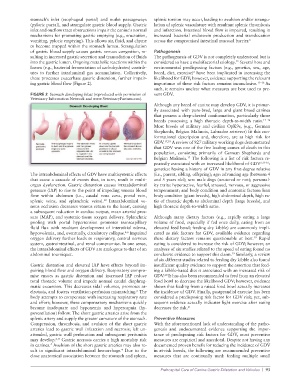
              these processes exacerbate gastric distention, further impair-  likelihood for GDV; however, evidence supporting the relevant
              ing gastric blood flow (Figure 2).                 importance of these risk factors remains inconclusive. 11–16  As
                                                                 such, it remains unclear what measures are best used to pre-
              FIGURE 2  Stomach developing bloat (reproduced with permission of   vent GDV.
              Veterinary Information Network and www.VeterinaryPartner.com).
                                                                 Although any breed of canine may develop GDV, it is primar-
                                                                 ily associated with pure-bred, large and giant breed canines
                                                                 that possess a deep-chested conformation, particularly those
                                                                 breeds possessing a high thoracic depth-to-width ratio. 11–16
                                                                 Most breeds of military and civilian OpK9s, (e.g., German
                                                                 Shepherds, Belgian Malinois, Labrador retriever) fit this con-
                                                                 formational description and, therefore, are at high risk for
                                                                 GDV. 17,18  A review of 927 military working dogs demonstrated
                                                                 that GDV was one of the five leading causes of death in this
                                                                 population, consisting primarily of German Shepherds and
                                                                 Belgian Malinois.  The following is a list of risk factors re-
                                                                              17
                                                                 peatedly associated with an increased likelihood of GDV 6,11-16 :
                                                                 genetics: having a history of GDV in any first-degree relative
              The intraabdominal effects of GDV have multisystemic effects   (i.e., parent, sibling, offspring); age: advancing age (between 4
              that cause a cascade of events that, in turn, result in multi-  and 5 years old); sex: male dogs (neutered or not); personal-
              organ dysfunction. Gastric distention causes intraabdominal   ity traits: hyperactive, fearful, stressed, nervous, or aggressive
              pressure (IAP) to rise to the point of impeding venous blood   temperament; and body condition and anatomic factors: lean
              flow within abdomen (i.e., caudal vena cava, portal vein,   body condition (giant breeds), high abdominal depth, high ra-
              splenic veins, and splanchnic veins).  Intraabdominal ve-  tio of thoracic depth to abdominal depth (large breeds), and
                                            10
              nous occlusion decreases venous return to the heart, causing   high thoracic depth-to-width ratio.
              a subsequent reduction in cardiac output, mean arterial pres-
              sure (MAP), and systemic-tissue oxygen delivery. Splanchnic   Although many dietary factors (e.g., rapidly eating a large
              pooling with  portal hypertension  promotes  transcapillary   volume of food, especially if fed once daily, eating from an
              fluid flux with resultant development of interstitial edema,   elevated feed bowl; feeding dry kibble) are commonly impli-
              hypovolemia, and, eventually, circulatory collapse.  Impaired   cated as risk factors for GDV, available evidence regarding
                                                     4,6
              oxygen delivery further leads to respiratory, central nervous   these  dietary  factors  remains  questionable  at  best.   Rapid
                                                                                                          19
              system, gastrointestinal, and renal compromise. In one sense,   eating is considered to increase the risk of GDV; however, an
              the intraabdominal effects of GDV are analogous to that of an   analyses of six studies related to the speed of eating found no
              abdominal tourniquet.                              conclusive evidence to support this claim.  Similarly, a review
                                                                                                 19
                                                                 of six different studies related to feeding dry kibble also found
              Gastric distention and elevated IAP have effects beyond im-  insufficient quality evidence to support the assertion that feed-
              pairing blood flow and oxygen delivery. Respiratory compro-  ing a kibble-based diet is associated with an increased risk of
              mise ensues as gastric distention and increased IAP reduce   GDV.  It has also been recommended to feed from an elevated
                                                                     20
              total thoracic volume and impede normal caudal diaphrag-  food bowl to decrease the likelihood GDV; however, evidence
              matic excursion. This decreases tidal volumes, promotes at-  shows that feeding from a raised food bowl actually increases
              electasis, and fosters ventilation-perfusion mismatching.  The   the incidence of GDV. Finally, postprandial exercise has been
                                                         6
              body attempts to compensate with increasing respiratory rate   considered a predisposing risk factor for GDV risk; yet, sub-
              and effort; however, these compensatory mechanisms quickly   sequent evidence actually indicates light exercise after eating
              become inadequate and hypoxemia and hypercapnia (hy-  decreases the risk. 21
              poventilation) follow. The short gastric arteries arise from the
              splenic artery and supply the greater curvature of the stomach.   Preventive Measures
              Compression, thrombosis, and avulsion of the short gastric   With the aforementioned lack of understanding of the patho-
              arteries lead to gastric wall infarction and necrosis; left un-  genesis and undocumented evidence supporting the impor-
              attended, gastric wall perforation and subsequent peritonitis   tance of predisposing risk factors for GDV, most preventive
              may develop. 6,11  Gastric necrosis carries a high mortality risk   measures are empirical and anecdotal. Despite not having any
              in canines.  Avulsion of the short gastric arteries may also re-  documented proven benefit for reducing the incidence of GDV
                      4
              sult in significant intraabdominal hemorrhage.  Due to the   in at-risk breeds, the following are recommended preventive
                                                   4
              close anatomical association between the stomach and spleen,   measures that are continually used: feeding multiple small
                                                                   Prehospital Care of Canine Gastric Dilatation and Volvulus  |  93

