


Page 100 - JSOM Spring 2018
P. 100
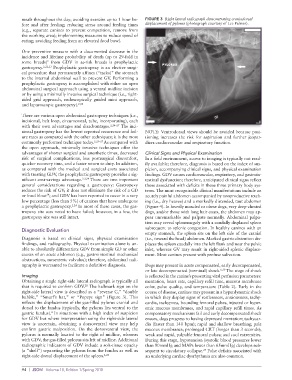
meals throughout the day; avoiding exercise up to 1 hour be-  FIGURE 3  Right lateral radiograph demonstrating craniodorsal
          fore and after feeding; reducing stress around feeding times   displacement of pylorus (photograph courtesy of Lee Palmer).
          (e.g., separate canines to prevent competition, remove from
          the working area); implementing measures to reduce speed of
          eating; avoiding feeding from an elevated food bowl.
          One preventive measure with a documented decrease in the
          incidence and lifetime probability of death (up to 29-fold in
          some breeds)  from GDV in at-risk breeds is prophylactic
                     2
          gastropexy. 2,22,23  Prophylactic gastropexy is an elective surgi-
          cal procedure that permanently affixes (“tacks)” the stomach
          to the internal abdominal wall to prevent GV. Performing a
          prophylactic gastropexy is accomplished with either an open
          abdominal surgical approach using a ventral midline incision
          or by using a minimally invasive surgical technique (i.e., right-
          sided grid approach, endoscopically guided mini approach,
          and laparoscopic gastropexy). 2,24

          There are various open abdominal gastropexy techniques (i.e.,
          incisional, belt loop, circumcostal, tube, incorporating), each
          with their own advantages and disadvantages. 2,24–27  The inci-
          sional gastropexy has the lowest reported recurrence and fail-  NOTE: Ventrodorsal views should be avoided because posi-
          ure rates as compared with the other techniques; it is the most   tioning increases the risk for aspiration and further jeopar-
          commonly performed technique today. 2,23–27  As compared with   dizes cardiovascular and respiratory function.
          the open approach, minimally invasive techniques offer the
          advantages of shorter surgical and anesthetic times, decreased   Clinical Signs and Physical Examination
          risk of surgical complications, less postsurgical discomfort,   In a field environment, access to imaging is typically not read-
          quicker recovery time, and a faster return to duty. In addition,   ily available; therefore, diagnosis is based on the index of sus-
          as compared with the medical  and surgical  costs associated   picion, accompanying clinical signs, and physical examination
          with treating GDV, the prophylactic gastropexy provides a sig-  findings. GDV causes cardiovascular, respiratory, and gastroin-
          nificant cost-savings advantage. 2,3,24  There are two important   testinal dysfunction; therefore, anticipated clinical signs reflect
          general  considerations  regarding a  gastropexy: Gastropexy   those associated with deficits in those three primary body sys-
          reduces the risk of GV; it does not eliminate the risk of a GD   tems. The most recognizable clinical manifestations include an
          or food bloat ; and GDV has been reported to occur in a very   acutely painful abdomen accompanied by nonproductive retch-
                    24
          low percentage (less than 5%) of canines that have undergone   ing (i.e., dry heaves) and a markedly distended, taut abdomen
          a prophylactic gastropexy. 2,24  In most of these cases, the gas-  (Figure 4). In heavily muscled or obese dogs, very deep-chested
          tropexy site was noted to have failed; however, in a few, the   dogs, and/or those with long hair coats, the abdomen may ap-
          gastropexy site was still intact.                  pear unremarkable and palpate normally. Abdominal palpa-
                                                             tion may reveal splenomegaly with a caudally displaced spleen
          Diagnostic Evaluation                              subsequent to splenic congestion. In healthy canines with an
                                                             empty stomach, the spleen sits on the left side of the cranial
          Diagnosis is based on clinical signs, physical examination   (i.e., toward the head) abdomen. Marked gastric distention dis-
          findings, and radiography. Physical examination alone is un-  places the spleen caudally into the left flank and near the pelvic
          able to absolutely differentiate GDV from simple GD or other   inlet, whereas GV may result in right-sided splenic displace-
          causes of an acute abdomen (e.g., gastrointestinal mechanical   ment. Most canines present with profuse salivation.
          obstructions, mesenteric volvulus); therefore, abdominal radi-
          ography is warranted to facilitate a definitive diagnosis.  Dogs may present in acute compensated, early decompensated,
                                                             or late decompensated (terminal) shock. 6,29  The stage of shock
          Imaging                                            is reflected in the canine’s presenting vital perfusion parameters:
          Obtaining a single right-side lateral radiograph is typically all   mentation, heart rate, capillary refill time, mucous membrane
          that is required to confirm GDV.  The hallmark sign on the   color, pulse quality, and temperature (Table 2). Early in the
                                    28
          right-side lateral view is described as a “reverse C,” “double   course of disease, canines may present in a hyperdynamic shock
          bubble,” “Smurf’s hat,” or “Popeye sign” (Figure 3). This   in which they display signs of restlessness, anxiousness, tachy-
          reflects the displacement of the gas-filled pylorus cranial and   cardia, tachypnea, bounding femoral pulses, injected or hyper-
          dorsal to the fundus (typically, the pylorus lies ventral to the   emic mucous membranes, and rapid capillary refill times. As
          gastric fundus).  In situations with a high index of suspicion   compensatory mechanisms fail and early decompensated shock
                      4
          for GDV but where interpretation using the right-side lateral   ensues, dogs progress to having depressed mentation; tachycar-
          view is uncertain, obtaining  a dorsoventral  view may help   dia (faster than 140 bpm); rapid and shallow breathing; pale
          confirm gastric malposition. On the dorsoventral view, the   mucous membranes; prolonged CRT (longer than 3 seconds);
          pylorus is normally located to the right of midline, whereas   weak and rapid, palpable femoral pulses; and cool extremities.
          with GDV, the gas-filled pylorus sits left of midline. Additional   During this stage, hypotension (systolic blood pressures lower
          radiographic indicators of GDV include a soft-tissue opacity   than 90mmHg and MAPs lower than 65mmHg) develops sub-
          (a “shelf”) separating the pylorus from the fundus as well as   sequent to circulatory collapse.  Pulse deficits associated with
                                                                                     29
          right-side dorsal displacement of the spleen. 4,28  an underlying cardiac dysrhythmia are also common.

          94  |  JSOM   Volume 18, Edition 1/Spring 2018

