


Page 95 - JSOM Spring 2018
P. 95
BJACH has approximately 23,000 visits per year. It is con-  Eleven patients (10.7%) were admitted to the hospital. Of
              sidered a Level 3 Army Emergency Medical Services ED that   these, nine were discharged in less than 24 hours. Five of the
              provides care mostly for active-duty personnel and dependents   11 patients were admitted because of rhabdomyolysis, with
              with a small volume of retirees. It is a small community hospi-  a CK level higher than 5,000U/L in all of them. One patient
              tal in a very rural area.                          was admitted for acute kidney injury with a creatinine level of
                                                                 2.0mg/dL. The remaining four patients had documented signs
              This was a retrospective review of heat injuries brought to the   of altered mental status (AMS) or dehydration. The two pa-
              ED from 1 May 2014 through 30 September 2014.      tients who stayed longer than 24 hours were both discharged
                                                                 in less than 48 hours. Both of the patients who were admitted
              Selection of Patients                              and kept in the hospital for longer than 24 hours were noted
              Daily reports log all training-related injuries and are reported   in the chart to have AMS during the ED visit.
              to hospital command. Daily reports were reviewed for heat
              injuries. All patients brought in from the field were included.   Discussion
              Patients were excluded if they were seen at another clinic be-
              fore being brought to the ED or had laboratory studies done   In this retrospective review of patients transferred from the
              before arriving in the ED. This usually occurs when labora-  field directly to the ED for heat injuries, we found low clini-
              tory studies are ordered by providers at the Combined Troop   cal yield to routine screening laboratory studies. Most labora-
              Medical Clinic.                                    tory studies did not result in a change in clinical management.
                                                                 Very few studies appeared to have an actual effect on clinical
              Outcome Measures                                   management. Of the patients who were admitted, most were
              Data were recorded by SGS on a standardized data collection   discharged in less than 24 hours, which calls into question
              spreadsheet using Microsoft Excel. The primary measure-  whether the admission was required during the initial contact
              ment was the occurrence of clinically significant abnormalities   or perhaps outpatient management could have been used. The
              found  on  screening  laboratory  studies.  Clinically  significant   only patients who required admission longer than 24 hours
              was defined as admission to the hospital as a result of the   had AMS documented as a symptom during the ED encounter,
              laboratory finding. Secondary measurements include admis-  which indicates that symptom-based treatment plans may be a
              sion and discharge rates. Laboratory study findings were con-  better method to determine resource use.
              sidered abnormal if outside of laboratory parameters. The
              following laboratory  studies were included:  comprehensive   There are several issues that must be considered when evalu-
              metabolic panel or basic metabolic panel, complete blood cell   ating the utility of laboratory studies with or without a clear
              count, coagulation panel, urinalysis, and creatine kinase (CK).  indication. First, there is significant cost to the healthcare sys-
                                                                 tem  that  comes  along  with  ordering  laboratory  studies.  Al-
                                                                 though it is common practice in many settings, there is cost to
              Results
                                                                 the Defense Healthcare Agency as a result of performing these
              During the project, 147 daily command reports (96%) were   studies. Second, there are significant measurable and immea-
              available for the 5-month period. There were 104 Soldiers   surable costs incurred during transportation of these patients.
              brought to the ED directly from the field for evaluation. The   At the Joint-Readiness Training Center, the austere training
              average age was 24.6 years (range, 18–56 years) and 102   locations often used are remote and at a significant distance
              (98%) were male.                                   from the BJACH ED. Often, there is very limited road access,
                                                                 making ground transportation difficult and sometimes unreli-
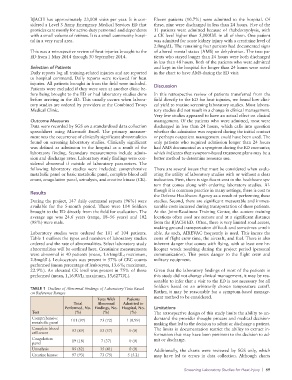
              Laboratory studies were ordered for 101 of 104 patients.   able. As such, AIREVAC frequently is used. This incurs the
              Table 1 outlines the types and numbers of laboratory studies   costs of flight crew time, the aircraft, and fuel. There is also
              ordered and the rate of abnormalities. Select laboratory study   inherent danger that comes with flying, with at least one he-
              abnormalities will be outlined here. Creatinine measurements   licopter wreck resulting during the project period (personal
              were abnormal in 40 patients (mean, 1.61mg/dL; maximum,   communication). This poses danger to the flight crew and
              2.8mg/dL). Leukocytosis was present in 57% of CBC counts   military equipment.
              performed (mean percentage of leukocytes, 13.6%; maximum,
              22.9%). An elevated CK level was present in 75% of those   Given that the laboratory findings of most of the patients in
              performed (mean, 1,163U/L; maximum, 15,627U/L).    this study did not change clinical management, it may be rea-
                                                                 sonable to infer that a visit to the ED is not necessary for all
                                                                 Soldiers based on an arbitrarily chosen temperature cutoff.
              TABLE 1  Outline of Abnormal Findings of Laboratory Tests Based
              on Reference Ranges                                Rather, it may be reasonable for a symptom-based manage-
                                         Tests With   Patients   ment method to be considered.
                               Total     Abnormal   Admitted to
                            Performed, No.  Findings, No.  Hospital, No.   Limitations
              Test              (%)         (%)        (%)       The retrospective design of this study limits the ability to un-
              Comprehensive                                      derstand the provider thought process and medical decision-
              metabolic panel  101 (97)   73 (72)    1 (0.99)    making that led to the decision to admit or discharge a patient.
              Complete blood   93 (89)    53 (57)     0 (0)      The limits in documentation restrict the ability to extract in-
              cell count                                         formation that may have been pertinent to the decision to ad-
              Coagulation      19 (18)     7 (37)     0 (0)      mit or discharge.
              panel
              Urinalysis       85 (82)    35 (41)     0 (0)      Additionally, the charts were reviewed by SGS only, which
              Creatine kinase   97 (93)   73 (75)     5 (5.2)    may have led to errors in data collection. Although charts

                                                                             Screening Laboratory Studies for Heat Injury  |  89

