


Page 91 - JSOM Spring 2018
P. 91
Chelation therapy is indicated for asymptomatic patients with   Prevention
              BLL higher than 80μg/dL.  Patients with a BLL of 40–80μg/
                                  43
              dL may be considered for chelation therapy based on clinician   The real question is: How do we protect our most elite human
              consideration of duration and temporality of exposure, nature   resources from a poison that is ubiquitous in the SOF environ-
              and duration of symptoms, and other medical comorbidities.    ment and subclinical in presentation but causes diverse and
                                                            16
              Providers should seek consultation from a medical toxicolo-  extensive disease? Furthermore, how do we protect SOF per-
              gist with expertise in treatment of lead exposures before initi-  sonnel who spend a large portion of their career in remote and
              ating treatment.  Medical toxicologists are available 24 hours   austere environments, far from the regulated world found in
                          39
              per day by calling the local poison control center in the United   the United States? The answer is primary prevention. Primary
              States at 1-800-222-1222. Chelation agents include parenteral   prevention means stopping exposure before it happens.
              calcium  disodium  ethylenediaminetetraacetic  acid  (calcium
              versenate) and oral dimercaptosuccinic acid (also called suc-  Elimination or substitution of toxic substances is the founda-
              cimer). Treatment duration may range from 5 to 19 days and   tion of a hierarchy of controls to provide primary prevention,
              should be titrated to BLL. 47                      as depicted in Figure 3. The idea behind this hierarchy is that
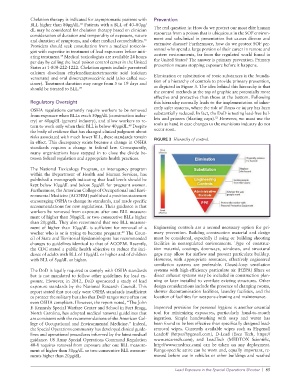
                                                                 the control methods at the top of graphic are potentially more
                                                                 effective and protective than those at the bottom. Following
              Regulatory Oversight                               this hierarchy normally leads to the implementation of inher-
              OSHA regulations currently require workers to be removed   ently safer systems, where the risk of illness or injury has been
              from exposure when BLLs reach 50μg/dL (construction indus-  substantially reduced. In fact, the DoD is testing lead-free bul-
                                                                                          52
              try) or 60μg/dL (general industry), and allow workers to re-  lets and primers (blasting caps).  However, we must use the
              turn to work only when their BLL is below 40μg/dL.  Despite   tools at hand in case changes to the munitions industry do not
                                                      48
              the body of evidence that has changed clinical judgment about   occur soon.
              risks associated with much lower BLL, these standards remain
              in effect. This discrepancy exists because a change in OSHA   FIGURE 3  Hierarchy of control.
              standards requires a change in federal law. Consequently,
              many organizations have stepped in to close the divide be-
              tween federal regulation and appropriate health practices.

              The National Toxicology Program, an interagency program
              within the Department of Health and Human Services, has
              published a monograph indicating that lead levels should be
              kept below 10μg/dL and below 5μg/dL for pregnant women.
              Furthermore, the American College of Occupational and Envi-
              ronmental Medicine (ACOEM) published a position statement
              encouraging OSHA to change its standards, and made specific
              recommendations for new regulations. Their guidance is that
              workers be removed from exposure after one BLL measure-
              ment of higher than 30μg/dL or two consecutive BLLs higher
              than 20μg/dL. They also recommend that one BLL measure-
              ment  of  higher  than  10μg/dL  is  sufficient  for  removal  of  a   Engineering controls are a second necessary option for pri-
              worker who is or is trying to become pregnant.  The Coun-  mary prevention. Building construction material and design
                                                   49
              cil of State and Territorial Epidemiologists has recommended   must be considered, especially if using or building shooting
              changes to guidelines identical to that of ACOEM. Recently,   facilities in nonregulated environments. Type of construc-
              the CDC stated a public health objective to reduce the inci-  tion material, coatings, doorways, windows, and structural
              dence of adults with BLL of 10μg/dL or higher and of children   gaps may allow for airflow and prevent particulate buildup.
              with BLL of 5μg/dL or higher.                      However, with appropriate  resources,  effectively  engineered
                                                                 ventilation systems are preferable. Closed-loop ventilation
              The DoD is legally required to comply with OSHA standards   systems with high-efficiency particulate air (HEPA) filters or
              but is not mandated to follow other guidelines for lead ex-  direct exhaust systems may be included in construction plan-
              posure. However, in 2012, DoD sponsored a study of lead   ning or later installed to ventilate existing structures. Other
              exposure standards by the National Research Council. This   design considerations include the presence of changing rooms,
              report stated that not only were OSHA standards insufficient   shower decontamination facilities, laundry facilities, and the
              to protect the military but also that DoD ranges were often not   location of facilities for weapons cleaning and maintenance.
              even OSHA compliant. However, the report noted, “The John
              F. Kennedy Special Warfare Center and School in Fort Bragg,   Improved provision for personal hygiene is another essential
              North Carolina, has adopted medical removal guidelines that   tool for minimizing exposures, particularly hand-to-mouth
              are consistent with the recommendations of the American Col-  ingestion. Simple handwashing with soap and water has
              lege of Occupational and Environmental Medicine.” Indeed,   been found to be less effective than specifically designed lead-
              the Special Operations community has developed clinical guide-  removal wipes. Currently available wipes such as Hygenall
              lines and operational procedures informed by the latest medical   Leadoff (https://hygenall.com), D-Lead (Esca Tech,  https://
              guidance. US Army Special Operations Command Regulation   www.esca-tech.com), and LeadTech (MEDTOX Scientific,
              40-8 requires removal from exposure after one BLL measure-  http://www.medtox.com) can be taken on any deployment.
              ment of higher than 30μg/dL or two consecutive BLL measure-  Range-specific attire can be worn and, equally important, re-
              ments higher than 20μg/dL.                         moved before use in vehicles or other buildings and washed

                                                                         Lead Exposure in the Special Operations Shooter  |  85

