


Page 43 - JSOM Spring 2018
P. 43
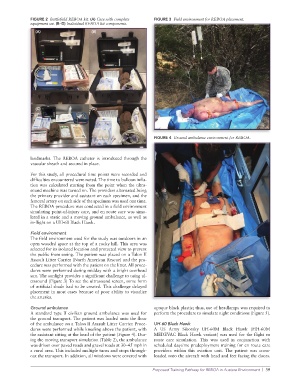
FIGURE 2  Battlefield REBOA kit. (A) Case with complete   FIGURE 3  Field environment for REBOA placement.
              equipment set. (B–D) Individual REBOA kit components.
                (A)                    (B)


                (C)                    (D)


                                                                 FIGURE 4  Ground ambulance environment for REBOA.


              landmarks.  The REBOA  catheter  is introduced  through  the
              vascular sheath and secured in place.
              For this study, all procedural time points were recorded and
              difficulties encountered were noted. The time to balloon infla-
              tion was calculated starting from the point when the ultra-
              sound machine was turned on. The providers alternated being
              the primary provider and assistant on each specimen, and the
              femoral artery on each side of the specimen was used one time.
              The REBOA procedure was conducted in a field environment
              simulating point-of-injury care, and en route care was simu-
              lated in a static and a moving ground ambulance, as well as
              in-flight on a UH-60 Black Hawk.
              Field environment
              The field environment used for the study was outdoors in an
              open wooded space at the top of a rocky hill. This area was
              selected for its isolated location and protected view to prevent
              the public from seeing. The patient was placed on a Talon II
              Assault Litter Carrier (North American Rescue) and the pro-
              cedure was performed with the patient on the litter. All proce-
              dures were performed during midday with a bright overhead
              sun. The sunlight provides a significant challenge to using ul-
              trasound (Figure 3) To see the ultrasound screen, some form
              of artificial shade had to be created. This challenge delayed
              placement in most cases because of poor ability to visualize
              the arteries.

              Ground ambulance                                   opaque black plastic; thus, use of headlamps was required to
              A standard type II civilian ground ambulance was used for   perform the procedure to simulate night conditions (Figure 5).
              the ground transport. The patient was loaded onto the floor
              of the ambulance on a Talon II Assault Litter Carrier. Proce-  UH-60 Black Hawk
              dures were performed while kneeling above the patient, with   A US Army Sikorsky UH-60M Black Hawk (HH-60M
              the assistant sitting at the head of the patient (Figure 4). Dur-    MEDEVAC Black Hawk variant) was used for the flight en
              ing the moving transport simulation (Table 2), the ambulance   route care simulation. This was used in conjunction with
              was driven over paved roads and gravel roads at 30–45 mph in   scheduled daytime predeployment training for en route care
              a rural area. This included multiple turns and stops through-  providers  within  this  aviation  unit.  The  patient  was  cross-
              out the transport. In addition, all windows were covered with   loaded onto the aircraft with head and feet facing the doors.

                                                                Proposed Training Pathway for REBOA in Austere Environment  |  39

