


Page 42 - JSOM Spring 2018
P. 42
use of human cadavers for research, development, test and   codified to include standardizing the equipment, a protocol
          evaluation, education, or training. Research funding was   for the conversion from percutaneous to open vascular access,
          provided  by  the  Defense  Medical Research  and Develop-  the creation of a basic vascular access surgical instrument kit,
          ment Program.                                      and development of a team placement approach, the partici-
                                                             pants advanced to more challenging environments (Table 1;
          The participants for this experiment were two board-certified   Figures 1 and 2). The next four procedures were performed
          active duty military emergency medicine physicians with no   on the floor of the laboratory with the specimen on a Talon
          prior endovascular surgery exposure or prior use of REBOA.   II Assault Litter Carrier (North American Rescue, http://www
          Both providers were proficient at ultrasound-guided vascular   .narescue.com) under normal- and low-light conditions.
          access before the start of the project. Both providers also had
          experience working in austere environments as well as train-  TABLE 1  Minimum Recommended Equipment List for Battlefield
          ing in providing medical care aboard military aircraft. The   REBOA
          participants would need to learn the procedure and success-  1 Case for equipment: Pelican M2450
          fully perform it with the newer-generation US Food and Drug   1 Monitor with invasive pressure monitoring capability
          Administration–approved REBOA catheters (ER-REBOA) in   1 Set invasive pressure monitor cables
          various  austere  environments.  The  project  comprised  three
          phases: skill acquisition, skill proficiency in austere environ-  1 Pressure infuser bag
          ments, and operational implementation.              1 Set invasive pressure monitoring tubing
                                                              1 Portable ultrasound device
          Phase 1: Skill Acquisition                          1 Bottle ultrasound gel
          Both  providers  attended  two  nationally  recognized  REBOA   2 Chloraprep swabs
          courses: the Basic Endovascular Skills for Trauma (BEST)   1 Standard 7F central venous catheter Cordis set
          course offered in Baltimore, Maryland, which is currently the   2 7F ER-REBOA compatible catheter introducer sheaths
          REBOA skills course recommended by the American College   1 Needle, 18 gauge 7cm
          of Surgeons; and the REBOA course offered through the De-  1 10mL syringe
          partment of Surgery at University of California, Davis Medical
          Center.  Both courses used various REBOA simulation mod-  1 30mL syringe
               19
          els, including perfused human cadavers, the Mentice VIST G5   1 5F catheter clamp
          (http://www.mentice.com) endovascular simulator, and vari-  1 Package of clear chest seals
          ous nonproprietary, custom-made endovascular simulation   2 Packages of sterile gloves
          models. The basic skills for percutaneous and open vascular   1 Package of 4×4 gauze
          access were discussed and performed, and basic endovascular   1 Rapid access surgical instrument set
          concepts for overwire placement of catheters were discussed   1 ER-REBOA  catheter
                                                                       ™
          and placement was performed.                        1 Abdominal Aortic Junctional Tourniquet (AAJT)
                                                              1 500mL bag of normal saline
          After training course completion, it was determined a new en-
          dovascular model was needed to complete the current feasi-
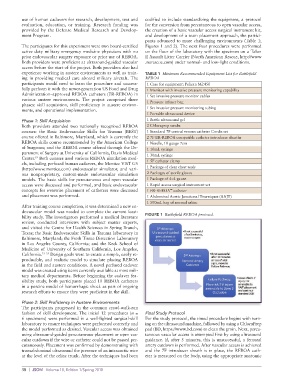
          bility study. The investigators performed a medical literature   FIGURE 1  Battlefield REBOA protocol.
          review, conducted interviews with subject matter experts,
          and visited the Centre for Health Sciences in Spring Branch,
          Texas; the Basic Endovascular Skills in Trauma laboratory in
          Baltimore, Maryland; the Fresh Tissue Dissection Laboratory
          in Los Angeles County, California; and the Keck School of
          Medicine of University of Southern California, Los Angeles,
          California. 21–23  Design goals were to create a simple, easily re-
          producible,  and realistic  model  to simulate  placing  REBOA
          in the field and austere conditions. A novel perfused cadaver
          model was created using items currently available at most mili-
          tary medical departments. Before beginning the cadaver fea-
          sibility study, both participants placed 10 REBOA catheters
          in a porcine model of hemorrhagic shock as part of ongoing
          research efforts to ensure they were proficient in the skill.

          Phase 2: Skill Proficiency in Austere Environments
          The participants progressed in the common crawl-walk-run
          fashion of skill development. The initial 12 procedures (n =   Final Study Protocol
          6 specimens)  were  performed  in  a well-lighted  surgical-skill   For the study protocol, the timed procedure begins with turn-
          laboratory to ensure techniques were performed correctly and   ing on the ultrasound machine, followed by using a ChloraPrep
          the model performed as desired. Vascular access was obtained   pad (BD, https://www.bd.com) to clean the groin. Next, percu-
          using ultrasound-guided percutaneous placement or open vas-  taneous vascular access is attempted first by using ultrasound
          cular cutdown if the wire or catheter could not be passed per-  guidance. If, after 5 minutes, this is unsuccessful, a femoral
          cutaneously. Placement was confirmed by demonstrating with   artery cutdown is performed. After vascular access is achieved
          transabdominal ultrasound the presence of an intraaortic wire   and the 7F introducer sheath is in place, the REBOA cath-
          at the level of the celiac trunk. After the techniques had been   eter is measured on the body, using the appropriate anatomic


          38  |  JSOM   Volume 18, Edition 1/Spring 2018

