


Page 39 - JSOM Spring 2018
P. 39
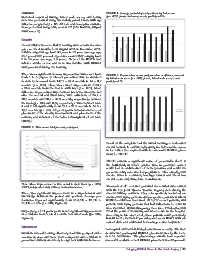
Statistics                                         FIGURE 4  Average pretraining and posttraining test scores
              Statistical  review  of  timing,  Likert  scale  scores,  and  testing   (p < .001). y-axis, test score; x-axis, participant No.
              data was performed using two-tailed, paired t tests with sig-
              nificance assigned at p < .05. All tests and descriptive statistics
              were performed using SAS, version 9.2 (SAS Institute, https://
              www.sas.com).

              Results

              Eleven IDMTs were enrolled in training and available for anal-
              ysis over the 4 months from August 2016 to December 2016.
              IDMTs ranged in age from 33 years to 39 years (average age,
              35.6 years) with years of experience as an IDMT ranging from
              2 to 12 years (average, 7.4 years). None of the IDMTs had
              taken a similar course and none was familiar with REBOA
              until presented during this training.

              There was a significant decrease in procedural times seen from   FIGURE 5  Preprocedure versus postprocedure confidence, assessed
              trials 1 to 6 (Figure 3). Overall procedural time (± standard   by Likert scale score (p < .001). y-axis, Likert scale score; x-axis,
              deviation) decreased from 147.7 ± 27.4 seconds to 64 ± 8.9   participant No.
              seconds (p < .001). There was a mean improvement of 83.7
              ± 24.6 seconds from the first to sixth trial (p < .001). Mean
              difference in procedural time between trials was most marked
              after the second and third trials, with reductions of 26.1  ±
              28.3 seconds and 28.5 ± 37.8 seconds, respectively, between
              the trials (p = .015 and .039, respectively). Time between trials
              4 and 5 fell significantly from 81.1 ± 21.0 seconds to 66.4 ±
              12.6 seconds (p = .04). All participants demonstrated correct
              placement of the sheath, measurement and placement of the
              catheter, and inflation of the balloon throughout all six trials
              (100%).
              FIGURE 3   Time versus trial for each participant.


                                                                 Based on the completion of this initial training, consideration
                                                                 should be made for additional training for field vascular access
                                                                 to learn the other required skills for successful REBOA place-
                                                                 ment for NCTH.

                                                                 NCTH remains a significant cause of preventable death in
                                                                 the battlefield, in which quicker  time to proximal control
                                                                 could lead to stabilization of hemodynamics and could im-
                                                                 prove mortality rates in select populations. Theoretically, with
                                                                 shorter times  to occlusion, less hypotension  and blood loss
                                                                 should occur and, thus, fewer transfusions.
              Note:  Mean  improvement  in  time  noted  in  dark  black  (p  <  .001).   8
              IDMT, independent duty military medical technician.  Morrison et al.  reviewed potential for combat intervention
                                                                 with the UK Joint Theater Trauma Registry data during the
              There was significant improvement in comprehension and   current military conflicts. They retrospectively looked at ca-
              knowledge between the pretest and posttest: Average per-  sualties with injury patterns and prospective patients in whom
              formance improved significantly from 36.4.6%  ± 12.3% to   REBOA could have been used. Of 1,317 overall patients, 244
              71.1% ± 8.5% (p < .001; Figure 4).                 patients with injury patterns that had indications for REBOA
                                                                 were identified. Within this group, there were 174 deaths, with
              Subjectively, all 11 participants noted significant improvement   79 at the point of wounding and 66 en route to the hospital.
              in confidence from 1.2 to 4.1 on the 1–5 Likert scale (p < .001;   According to Morrison et al., these patients could potentially
              Figure 5).                                         benefit from a battlefield provider, such as an IDMT with ad-
                                                                 vanced skills and additional hemorrhage control adjuncts. 8
              Discussion
                                                                 Prehospital and battlefield deployments are a reality. The first
              Simulation-based training effectively took this group of endo-  documented prehospital REBOA placement was by the Lon-
              vascular novices and made them competent and confident in   don Air Ambulance. The physician-paramedic team reported
              procedural skills in an entirely foreign task with much success.   successful roadside zone 3 REBOA placement in a 32-year-old

                                                                             Bringing REBOA Closer to the Point of Injury  |  35

